Software
Houzz Logo Print
hzdeleted_19696500

fast growing shrubs for privacy (with short video)

11 years ago
last modified: 11 years ago

I am looking to replace some privacy shrubs that I removed earlier this summer because they were planted too close to each other by the previous homeowner and started to die off.

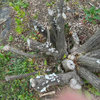
Below is a link to a short 1 minute video of the area I need to cover. Note that the existing branches are still stuck in my neighbors fencing. That's a job I'll save for a cooler day.

Sears is having a 40% off sale on shrubs this weekend so I was thinking this might be a good time to get them.

Only question is what kind, how many (to account for proper spacing, and when I should plant them (way too hot these next few days in NE NJ). I could leave them in the shade next to my shed until the time is right.

I do not want Cypress.... I hate it even though it grows super fast. Whatever I get needs to be drought tolerant and can handle full sun. I have no irrigation that high up the mulched hill so it would need to rely on rainfall. I would like it to have both vertical (at least up to the height of the fence eventually) and horizonal coverage (but in a natural unmanicured way).

Suggestions???? Thanks!!

Comments (17)

  • 11 years ago

    Those pieces in the fence are somewhat macabre.

    What were the shrubs that were there? Are the shrubs visible in the video the same kind? If so you could plant them again with better spacing, if there aren't lots of leftover roots.

    Shrubs that can live on only rainwater would still need initial irrigation until they are established.

    I would say to resist planting right now and not to hold plants in nursery pots for long periods of time. Best to buy what you decide on in fall and plant in fall.


  • 11 years ago

    nj,

    Did the previous shrubs die off because they were planted too close together, or did they die off because they were not watered? Just to let you know, almost anything planted at the top of that berm, or hill, if going to need watering, or if you have no intention of watering it, buy yourself some nice looking bamboo fencing, (they even come in black),and use some wire, and put the pretty bamboo fencing right up on that chain link. There you go.

    When you have shrubs, newly planted, at the top of a berm like that, and when it rains, if it rains, the mulch and water runs right off the shrub, good luck trying to get something established.

  • 11 years ago
    last modified: 11 years ago

    It's hard to judge the width of the bed but there doesn't seem to be a huge amount of space there. I'd estimate one or possibly two shrubs would fit. Whatever you decide on would need to be put in around where the day lilies are now if you are not to end up with them growing through the fence again. You will also need some space between the shrubs and the fence for maintenance. What are your criteria? Evergreen? Deciduous? Flowers? Leaf form? Growth habit?

  • 11 years ago

    I like the bamboo screening idea. I would use one if I had a chain link fence to prop it up on. Certainly can't get much easier than that. If you do decide to plant the area the grade doesn't appear to be too steep. To help moisture find its way to the rootballs and not run off, just terrace the area so that the planting holes are as level as possible. This is done in China; think hillside rice paddies. You can find good instructions online by searching for hillside terracing, how to plant a slope, etc. To add to this you may also install baffles on the downhill side of the plants, half buried as you would edging. You can make them yourself using sturdy plastic such as a nursery pot cut open and placed so that it forms a semicircle around the plant. Kind of like a doorstop for water. I have to plant on a slope and know of what I speak. It works!

  • 11 years ago

    Not fond of a bamboo fence just for that short section. Don't know the previous type of shrub that was growing there.

  • 11 years ago

    I'm not sure you mentioned the amount of light this area gets. If it get's part to full sun, you might try Ceanothus americanus. It's on the short side but I think it would get to the top of the fence eventually. This is definitely a low maintenance native plant that might suit your application. Also, when planting for dense cover, people usually plant those shrubs closer together. Perhaps it wasn't that the plant were too close together that brought there decline. Surely a fence being in the middle of a trunk was doing a couple of them no favors.


  • 11 years ago

    nothing is droguht resistaent.. until it gets over transplahnt... what we call.. fully established.. which is at least one season.. plus watering in drought the second ...


    not your pool right.. hiding it is the goal??


    Thuja occidentalis 'Degroot's Spire' ... 3 to 4 foot max ...single leader plants would be best.. to start with ...

    https://www.google.com/search?q=Thuja+occidentalis+%27Degroot%27s+Spire%27&source=lnms&tbm=isch&sa=X&ved=0CAgQ_AUoAmoVChMIzOKw5561xwIVEQeSCh1ZmgQ3&biw=923&bih=745&dpr=0.9


    plant properly per link ...


    i highly doubt anything died because it intertwined with a neighbor .... there had to be other reasons... maybe chlorine water ...????


    good thinking on timing of planting ... i would just leave the wood hanging there ...


    ken

    https://sites.google.com/site/tnarboretum/Home/planting-a-tree-or-shrub


  • 11 years ago

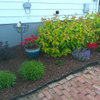
    I have no problem babying them for the first year or two but after that I kind of just want to forget about them. You can see what the shrubs directly in contact with the fence looked like when I originally was considering taking them down this past May.

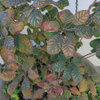
    Prior to that I took down other set of shrubs that were crowded right in front of them. Below are photos from 2014 showing how the leaves of THOSE shrubs were wilting and turning black (none of which was observed in the Summers of 2011/2012/2013). I bet that when I removed the frontal shrubs in 2014, the ones that died off in 2015 followed the same fate. But I still contend that they ALL of these were planted too close.

    When we bought our house 4 years ago all of the shrubs appeared healthy.


  • 11 years ago

    Is that an Aucuba?

  • 11 years ago

    Yes, it is.

  • 11 years ago

    Well that pic looks taken in the spring and the plants probably got burned out from the winter. This spring and spring of '14 they'd surely look 'dead' or 'dying'. Aucuba is marginally hardy for Zone 6 and will often suffer in bad winters. I'm not saying the plants shouldn't have been removed but I still don't think it was because they were spaced too closely. The plant could have been a poor choice for the application though.

  • 11 years ago

    Aucubas usually recover pretty quickly from cold damage - at least from the degree of cold damage as is seen in that picture. I would have left it.

    But what is growing behind it? Japanese holly?

  • 11 years ago

    So now that we all know what I used to have growing there (whether they should have been or not) what recommendations do all of you have moving forward? Just throw names at me. Something that will give me some semblance of privacy that I used to have (even though my neighbors are the ones that own a pool and not me).

  • 11 years ago

    Dave in NoVa, I have no idea but you can get some closeups at this link.

  • 11 years ago

    I mentioned it before but what about Ceanothus americanus? Also good shrubs, Blue Muffin Viburnum, Viburnum carlesii, various spirea, certain weigela varieties, etc...


    It depends on what you're looking for in a shrub. Do you have any preference other than low maintenance, 4-5' tall growth, and dry condition tolerant?

  • 11 years ago

    Some of the Hydrangea paniculata types with "little" in their names: Little Lime, Little Lamb and Little Quickfire.

  • 11 years ago

    Re the Ceanothus recommendation. I've had mine for many years and it gets about 2 ft tall maximum. Nice plant, but not one for screening.

    IMO, the choices for screening are tremendous. Go to any good nursery and pick several shrubs that would be fully hardy for your zone.