Software
Houzz Logo Print
bennml

Need help with logan labs soil test.

11 years ago
Long time reader looking for tips. My lawn is mainly fescue with sandy soil. I have one acre, with irrigation. Planning on overseeding small area this fall with JD tall fescue select blend. Would appreciate any advice. Thanks.

Comments (2)

  • 11 years ago

    With a full acre, you may not want to head for the perfect groove, or at least not as quickly as I outlined below. Feel free to add time, any amount that's convenient, between these applications as your budget demands or simply just as you feel like doing.

    I also always head for the perfect analysis. If you want me to prioritize, let me know, although in this case I've noted that to some extent in the text.

    I don't know your general location, so I made my recommendations as if you were in central Michigan. While you probably have more of a window than that, conservative never hurts in terms of soil applications!

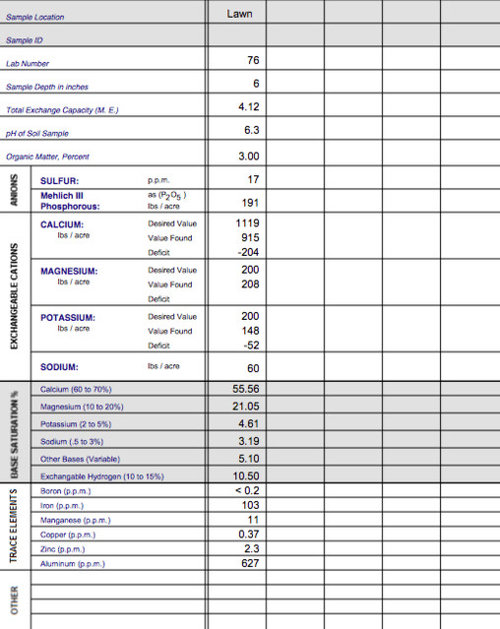
    Sample Depth 6": I'll adjust your numbers to the 4" standard. In the future, sample to four inches and state that on the form. Some numbers do change.

    EC 4.1: Yep, sand. Your soil doesn't hold a vast amount of resources, so plan on testing relatively regularly. Yearly would be optimal, but every other year would be just fine.

    pH 6.3: An interesting conundrum, some of which is set off by the sodium saturation. Still, I don't want to kick this up too much, but you do need calcium...

    OM 3.0%: Probably a slightly low reading if you actually took samples to the six inch depth. Still, this is in the Fair range. Certainly always mulch mow, mow all your fall leaves, import leaves if you can, and consider feeding organically (at least on areas near the house that are used).

    Sulfur 17: A perfectly good answer.

    Phosphorus 191: I'm adjusting this to 130 in the 0 to 4" profile, although I'm probably a little low on that (P levels tend to be lower the deeper you go, but I can certainly think of tons of exceptions). While not deficient, it's a bit trim, so of moderate to moderately high importance. I've recommended starter fertilizer below, so just get the cheapest. They're all pretty much the same.

    Calcium 55.6%: A little low, but not horribly severe. The 200 pound per acre deficit is really only about 135 pounds. This is of high importance, however. We use high calcium limestone, not the cheap stuff which is slow, weak, and contains elements you either don't need or that I add differently. Use Encap, Mag-I-Cal, or Pennington Fast Lime for the calcium adjustment.

    Magnesium 21.1%: Actually, this is perfect. The inflated percentage (I like to see around 11-14 in soils this sandy) is because there's a slight calcium deficit. Raising calcium will lower this saturation naturally and without any further intervention from us--although it does take a while to happen. No magnesium required or desired.

    Potassium 4.6%: There's a slight deficit in the soil, with this percentage as high as it is due to the lower calcium levels. While I want to adjust this, I'm tabling it for this test--it's not severe, it's not important, and it can wait for other things that are far more critical. This number will drop as the calcium levels come up to optimal.

    Sodium 3.2%: High, but not a problem yet, and the actual amount in the soil is quite reasonable. The higher percentage is kicking up your pH a bit, but the calcium will help dispel a little bit of this. If it stays high and your pH rides too high after the calcium, we can dispel this if we have to. I doubt we'll have to.

    Minor Elements: Copper is really low, but repeated mulch mowing and mowing fall leaves will tend to lift this a bit, so I'm riding it until the next test. Using organics will also nudge this up. I'd prefer to see around 1 PPM on this soil. Except for iron and boron, all the others are fine.

    Boron <0.2: Undetectable, which means very, very deficient. Grasses aren't particularly boron demanding, but we do try to target 0.7 on this test. Importance is very hard to determine; if it were me, I'd call this absolutely critical until it reaches 0.3, important after that to 0.5, nice but not strictly necessary to 0.7.

    We use Milorganite as a carrier and 20 Mule Team Borax as the boron source (one box should be entirely sufficient for the entire acre, with plenty still left over). You can purchase 20 Mules at the grocery store in the laundry section. In a wheelbarrow or the like, dump the Milo. Spraying very, very lightly with water (I use a spray bottle like the kind people use to damp their clothes when they iron) will help the boron stick. Add the recommended amount of 20 Mule Team Borax and stir, spraying occasionally to get the stuff to stick to the Milo. Then apply over the recommended area. So if going for bag rate Milorganite (1 bag per 2,500 square feet), you'd add 12.5 tablespoons of 20 Mule Team Borax.

    On an acre, that's a LOT of Milorganite, and I'm afraid I haven't tested any other carrier. You could go thinner on the Milo if you want, down to the point where you can just barely get that much 20 Mules to stick--but it's then important to irrigate well immediately afterwards! As long as the amount of 20 Mules works out to exactly 5 tablespoons per thousand square feet, it's fine.

    Iron 103: Rather trim, but certainly not deficient in the slightest. Still, this won't produce the best possible lawn color, particularly as calcium levels rise. Fortunately, fescues aren't particularly demanding of iron. Whenever you like, you can use Milorganite to raise this very, very slowly, but I understand you probably aren't going to do that very often on a full acre! This is entirely optional.

    Recommendations:

    September 1 (or with your overseeding): Apply starter fertilizer at bag rate.

    September 15: Apply 5 tablespoons per thousand square feet of 20 Mule Team Borax. Irrigate very well on the newly-seeded areas at minimum, and the entire lawn if you use a lower level of Milorganite to carry the same amount of borax.

    October 1: Apply starter fertilizer at bag rate.

    October 15: Apply 4 pounds of Encap, Mag-I-Cal, or Pennington Fast Lime per thousand square feet.

    April 15, 2016: Apply 4 pounds of Encap, Mag-I-Cal, or Pennington Fast Lime per thousand square feet.

    Memorial Day, 2016: Apply starter fertilizer at bag rate.

  • 11 years ago

    Thanks Morpheuspa for the information. I am in the transitional zone, maryland. First time post long time reader. Just trying to make a few of my areas of grass look better. Not expecting a perfect lawn. Picked up a few bags of milo on sale the other day at walmart. Will be following your recomendations. Thanks

Sponsored
Peabody Landscape Group
Average rating: 3.5 out of 5 stars8 Reviews
Columbus' Reliable Landscape Design & Contracting