Software
Houzz Logo Print
hzdeleted_24144954

terracotta balls

11 years ago
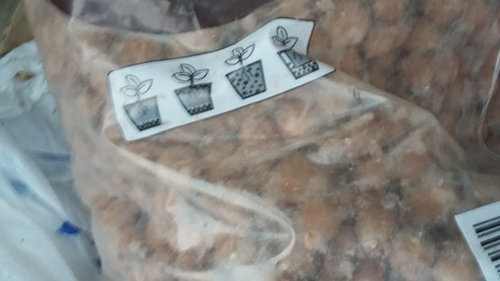
I purchased this bag of terracotta balls with all sorts of ideas, but I am hesitant that they will disintegrate in water and break down in soil. Does anyone have any experience with these?

Comments (24)

  • 11 years ago

    They won't break down, but they wouldn't be useful as a fraction of a solid medium (soil) because of their overly large size.

    Al

  • 11 years ago

    I thought in water they would be an anchor for roots adding stability and added to soil they could be add aeration for root health.

  • 11 years ago

    I used them to grow plants in water, adding a drop of super thrive for nourishment. Had to change water when it got grungy and I eventually grew tired of the changing water chore. You don't have to change anything when growing in good soil. Balls were solid. I got rid of the setup, rinsed the terra cotta balls and put them away for next garage sale..,

  • 11 years ago
    last modified: 11 years ago

    Does good soil=gritty mix?

  • 11 years ago
    What works for me is equal parts of compost and perlite. However if you do a search here you will find 1 gazillion ideas on the subject, kinda like the best fishing lure.
  • 11 years ago

    Shawn - imagine a pint of pudding (same as a pint of potting soil). Now mix it into a pint of the terra cotta balls. In the minds eye, you can see that ALL the air spaces between the balls are now filled with the potting soil or pudding ...... so where is the improved aeration? You have the same amount of aeration as you would have had with or without the clay balls. The same thing holds true if you mix compost with an equal measure of perlite. Where is the aeration when all the spaces between the perlite particles are full of compost?

    In order for a soil to benefit in the aeration dept from using coarse material, there has to be so much coarse material that there isn't enough fine material to fill all the air spaces between the larger particles.

    There are 2 ways to rate soils. One way is from the grower's perspective, which might or might not have anything to do with the plant's perspective. From the plant's perspective, the worst soils are those with the greatest degree of inherent limitations - usually in the form of excess water retention. The best soils are those with the least amount of inherent limitation(s), which would require that the soil always provides ample aeration, even at container capacity (when a soil is holding as much water as it can hold). Water retention isn't the only consideration, but it's usually the obvious point of delineation.

    Al

  • 11 years ago

    I use these in semi-hydro setup, very easy compared to soil. They break down by time (about 5 % per year depending on type of
    plant) and small particles get washed out on drainage holes from the pot
    when you flush with water.

    You can use clay balls as top dressing.

    I think they can hold a good amount of air because of their porousness. (But maybe Al is right and it does no good in soil mix - he is the expert.)

  • 11 years ago

    I use these in the bottom of pot saucer to water my plants from under, for me they work great..

  • 11 years ago

    Hi

    I use them mostly for epiphytes such as orchids anthuriums and calatheas Any thing that needs sharp drainage also good for emergent water plants . I find that crushed lava rock works just as well at about a third the cost

    Keep in mind that I grow in pots but outdoors and they are subject to almost daily rainfall. In your case will probably work keep in mind that it will require more water gary

  • 11 years ago

    Is the crushed lava sterile?

  • 11 years ago

    Why would it matter. Soil is almost an organism unto itself because it (normally) contains so much life.

    Al

  • 11 years ago

    How many organisms does gritty mix contain? It is my understanding that certain "organisms" promote root rot. Why did we bake all of our soils at the college greenhouse if there were not the possibility of soil pathogens?

  • 11 years ago

    Some soil organisms can cause root rot, but usually only in numbers too many to resist under anaerobic conditions. Plants live in harmony with many thousands if not millions of species of fungi, bacteria, and larger organisms that make soil a livable place for plants. The likelihood of your plants contracting any harmful disease in a well-aerated medium is very remote. As long as there is food for bacteria/fungi/mold to digest, they normally multiply very rapidly until they have depleted the N supply or are limited by a diminishing N supply. They then die & become a part of the food chain on which other soil life feeds. The moment you water your 'sterilized' soil, it became a buffet for airborne soil life - the same soil life you killed when you sterilized it ..... so what's the point? Perhaps it might have been to kill insect eggs or larvae hiding in the soil.

    The gritty mix supports small populations of soil life - the 5:1:1 mix larger, but containers are generally inhospitable places for small critters to reside.

    Al

  • 11 years ago

    Though no one would disagree that a rocky soil like gritty mix is quite porous, it's use would make having house plants even more challenging than it all ready is. These plants were never meant to live indoors to begin with so the growing conditions are never going to be optimal...

  • 11 years ago

    They are a porous fired clay and do not degrade quickly. I use frequently them in orchid media and with some carnivorous plants. As been mentioned, they are popular for use when growing a plant in semi-hydro. Just as with any rock, perlite, bark, et cetera you should rinse them before use to rid them of the clay dust which might otherwise clog pores.

  • 11 years ago

    Using sterilized substrateso is at least a large proportion as to why my first attempt at horticulture was so dreadfully depressing.

  • 11 years ago

    Well AL the items in gritty mix seem to be hard to locate in my area...also I couldn't imagine that mix in hanging pots because of the weight.

  • 11 years ago

    The gritty mix gets a bad rap because it contains granite and granite is heavy, but granite is only 1/3 of the volume. Turface and bark are pretty light, and because Turface has a high air volume and low water retention compared to the very water-retentive media most growers use, it's not THAT MUCH heavier than say Miracle-Grow soils at container capacity (fully saturated) - maybe 25%. The problem of finding ingredients may or not be real. Very often, but not always, the inability to find ingredients is resultant of not knowing where to look. I can often find the ingredients for growers in other states with only a few minutes of searching - and regularly do that. While finding and assembling may be an undertaking not all will wish to undertake, the fact remains that the gritty mix makes it very easy to maintain houseplants in good health - much easier than media like Miracle-Grow et al based almost entirely on fine particulates. From the plant's POV it's a great mix, even if the grower isn't up to the effort it takes to put things together.

    Al

  • 11 years ago

    I would like to try to experiment with the gritty mix, but the searching I did for the Saint Paul Minnesota area for the Turface and other ingredients came up fruitless.

  • 11 years ago

    You can get it from Tessman Seed (800) 882-5704 in St Paul or any of the 5 John Deere Landscapes stores surrounding the Minneapolis area. Since quartzite is mined in New Ulm, MN, that should be very easy for you to locate - try rural feed stores that cater to folks who raise fowl, they'll have it. You're looking for Turface MVP (or Allsport if from John Deere Landscapes) and #2 cherrystone - sometimes called quartzite. If you find a usable barkm all the better, but you can make a very good soil w/o bark. I suggest you use Foliage-Pro 9-3-6 because it has all the nutrients essential to normal growth - almost all are several nutrients short of having everything. I hope that helps.

    Al

    User thanked tapla (mid-Michigan, USDA z5b-6a)
  • 11 years ago

    I will work at getting these ingredients together before the snow flies because I understand certain components must be sifted

  • 11 years ago

    Is the sifting to eliminate smaller particles?

  • 11 years ago

    Yes. One of the main features of the gritty mix lies in the fact that it doesn't hold water between soil particles. Water is held on the surface of particles, inside the particles that are porous, and at the interface where particles touch each other. Screening out the fines is what ensures so much air porosity and an absence of perched water.

    Al