Software
Houzz Logo Print
hzdeleted_20575877

Um, you ok there violet? (browning leaves?)

11 years ago
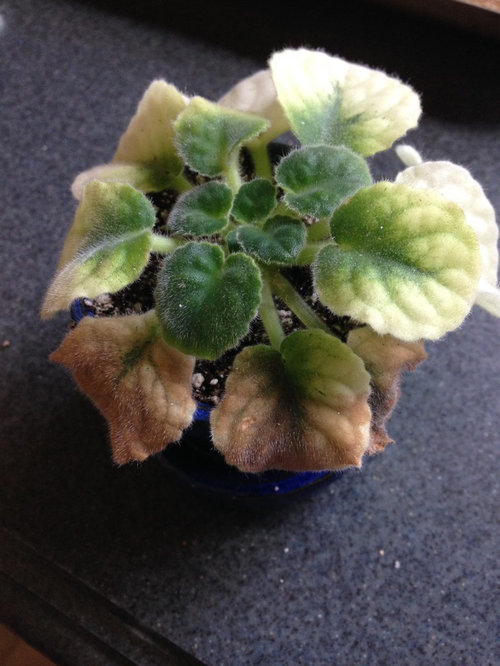
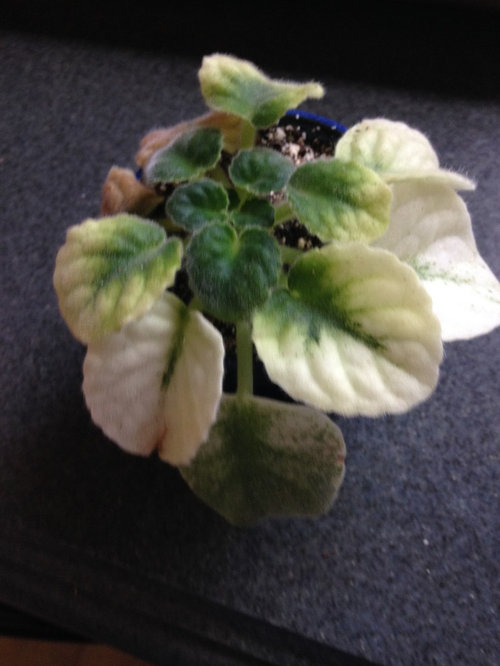
So I woke up this morning and my mostly-white violet looked like this:

Is it because the leaves are so white? Is that going to happen to the rest of the white leaves? Because the other white leaves look and feel just fine, besides being mostly white. In fact, the rest of the plant looks just fine to me.

Should I take those dying ones off?

Comments (10)

  • 11 years ago

    If you mean will they heal and look good again? No, they won't come back. You can remove those two really brown leaves if you want, although your plant will be somewhat lopsided for a while. Since they were mostly white anyway, they're not as important to the plant as the dark green ones (for making chlorophyll.) All white leaves on variegated plants are extremely fragile and will "bruise" and turn brown with handling. Was the plant moved around or brushed up against lately or anything like that?

    On an aside, your pot looks very familiar to me...is it a glazed ceramic pot with an attached saucer? When I started expanding my collection I found those pots at a local Jo-Ann Fabric and Crafts and snapped up all they had - the perfect size, I thought! After using them a few years, I finally admitted that they were the cause of some plant deaths. That attached saucer is a real problem if you slip up and over-water. I finally gave them up and moved my plants to the standard plastic pots - and my plants did much better. (Now I have a box out in the garage of 32 of those ceramic pots that I really should put on Ebay or something.) Not saying that your plant is doing poorly because of the pot necessarily, just giving you a heads up to keep a careful eye on that.

  • 11 years ago
    last modified: 11 years ago

    Be careful with your watering. Make sure that the plant's soil is not saturated with water at any time. Your plant's soil should always be allowed to dry a bit before restarting.

    Also be careful of excessive heat or sun for this plant.

    Your plant looks healthy, but is showing signs of some level of discontent.

  • 11 years ago

    I didn't see any brown leaves. I saw what looked to be "pink" (variegated?) leaves?

    If it were my plant, I would remove all of the white leaves and leave only the first 2-3 sets of green leaves and repot the plant in a nice light mix.

    Your green leaves are the ones going to sustain the plant not the white ones, that is why I would remove them straight away, and get on with growing the plant. The variegation will return when the plant is ready for it to return. Same with the blooms.

    Are there no drainage holes in that pot? Being ceramic, you could always drill some. Then just get one of those transparent plastic things they sell at Lowes or any store really, just to catch the water. This are really cheap.

    That is just what I would do if it were mine. Good luck!!! Rosie


  • 11 years ago

    Oh, gosh, I would not recommend removing any more leaves. The plant is struggling and needs all the leaves that it has. If Katie wants to turn the leaves green, all she has to do is feed the plant with Epsom Salts, refer to the topic on this forum for the amount and do not overdo. Less is more with Epsom Salts. Or use a high Ni fert.

    Variegation is subject to change on any leaf, even if it seems to start out white, it can turn to green as it grows or as you fertilize. Good observation, Anne. I was told the self watering pots made in china do not work as well as though made by small companies in the U.S. that check for porosity. And a clay pot can lose its porosity. I am glad everyone chimed in. Variegated plants are highly dependent on getting the exact amount of water. A real danger is letting the plant dry out to the caked soil stage and then watering. But that might not have been what happened here. Finally, they want indirect light. You might want to view the most recent podcasts on All About African violets. Annie talks about a similar situation.

    Sooner or later, most of have to convert to green or clay color plastic pots. We learn to love them when we see how much happier our violets are when potted in them. Many of us have stacks of unused gorgeous, hand-made ceramic pots just gathering dust. I use them as outer cache pots when giving a plant to a friend. But I also tell them how to water the plant correctly, Joanne

  • 11 years ago

    Aegis,

    May I ask you to elaborate on what you meant when you said "Your plant's soil should always be allowed to dry a bit before restarting"?

    Does it mean that when you water, you should let the soil dry up a bit?

    This runs counter to what I read about consistency and never letting the soil go dry because the plant doesn't like fluctuations but rather evenly moist/damp soil.

  • 11 years ago

    Ha, they are in fact the ceramic pots with the attached base. I usually water with filtered water and an eyedropper, so I can ensure the leaves don't get wet when I water from the top (I mentioned this in another post, but I have had a really terrible time with wick-watering and bottom watering so I switched to careful top watering and my violets seem much happier as long as I don't get any on the leaves). I assumed this would help me control the amount of water I give them so I won't over water but if the ceramic pots in question will be a problem in the future, I'll replace them. My larger violets also have similar glazed ceramic pots but they do not have an attached base and my dad was nice enough to drill a hole in the bottoms.

    I didn't think the browned leaves would revive, but I was curious if removing the leaves would be more traumatic to the plant than just leaving them on. The plant didn't give me much choice, though. It basically dropped the leaves this morning (I didn't even have to cut them, I could just pull them off).

    I'm going to leave the large mostly-white leaves on for now. I don't have any pots that are large enough for the rootbase but small enough for the small ring of mostly-green leaves in the middle. I'm happy to see healthier green leaves coming in!


    Does anyone have any ideas of why those three leaves in the first photo wilted but the rest are fine? You all have given me some great tips on watering and pots (I really appreciate it!). But I still need to avoid more leaves browning like that.

  • 11 years ago

    Hi I look forward to Aegis comment and helpful advice.

    So my comments are on a separate topic related to the plant pictured.

    Katie's situation may have been different than A's advice. Anne observed that she may have been using a self watering pot that was not draining properly so her plant may have become waterlogged. That may have caused the leaves to rot. Or else, many other factors could have caused it, including not enough light, or letting it get way to dry then overwatering, among a few possibilities. Leaves die off for many reasons. How they die sometimes reveals something about something in our care and culture that needs to be changed. Sometimes it is a warning and other times, they recover once consistent care is resumed. Joanne

  • 11 years ago
    last modified: 11 years ago

    This is what Optimara says about watering African Violets ...

    Watering: Keep soil moist to dry, and allow soil around roots to dry out before watering to encourage blooming. Water from the bottom with room temperature water by placing the plastic grower's pot in water, and allowing the plant to absorb the water ( not more than 30 minutes ).

    From Lyndon Lyon ...

    Improper watering is one of the most common reasons for failure of African violets. Always use room-temperature water, watering only when the top of the soil feels slightly dry to the touch. Use water that is fit for drinking. Never use water that has been through a softener. Watering may be from the top or bottom, by wicking, or you may wish to choose one of the many self-watering pots available today. Never allow plants to stand in water after the soil has taken up what it can hold. After 15 to 20 minutes pour off any water that is left in the saucer. Violets do not like wet feet!

    From Fancy Bloomers ...

    2. Water your violet when the soil is dry to the touch. Water it from the bottom and let it sit in the water for 20 minutes then discard the remaining water. To keep the violet blooming use a fertilizer (i.e. Miracle Gro) every time you water.

    Letting your plants go semi-dry between watering is the advice I was always given, ... although that, obviously, is somewhat violated by the successful practice of wick watering. The most common watering advice I remember getting is ... let the surface of the soil dry before giving a plant more water.

    The main issue in watering your violets is AVOIDING letting the soil become saturated with water (in which the roots will rot). Before wicking became popular, one of the ways to avoid this is to avoid watering a plant that already has enough water, therefore risking root rot.

    The counter-advice is to avoid the extreme of letting your plants become desert-dry before you water them. The ideal is somewhere between the extremes.

  • 11 years ago

    Also, the Optimara Watermaid mat watering system keeps the potting medium evenly most. I use it on larger, blooming plants and occasionally let the saucers dry out a little.

  • 11 years ago

    I just want to clarify: the ceramic pots with attached bottom saucers I was describing are not the self-watering pots - not the ones with the inner unglazed liner that sits down inside an outside glazed pot which holds the water. No, these are just small ceramic pots, sort of rounded and all one piece with the saucer. There is ONE drain hole from the bottom level of the pot out into the little saucer, but that as I found out is not enough. What I discovered when taking AV's that were doing poorly (or dying) out of the pot is that no matter how carefully I was top watering, there was a soaking wet core down at the bottom of the soil in the pot. The potting mix dried out on top making me think it was time to water again, but due to the angle and slope of the pot walls narrowing down to the bottom part of the soil (and root ball) stayed saturated. All the time. That's a set up for root rot. Not saying that is what has caused your plant's brown leaves - but it is possible. When you think the soil is dry enough to water again, lift the entire root ball out and set it on a piece of paper towel to see. You may be surprised at how much water is still down there.

    And no, I wouldn't pull off all the rest of the white leaves either. When I said they weren't contributing to the plant as much as the dark green ones I just meant if you wanted to remove the couple of browned white ones it wouldn't hurt the plant overall too much. But Joanne is right: it's already struggling so let it have whatever leaves it can have. The browning could be from any number of problems - a watering issue, a fertilizer issue, or even being too close to an air conditioner (cold.) If you haven't been to this Optimara site, it may be helpful. http://www.optimara.com/doctoroptimara/diagnosis.html