

Please advise! Redoing lawn!
Hi,
Would really appreciate some advice on how best to proceed with my lawn.
We built a house about 18 months ago here outside of Raleigh, NC, on a plot which is about 0.28 acres - I think we have around 7500 sq ft of lawn. The bare ground was scraped and was pretty solid clay. The builder laid bermuda sod at the front (it's triangular in shape, with a point being the front) and claimed he'd seeded the back with bermuda too. Turns out the contractor only put out annual rye!
After we moved in, they dug out a wooded area right behind us (mainly pine trees) to build a dry retention pond, and when they did they offered to put some of the soil on our plot to level everything out, which they did.
My wife really wants fescue, so I bought some special chemical and killed the bermuda at the front. After they'd graded things, I brought in a guy with a tractor and tiller, added lime indicated by soil test, and had him till everything to 6 inches.
I then put in an irrigation system (it gets very hot down here!) and sowed everything, but all of that took me much longer than I'd hoped and didn't get it sowed until November.
Grass grew great, looked really good over the winter/spring, but has struggled this summer a lot. Also, the irrigation trenches settled and I had someone fill them all with top soil. Unfortunately that took until the summer so it was too hot to reseed. Those areas have now grown a lot of weeds.
A big mistake I believe I made was I sowed with Kentucky 31, which hasn't done at all well in the heat.
So, I am trying to figure out what to do!!
I am tempted to kill everything with roundup, and reseed with a fescue blend which is heat tolerant (I get pretty much full sun). If I do this, I have several questions on how best to do that:
1) I was going to have a guy come back and till everything again. However, I've read on here as I've been researching that tilling is not recommended as it takes up to 3 years to settle. Is that just not recommended for a rototiller? Am I best not even tilling with a tractor setup? Another guy on craigslist has a tractor with a disk tiller that I believe just pulverizes the surface - is that ok?
2) Do I need to get rid of the dead grass?
3) how smooth does everything need to be to reseed?
The other option is to spray roundup along the irrigation trenches to call the weeds, along with spot treating other areas, and then overseed with the blend. Will the blend take over what K31 survived the summer? If I go down this path, I've read I can take a dethatcher/power rake set the blades as deep as possible, and run it over the yard in several directions. Then mow at the lowest setting, bagging the clippings, and then reseed. Is that a good idea? How much will that pulverize the soil?
I'm planning to do a soil test done in the next week so I can assess what enrichment is needed.
All advice greatly received!!!
cheers!
David
Comments (71)
Redcoat Dave
Original Author11 years agoOk.
Assume I should just order standard test?
Also, do you think the lime I used last time was ok?
Redcoat Dave
Original Author11 years agoThanks again for all the help here! I've mailed the sample to Logans, so should hopefully hear early next week.
I'm still trying to figure out the best way to prep everything for seeding. I have mowed at the lowest setting on my mower, and bagged the clippings. There's still a fairly thick base of (dead) grass, which I'm assuming all needs to be raked up by hand to allow the seed access to the soil?
Also, it's obvious it's going to need quite a bit of smoothing out. There are multiple areas that 'undulate', and most of the irrigation trenches are still a little lower than the surrounding areas, even though they were filled a few months ago. In light of all this, and some health issues, the yard is too large to manually rake if I have to break up the surface too. I understand I don't want to till to any depth, but is there something I can rent to smooth everything out? I'm wondering whether running a dethatcher, set at an inch maybe, over everything multiple times would help get things pulverized so that raking and smoothing is easy? I also had a quote from someone local who has a disc tiller on his tractor, that I understand would just hit the top couple of inches and also smooth things out at the same time.
Thoughts and recommendations?
Related Professionals
Fort Myers Landscape Architects & Landscape Designers · Saint Joseph Landscape Architects & Landscape Designers · Lebanon Landscape Architects & Landscape Designers · Longview Landscape Architects & Landscape Designers · Springfield Landscape Contractors · Madison Landscape Contractors · Grand Rapids Landscape Contractors · South Sioux City Landscape Contractors · Missoula Landscape Contractors · Waycross Home Builders · Sugar Land Home Builders · Augusta Home Builders · Kearney Home Builders · Madison Home Builders · San Angelo Home Builders 11 years ago
Don't bother raking. It'll hurt your back without being necessary in the slightest.
A dethatcher, set either a touch high or just to nick the soil surface, will help clear the field if it really needs to be cleared. Then just mow it with the bag on.
Even that's probably unnecessary. I did absolutely none of it, and my old lawn was thick, thick bluegrass (just not a color I liked or of consistent growth rates).
- 11 years ago
A dethatcher will pull up a lot of good grass & I'm not sure if fescue would bounce back as well as bermuda... I wouldn't go that route, but if you do, definitely do it more like 3/8 or half an inch or else you'll have nothing left but dirt.
Redcoat Dave
Original Author11 years ago@reeljake - the grass is all dead (sprayed with roundup), so there ain't no bouncing back :) I'm more concerned with smoothing everything out before I seed - there are the irrigation trenches that are a little lower than everything else, plus areas that are just "bumpy" for lack of a better term. Hence my suggestion of dethatching at about an inch so that I end up with pulverized dirt that is easily smoothed?
I feel like I'm missing something...
- 11 years ago
Fill in the trenches with top soil that's a reasonably good match for your existing lawn soil--and remember to put in a bit of a hump to account for settling.
Bumpiness could theoretically be solved by a box blade, but it's kind of late to find somebody to do that now...plus you need to be very careful with your irrigation heads.
- 11 years ago
I see what you're saying about smoothing the top inch of soil & that does happen. You get a nice fluffy layer, but not very flat. My dethatcher is only electric, so I have to drop my amendments before I start so it all mixes together. It wont make new dirt, so buy a few bags of extra dirt before you start. YMMV. Best of luck!
Redcoat Dave
Original Author11 years ago@reeljake: you're saying I'd get an inch of fluffy dirt if I rented a de thatcher and set it deep? And then I could just rake that smooth? Should I rent a roller too and compress it a little when done?
- 11 years ago
I still don't think a powered dethatcher is the right solution on your fescue or other upright grasses, but that loose fluffy top layer happens when I use mine on my bermuda. The disclaimer is that I could literally take my yard down to the crowns & bermuda's roots will make me a nice new green top in a few weeks. Totally different grass. Maybe just pick up a hand dethatching rake at the local big box store to limit your damage potential this first time? Setting it deep as you propose will do serious damage to the existing good turf & I've learned not to trust seeds to come in on time. If you look at large scale turf seeders & spriggers, a big part of their common design is that they do not destroy the existing healthy stand of turf. On top of that, you have trenches that will cause extra scarring & need to be filled.
Redcoat Dave
Original Author11 years agoI have *killed* what was there before - it was KY 31 that someone wrongly advised me to use, and I'm starting from scratch with a tall fescue blend. Unless I'm missing something (quite possible) I'm thinking that getting that loose fluffy layer will help me smooth everything out, and make a nice seed bed. The irrigation trenches *were* filled in several months ago, so they are close to the rest of the lawn, just still a little deeper and I'd like everything perfectly smooth. I don't want to have to do this again!!
Does anyone have any concerns on this approach, or anything I'm missing?
- 11 years ago
Well, I guess you're right--The existing lawn is already toast, so it can't hurt... Wear a mask though, that's gonna make a heck of a mess! And mark your sprinkler heads before you start or there will be even more mess.
 11 years ago
Grass seed does not need a nice bed.
The irrigation trenches should have been mounded up, not simply filled in.
If you know where the high and low spots are, you could run the dethatcher to dig up the surface at the high spots, and then rake the loose soil to the low spots.
How bumpy is your yard? Is dethatching worth the cost and delay it's causing?
Redcoat Dave
Original Author11 years agoYes, I think it is bumpy enough to warrant smoothing out, and some of the high/low spots fixed.
Redcoat Dave
Original Author11 years agoJust got my soil test back from Logans - hopefully you can see this? Soil Test
@morpheuspa, I'd love to get your feedback on it. Thanks!
- 11 years ago
Yep, no problems!
Overall, it's not at all bad for a first test, although some corrections are required or recommended.
I'm not completely certain how to treat this lawn as I think you have Bermuda in the front and are currently seeding the back, yes? I'm going to write the Recommendations that way, but may need to revise it if that's not true.
Exchange Capacity 3.7: Sand, essentially. With an EC this low, yearly testing is pretty much a must as resources will tap quickly and balances will shift very fast.
pH 6.0: Not bad, but a touch low. We'll fix this under calcium below.
OM 1.8%: In the Fair range. Given your low EC as another consideration, I'd never allow a usable organic to leave your property. Always mulch mow, mow all fall leaves, take other neighbors' leaves if the lawns don't have severe disease or weed problems, feed organically, and so on.
Sulfur 19: A normal answer with plenty of room for modifications to the soil. We really don't need much margin as you won't require a lot of sulfate-based chemistry.
Phosphorus 112: Kind of low, but not deficient in any sense. We use starter fertilizer for this, the cheapest you can get your hands on as they're all in the same ballpark. Recommendations below.
Calcium 51.4%: Low, but not extreme, so I think your lime application worked. I'm not familiar with the Bonide Turf Turbo Fast Acting Lime and can't find a label online, so I can't say if it's appropriate here. What we want is a lime with an extremely high percentage of calcium carbonate--95% or so--and no magnesium in it. Of the ones I know, Encap, Mag-I-Cal, and Pennington Fast Lime are all completely workable. Other limes may contain too much magnesium, work too slowly, or require different amounts. Target saturation will be from 60-70%, and I'd prefer closer to 70% in this soil. Recommendations below.
Magnesium 14.1%: Deceptive. The soil actually has a shortage which is masked by the more severe calcium shortage. We'll want to boost this a bit. Overall, the target is 10-20%, and I'll shoot for 15% in your soil. For that, we use Epsom salt, available at your local drug store in the bath or first aid section. Recommendations below.
Potassium 9.7%: Deceptive, for the same reason the magnesium is. This is in the correct range and the percentage will naturally fall toward 7% as the calcium levels rise. I'm a fan of a touch of extra potassium, which you have.
Minor Elements: Boron is deficient. While I could tap zinc a bit, I'm tabling it this year as it's not that important. Iron is mentioned below as well as the boron.
Boron <0.2: Deficient. We use Milorganite as a carrier and 20 Mule Team Borax as the boron source. You can purchase 20 Mules at the grocery store in the laundry section. In a wheelbarrow or the like, dump the Milo. Spraying very, very lightly with water (I use a spray bottle like the kind people use to damp their clothes when they iron) will help the boron stick. Add the recommended amount of 20 Mule Team Borax and stir, spraying occasionally to get the stuff to stick to the Milo. Then apply over the recommended area. So if going for bag rate Milorganite (1 bag per 2,500 square feet), you'd add 12.5 tablespoons of 20 Mule Team Borax.
Iron 125: Normal, and it certainly isn't deficient. This should produce tolerable color in both Bermuda and fescue, but if you discover the colors lightening as the calcium works in, you can feel free to use Milorganite at bag rate to add a little iron and deepen the lawn color.
Recommendations:
Note: These are written as if you have Bermuda in the front and are about the seed the back with fescue. I'm trying to hold applications together to avoid a major front/back date difference and app rate, so unless I specify, each application goes on the entire lawn.
Seeding Time: Apply starter fertilizer at bag rate.
October 15 (one month post seeding): Apply starter fertilizer at bag rate.
November 1 (six weeks post seeding). Apply 3 pounds of Encap, Mag-I-Cal, or Pennington Fast Lime per thousand square feet. This might cause a bit of lightening in the new lawn. Apply 5 tablespoons of 20 Mule Team Borax per thousand square feet.
April 1, 2016: Apply 4 pounds of Encap, Mag-I-Cal, or Pennington Fast Lime per thousand square feet.
April 15, 2016: Apply 2 pounds of Epsom salt per thousand square feet.
June 1, 2016: Apply starter fertilizer at bag rate.
July 1, 2016: Apply 1 pound of Epsom salt per thousand square feet. Water in this application with at least 1/4" of irrigation, or time this just before a late June or early July rainfall.
Redcoat Dave
Original Author11 years agoThank you! This is extremely helpful!
I have killed everything, and am going to reseed front and back with a really good Fescue blend.
I did manage to find the Bonide label: http://www.bonide.com/lbonide/labels/l60448.pdf. Would be interested to hear what you think of it, though I'm not married to using it.
Very interesting to hear that it's basically Sand. The crazy part is that underneath it's solid clay, which they dumped the soil from the wooded area on top of. They dumped a lot of soil though to flatten the yard out - most places in the back it's 6 - 8" deep, less so in the front.
- 11 years ago
With that CEC? Sand. Not quite pure, but pretty durned close. You could do the jar test to verify that if you like.
The schedule is great for a complete kill and reseed, since that had to be my target in the first place (the Bermuda was just going to have to deal with it). So I don't need to change a thing!
The Bonide is fine; the Calcium Carbonate rating is 95%, which is perfectly fine, magnesium levels are extremely low at 0.40%, and 90% passes a 200 (very small) sieve. Wow, their recommendations for application are way off the charts, though! That would render most lawns yellow.
Redcoat Dave
Original Author11 years agoOk, great.
I know we'd discussed above using a dethatcher to pulverize the top 1-2 inches of the lawn to help in smoothing everything out, but a contractor has given me a great price to use a rototiller SET AT A LOW DEPTH to achieve the same thing. I know a rototiller is a banned word on these forums :) but will it work out to be the same thing?
- 11 years ago
I'd restrict overall soil disturbance from tillage or dethatching to 1/4". If you wanted, for instance, to use a tiller to just scratch the surface, great. A quarter inch deep, great. Lower than that, you're asking for trouble as the soil settles unevenly--and barring the use of a box blade, that's going to happen.
Redcoat Dave
Original Author11 years agolast modified: 11 years agohmmm, ok. But as I pointed out above, I have areas that vary more than 1/4" - both areas that undulate some, and others that are high or low. I'd like to have what's there pulverized and raked, rather than bring in top soil... So I'm scratch my head a little on how to do that!
- 11 years ago
Box blading would even out the soil and get rid of the undulation, while also prepping the soil surface. It still comes with problems, but since it's intended to solve another problem, that's acceptable.
- 11 years ago
Somewhat at a loss how clay became sand, but soil tests don't lie.
Rototilling is not going to level the soil. If that is the goal, ask him to use a box blade. BTW No slit seeder/vertical rake, that I'm familiar with will cut deeper than 1". A walk behind tiller is very hard to keep at a set depth, but learning first hand is always the best teacher.
Redcoat Dave
Original Author11 years agoClay became sand when they dumped a bunch of (apparently) sandy top soil on top! (from a retention pond they excavated close by).
Hmmmm, what seems natural to me apparently isn't. So asking someone to do some light box blading would be best? What are the problems that it comes with?
- 11 years ago
what seems natural to me apparently isn't.
A rototiller or power rake will break up soil, but it doesn't move it. A box blade will move soil from high spots into low spots making the soil level.You could do it yourself with a landscapers rake, but it is a lot of work. Considering that you have so recently done so much mechanical manipulation, box raking should create no increased problems.
- 11 years ago
>>Clay became sand when they dumped a bunch of (apparently) sandy top soil on top! (from a retention pond they excavated close by).
It happens--a lot. Assuming you took the sample as per the Logan instructions, we can be certain that the sand is at least four inches deep. That's sufficient for the topmost ("A horizon") of your soil.
Below that, if it's clay, the grass can manage...although it's extremely unlikely to drop much root into that layer as plants aren't particularly happy about moving into denser soil types with their roots. The sand acts as the soil in a clay "pot."*
Given your locale, it's not highly likely that you have clay (but it is possible as pockets of clay do exist in many locales). Dense silt is more probable. You can do the (free, at home) jar test with your sub-soil to find out if you like.
Not that it matters. At that depth, no mechanical process is going to do overmuch to lighten it, but over time (a few years) you can harness the soil biology to do it for you--specifically, feed organically to increase your worm population, which will drill into that subsoil layer and, over time, churn it in with the sand.
Like I said, it's no huge damage and the grass will manage, but this is something to mentally add to your "work on gradually over the next five years" list.
* That's why amending soils for trees or shrubs isn't recommended. The plant will hit the edge of the lighter, amended soil and root expansion drastically slows or stops. That can cause a lot of problems, up to and including the death of the plant. There are exceptions, but they're rare.
Redcoat Dave
Original Author11 years agoGetting really close here! After a boat load of rain, I have someone coming to do final fine grading tomorrow, reset some of the irrigation, and then seed Triple Threat tall fescue blend on Thursday.
Can anyone offer more advice on using straw? From the negative implications I've heard - it can leave clumped areas, can introduce weeds, or needs to be raked up - I'm tempted to just lightly drag the seed into the soil and make sure it stays moist with the irrigation system. Thoughts?
Redcoat Dave
Original Author11 years agoI've heard mixed reports on peat moss, and concerned about cost as this is around 7500 sq ft. If I rake gently back into the pulverized top 1/2" I'd think I'm achieving something similar?
- 11 years ago
Similar, but not quite the same. Layering new material like peat or straw on top of seed is not the same as raking seed into the soil below, although it does accomplish some of the same things. I've also heard of people mixing their seed with fine sifted sand & spreading them together as a mixture, but I'm not sure any of those is right for your lawn. You had a lot of reservations about bringing in topsoil to level the low spots, so I don't think you'll like the straw either... I do know that the seed you don't sow will never grow, so you have to get it down on the ground. I've also heard that peat moss is a royal pain to spread evenly, but I've never done it myself.
- 11 years ago
You'll get different advice on that from every region. Mother Nature does not use peatmoss or drag the seeds around. What happens in Nature is the livestock knock the seeds onto the ground and then walk on them. You can mimic that with a water fillable roller. That's what the sod farmers do.
- 11 years ago
There is a great thing called a "peat moss/compost" roller that does a great job putting a nice level layer of peat/compost material down (looks like an over grown bingo/lottery ball cage). Sadly it's $300 new, and I can't find ANY places that rent them, unlike the regular lawn rollers.
If you aren't going to have heavy down pours, or have a lot of slope to the land, the peat moss won't really be necessary. I've used it on the areas that even the sprinklers had a tendency to move the seed, and even then it still shifted with any significant rain. The peat can hold on to moisture, but with irrigation and this time of year you shouldn't need that aspect.
Save yourself the time and just seed and then use a lawn roller (rented from the big box stores) and just roll the surface. Fill the roller half way, which should press the seed to the soil but still let you leave shoe prints as you walk. No shoe prints= too heavy, Deep imprints=too light. Don't worry about it compacting the soil unless the soil is wet. Redcoat Dave
Original Author11 years agoThanks all! Sounds like birds aren't too much of a problem, eating all my precious seed? :)
- 11 years ago
It does depend. I had flocks of seed-eating birds in clouds all over my reno, but everything worked out fine. I'd top-dressed, so there was some level of protection.
I've seen people with failed renos blame the birds, but usually it simply doesn't work that way. You're putting down hundreds of thousands of seeds per thousand square feet. They can't usually get enough to destroy a reno.
If it concerns you, top dress. Or use a fake owl. However, birds are quite smart and rapidly figure out that the owl isn't real; I've seen sparrows perching on those.
Redcoat Dave
Original Author11 years agoWell, things didn't go well :(
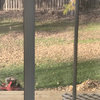
I hired a contractor to come in a scrape, and he did a semi-decent job. Was a lot of raking left to do, and the guys who did it did ok. However, we had a heavy couple of days about a week after I seeded, and that revealed numerous areas that where the grading wasn't ok and the water didn't drain well especially at the back (see first pic during the rain).
12 days in, I'm left with very patchy areas, as you can see.
Unfortunately I was right at the end of the recommended seeding timeframe, so now I'm kind of stuck. I see these as my options:
1. Reseed now and again in the Spring. Fix low spots in the Spring too.
2. Leave it as is over the winter. Fix low spots in Spring and reseed
3. Fix low spots now via wheelbarrow and reseed now. Reseed again in the Spring.
However, I've read that seed sown in the Spring can struggle to survive the summer heat here (Raleigh, NC).
If I reseed now, I'm thinking it *might* squeak through depending on the weather... If I try, should I worry about steeping on the shoots that are growing?
Any advice welcome!
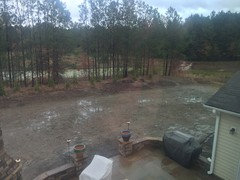
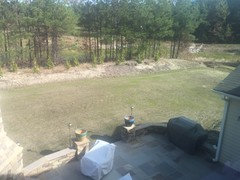
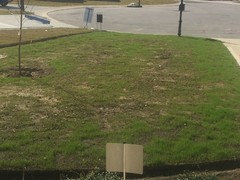

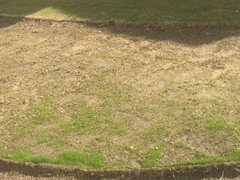
- 11 years ago
2 weeks for TFFF? Probably should have germinated by now I think. You can do annual rye for this winter? It should germinate quickly then die in the summer, overseed in spring and fall with more TFFF .
Redcoat Dave
Original Author11 years agoYeah, that's what I've feared :(. I've heard that annual rye can make it hard for tall fescue to be established in the spring?
- 11 years ago
It's more that the annual rye is using up space and consuming resources (and exuding chemicals from its roots to kill intruders, but most plants do that to some extent).
But if you gotta, you gotta.
Redcoat Dave
Original Author11 years agolast modified: 11 years agoBut do I gotta? :)
trying to figure out the best path forward here. We have 1 - 2" rain coming tomorrow. I was wondering about just throwing down more fescue seed after that?
would what is there survive a roller at that point?
Any thoughts on whether spring-sown fescue will likely survive the summer heat?
- 11 years ago
November 2nd isn't optimal for either fescue or rye, so I suppose it doesn't much matter. It's worth a shot, I suppose.
In this case, I'd skip the rolling. It's too likely to damage your new lawn!
Survival of a spring-planted stand is definitely going to be lower. If you get lucky and have a cooler, wetter summer than average, losses might be very minor. A very hot, very dry summer could cost you quite a bit of the new grasses.
I think I'd dormant seed and hope that works. It's far from perfect, but survival will be superior to a spring-sown lawn since it has more time to grow.
Redcoat Dave
Original Author11 years agoThe weather actually looks not too bad for Raleigh over the coming week, so I think I might give it a go. What would you recommend instead of rolling? I've read that raking produces poor results, and it's a pretty large yard to try and cover with compost. Also, there doesn't seem to be a huge amount of existing seed that took...
- 11 years ago
At the worst, it's simply going to fail again. So I wouldn't spend a huge amount on seed...
Rather than roll or whatnot, simply do nothing (except water regularly when not raining and while temperatures hold). Grass seed is very good at finding the soil, as long as the soil's down there somewhere.
Redcoat Dave
Original Author10 years agoSo...things haven't gone great overall :(
The original seed and some of the extra seed has come in much more, which is good.
But the weather took it's toll - it was extremely wet for many weeks after I sowed the seed (a little late in the year, but had pretty warm weather after I did). The rain was so heavy that it truly saturated the soil, and have lots of areas where it is no longer smooth. It also has been so wet here that it took a while for me to get a window where the ground was dry enough to walk on to spread the starter fertilizer and lime. The front of the house isn't too bad, but the large back area is not looking great - very patchy, and, more worrying, the grass that is growing just doesn't look healthy and hasn't grown near as much as the front.
Wondering whether it is related to how sandy the soil is and lack of organic material? Just shooting in the dark as I have no idea. If so, it is worth top dressing carefully at this point? We have a week of fine weather forecast...
I didn't have the chance to spread the 20 Mule Team Borax either - and am a little confused how to do so - what should I use?
I can post pics if that would help, but I'm pretty disappointed how this worked out :( Any advice welcome!
Redcoat Dave
Original Author10 years agolast modified: 10 years agoAnyone got any advice? I'd very much appreciate it!!
It seems like my yard is severely lacking on organic material? What's the best way to introduce that? Will Bermuda likely have the same issues? I hate the idea of giving up on Fescue, but...?!
- 10 years ago
We're so far over the line that seeding now isn't going to work. This weather, fine as it's been, could flip to early winter at any moment.
At this point, I'd wait for full-on winter and spread some seed at that point. That'll have all winter to work in, then sprout at the first moment it can in spring. It's rarely perfect, but it's better than nothing.
Redcoat Dave
Original Author10 years agolast modified: 10 years agoHi,
Thanks for the advice - I agree and wasn't actually thinking of *seeding* right now. As you suggest, I can do it either after winter kicks in, or in March before any warmer weather.
My bigger concern is trying to understand why the grass that is growing seems to be doing so poorly. It's reasonable in the front, but hasn't grown very high at all in the back and looks very pale and unhappy.
That's what led to my question about introducing organic material...is top dressing this time of year worth it? Are there better ways to improve the soil? I can post pictures tomorrow if that would help.
Thanks!
- 10 years ago
Given that you seeded about six weeks late, I'm surprised it looks like anything at all, really.
I'd ride it though spring and see what happens. It didn't have much time to set up root systems in fall, and certainly didn't have time to stockpile the resources to look good.
Winter's also not the time to add organic matter, so hold off there as well.
Redcoat Dave
Original Author10 years agoYep, it was much later than I'd hoped :( Thankfully the weather was warm, despite being very wet for a period. My main concern is the difference between the front and the back :(
If now is not time to add organic matter, where could I find recommendations on how to improve the soil over the coming year?
As always, I appreciate your help!
- 10 years ago
Mostly, I tend to simply recommend organic feeding if you want to, and rebalancing soil resources chemically to optimize growth. Plus mowing every fall leaf!
- 10 years ago
David, it's not so much adding organic matter. I think morph was talking about organic fertilizer in the winter. Organic matter is a broad term which most people think of as fallen tree leaves. Morph is ALL ABOUT adding all the fallen leaves you can get. The most important 'organic matter' in the soil is the living microbes. There are over 100,000 species of fungi, bacteria, microarthropods, and other classifications of critters living in your soil. There are billions of them in a cubic inch of soil. Your plants are absolutely dependent on this type of organic matter. What morph is talking about is organic fertilizer which is used to feed the microbes. Well fed microbes will do a better job of making your plants and grasses grow. If you look at a bag of organic fertilizer you'll see that it's full of ground up grains, nuts, beans, and seeds like corn, wheat, soybean, cottonseed, and sometimes poultry litter. These things are food to us and to the microbes. We've found that you can buy the same ingredients at a local feed store for about 1/6 the cost of commercially bagged organic fertilizer. My favorite is corn meal and alfalfa pellets (rabbit chow). Morph's favorite is soybean meal along with Milorganite. Price plays a big part for all of us. Corn is cheap for me in Texas while soybean meal is very expensive. Alfalfa pellets seem to be about the same everywhere.
Redcoat Dave
Original Author10 years agothis was getting very long, so I started another thread here: http://forums2.gardenweb.com/discussions/3771966/m=23/what-now.






User