Software
Houzz Logo Print
rick7072

Soliciting opinions about spacing between plants

11 years ago

My annual flower garden is looking pretty good now. I
planted seeds from several varieties a bit late, in mid-June, but most of the
plants have blooms now. I have bachelor's buttons, cosmos, zinnia, marigold,
coleus, sunflower, calendula and a few others.

I want to
solicit people's opinions about the proper spacing between plants. I'm not so
much interested in the actual figure of inches or feet for any given flower, as
I know this is typically given on the seed packet. I'm more interested in a
general discussion about this issue on a broader botanical and aesthetic level.
When I initially planted the seeds I envisioned a wildflower look to the
garden: plants close, a profusion of blooms close together with not a lot of
space between plants or flowers. I do like that look as it seems more
"natural" and "wild": visually closer to a field in nature.

But I also
like the tidy, clean, maybe sparse look.
I'm aware that when plants are too close they do compete for water and
sunlight and nutrients. Each plant then suffers and perhaps doesn't produce as
many blooms as it would if it had more space to itself. When the plants are farther apart, the garden
has a tidy, clean look to it but sometimes the feeling is too much of a "finished"
look.

I'd love to
hear people's comments about this issue. Which look do you like and what do you do
to achieve it? Have you found that putting plants too close together genuinely
does result in each producing fewer blooms? Are you content with that in order
to have a more natural, wild look? Or do you prefer a more "clean" look?

Comments (10)

  • 11 years ago

    Rick - Ah...here's a subject close to my heart. I am a "wild" planter; I like the natural look rather than the "too clean, too regimented, too 'finished' look". But it's all a matter of taste and time. The carefully laid out symmetrical bed can be aesthetically pleasing to me, but the time involved in keeping it neat and clean is labor-intensive.

    Still, here is another thing to consider: plants spaced so that ultimately they touch each other at maturity, shade the ground and serve as a living mulch. This can be important in an environment where rainfall is sparse, or even where summer temps can get high causing evaporation. I have observed first hand in my garden, as well, that some plants enjoy the company of a taller neighbor who provides a bit of shade during the middle of the day when it is hottest. When I run my hand through the dirt under this taller companion, I feel that it is cooler and more moist.

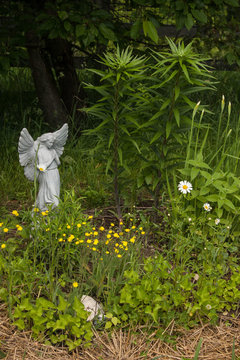
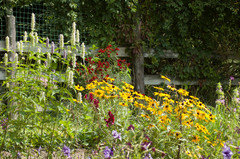
    Here's a pic from June with things a bit sparse; only some wildflowers blooming - hawkweed and oxeye daisies. The tigerlilies, Siberian iris and monarda are still to come:

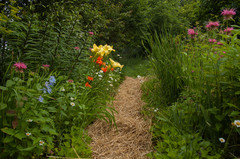
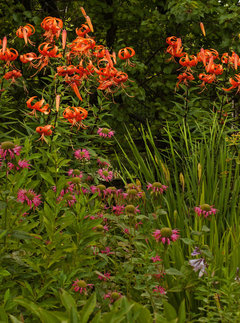
    In July we get a burst of bloom. Monarda are blooming, as are some daylilies and Asiatic lilies; tiger lilies are still putting on growth:

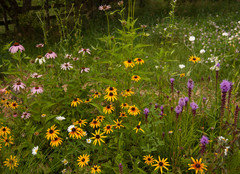
    Then August, another flush of bloom:

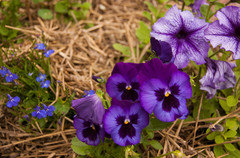
    This last pic shows the tigerlilies in full bloom and the monarda on its way out. Except for the pansies, petunias and lobelia, of course, these are all perennials. But the same principles apply. I plant things with consideration of how large they are "supposed" to grow, hoping that inevitably they will touch each other and fill in the bare spots.


    Rick (zone 6b, MA) thanked samhain10 - 5a
  • 11 years ago

    zen_man and Samhain10 -- this is exactly the kind of thoughtful discussion I was hoping to have. Thank you. Zen_man, I grinned from your observation that a plant is its own worst weed -- it sure is. And I like the idea of applying principles of painting composition to gardening. Samhain, your point that touching plants provide a sort of natural mulch is important. And of course this discussion is as applicable to perennials as it is to annuals. Your photos are gorgeous.

    Thank you for this.

  • 11 years ago

    creating a tapestry of shape, color and form ... really has little to do with spacing nor the plants ...


    it is a highly individual palette ...


    and that is why ... when peeps want to design it all out on paper ... old school .. lol ... i can tell they are newbs ... and really have no clue what they are doing... they tend to think its a one time.. get it right ... and get it perfect for eternity ...


    well .. a real green thumb gardener.. will tell you.. it took years .. many years.. to evolve what it eventually became ... you plant things... you move things... you kill things.. and you just keep collecting until you are happy ... and you are never really happy .. because it is the process ... the evolution ... that is what is the best part ...


    one definition of a green thumb gardener.. is that they have killed every plant 3 times.... before they either perfected it ... or gave up on it ...


    and you will get to this point.. and probably.. move away from annuals.. and start getting into perennials... flowering shrubs, conifers and trees ...


    enjoy the process ... the evolution ....


    ken


    Rick (zone 6b, MA) thanked ken_adrian Adrian MI cold Z5
  • 11 years ago

    Perfect definition: having killed every plant 3 times = experienced gardener.

    Annuals/perennials: I've mostly grown perennials in most of my yard. But just this year I created a new flower bed where only weeds and small ugly trees had been and decided to plant it with all annuals. I prefer nurturing a plant all the way from seed and I started late, and I knew that my best chance of getting nice blooms before the frost hit would be with annuals. It's an interesting experience to accept that as of October/November the ocean comes and sweeps away my beautiful sand castle and I have to start all over again.

  • 11 years ago

    Yes, in it's own way, analogous to the sand paintings of the Navajos and the Tibetan Buddhists - life is evanescent.

  • 11 years ago
    last modified: 11 years ago

    Rick, what a great topic!

    I taught landscape design for many years at two different levels.....college level semesters as well as adult education courses for the home hobbyist. Both audiences received a healthy dose of the principles and fundamentals of art, without which a good landscape design is much less effective. Even a very small garden will benefit from well applied design elements.

    For my own home, I prefer an informal, cottagy look, which without applying basic design elements, would look like the results of a game of 52 card pick-up.

    I've always planted my permanent plants as well as my annuals and containers with plenty of elbow room, thinking ahead to their adult size. Most will brush up against their neighbors but without smushing each other.

    My cutting garden is different! Closer together gives me more and taller stems!

    By the way, planning on paper is far from "old school". It's smart, thoughtful, and even thrifty.

  • 11 years ago

    What a great thread! I was just thinking about my lack of a knack for plant spacing, but I'm new at this and hope to get better. Symmetry is important when considering aesthetics and consistent spacing and symmetry in the garden goes a long way toward achieving beauty. I am guilty this year of planting marigolds and cosmos too close (or not thinning them thoroughly enough, rather) and the results are terrible! Not to mention that I assumed the marigolds were going to be 6 inches tall and they turned out to be the 3 foot kind. I just pulled a tangled mess of them from an 8 inch pot this evening and threw them in the compost. The giant thick stems dragging the tiny clay pot was almost comical.

  • 11 years ago

    Arlene, the simplest tip for a newby is to pay close attention to the information on your seed packet or the catalog description when you buy your seed. For example, there are hundreds of varieties of marigolds, each different from the others. By carefully selecting the variety that best suits your needs, we can avoid the kinds of problems you've described.

    If you purchased cell packs from the nursery, it's possible to use your cell phone to look up information on the variety before you buy.

    I'm all about information gathering and planning. Doing so saves time, money, and work....to say nothing about that awful frustation.


  • 11 years ago

    rhizo, very good advice!

Sponsored
Bella Casa LLC
Average rating: 5 out of 5 stars17 Reviews
The Leading Interior Design Studio in Franklin County