Software
Houzz Logo Print
zzanowiak

Soil Test Results

11 years ago
I just received my soil testing results and am hoping for a critique of my findings. In addition to the soil test I just did with Logan Labs, I am also including a university soil extension test I did a few months ago. In addition to the general lawn health motives, I have also been plagued the last few years with the dreaded Spring Dead Spot. I understand contributors to this include several of the problems I see in the results including high PH, low potassium and mostly clay. I just acquired a plug aerator that I intend to use a lot in the coming months as the fungus associated with SDS becomes active. I also applied Potash in June at a rate of 1.5 lbs per 1000 ft that resolved my potassium issues (maybe too much). And, to lower the PH, I also applied elemental sulfur at approximately 1.3 lbs per 100 ft. I think the following are my issues now in order of importance...
Boron (Add), PH (Lower), Calcium (Add), Organic Matter (Add), Phosphorus(?)
Any suggestions would be greatly appreciated.

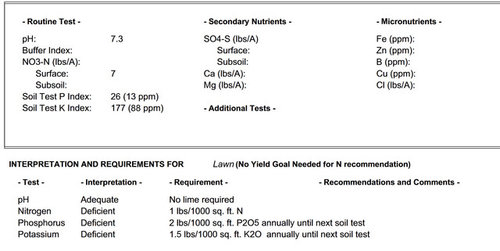
University Extension Soil Test


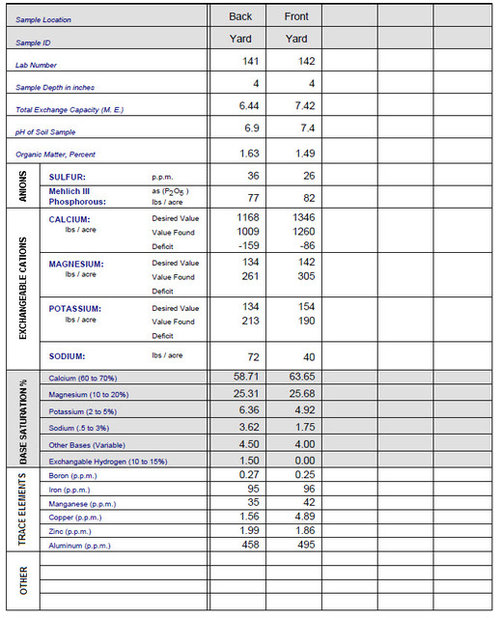
Logan Labs Soil Test

Comments (3)

  • 11 years ago

    >>Boron (Add), PH (Lower), Calcium (Add), Organic Matter (Add), Phosphorus(?)

    You wanna help out with the reading, because you hit it nose on. Except for the pH; it would be nice to lower it, but it's very difficult to do, so we're going to let it ride. Surface additions of sulfur generally out-gas as sulfur dioxide (smog) without making much of a change to the soil pH.

    Next year, this soil will have a bit more of a split personality than it does now; the pH should separate a bit, with the front remaining high and the back lowering a bit. Resources should stabilize, though, and we can work with these pH levels.

    EC 6.4, 7.4: Sand-silt. (you have no appreciable clay to speak of, so that's not contributing at all to the spring dead area issue).

    pH 6.9, 7.4: A little high in the front, but nothing terrible. Borderline high in the back, and entirely workable. If I add anything, it has to be done in a pH-unchanging or acidic manner, which isn't a problem.

    OM 1.5%-ish: In the Poor range. Mulch mow, mow all fall leaves, import leaves from curbsides, and consider feeding organically.

    Sulfur 30-ish: A little higher than I usually see. There's a touch less margin than in some other soils, but we'll work with it. This came from your soil addition of sulfur.

    Phosphorus 80-ish: Pretty low. This is a good chunk of the issues you're having. I keep arguing with myself over the target levels, which technically differ front and back. Just to pick a number, I'm going with a target of 260 property-wide. To correct this, we use starter fertilizer, and you can just buy the cheapest. They'll all target around the same amount of phosphorus. Recommendations below.

    Calcium 58.7%, 63.7%: A teeny hair low in the back, pretty close to perfect in the front. I'm disinclined to fiddle too much in the front due to the near-perfect levels, lower sodium, and higher pH. For this, we'll use gypsum (calcium sulfate), which you can get at most garden shops, and even most big box stores carry it. Please note in the recommendations that only the first application goes on both.

    Magnesium 25%-ish: Extremely high. This is what's setting off a good chunk of the high-pH issue. It's also setting off a lot of the tight soil issue. There's no easy way to dispel this (although the gypsum may knock out a tiny bit), so my advice is to avoid all possible significant magnesium sources--so no cheap lime or Epsom salt.

    Potassium 6.4%, 4.9%: High, but not unreasonable. Still, you don't need any more potassium. Potassium isn't a significant contributor to high pH.

    Sodium 3.6%, 1.8%: High in the back, pretty normal in the front. Sodium sets off high pH and does nothing useful for the soil in amounts much over half a percent or so.

    Minor Elements: Most are fine, although boron is very low and iron is mentioned below as well.

    Boron 0.27, 0.25: Low, and essentially identical answers. We use Milorganite as a carrier and 20 Mule Team Borax as the boron source. You can purchase 20 Mules at the grocery store in the laundry section. In a wheelbarrow or the like, dump the Milo. Spraying very, very lightly with water (I use a spray bottle like the kind people use to damp their clothes when they iron) will help the boron stick. Add the recommended amount of 20 Mule Team Borax and stir, spraying occasionally to get the stuff to stick to the Milo. Then apply over the recommended area. So if going for bag rate Milorganite (1 bag per 2,500 square feet), you'd add 10 tablespoons of 20 Mule Team Borax.

    Iron 95-ish: Not deficient or low, and certainly not a problem, but at your pH this isn't going to produce decent color. Whenever you like, you can apply Milorganite to very slowly raise this over time. There's also a method of slowly nudging down soil pH using ferrous sulfate, but this definitely isn't the year to do that.

    Recommendations:

    September 1: Apply starter fertilizer at bag rate.

    September 15: (Front and Back) Apply 10 pounds per thousand square feet of gypsum.

    October 1: Apply starter fertilizer at bag rate.

    October 15: Apply 4 tablespoons per thousand square feet of 20 Mule Team Borax.

    April 15, 2016: (Back Only) Apply 15 pounds per thousand square feet of gypsum.

    Memorial Day, 2016: Apply starter fertilizer at bag rate.

  • 11 years ago

    Wow! This is great information. I do have a question though. I had not intended to apply nitrogen again this year as I understand a late year nitrogen application increases the incidence of SDS. Is the addition of phosphorus more important in the prevention of SDS than the added risk I would create by adding nitrogen now? Or, is there another cost-effective way to add phosphorus without adding nitrogen?

  • 11 years ago

    I had assumed you had a northern grass (fescue, KBG, or rye). If not, some reconfiguration of the schedule is required.

    For northern lawns, October isn't a late application...it's actually right in the groove. For SDS, I'd recommend skipping the winterization step (usually done around Thanksgiving just as the grass stops growing but is still green), but an October feeding will be long gone by the time the grass shuts down and shouldn't cause any problems.

    Even if it weren't, your phosphorus levels are low enough to warrant the application, and the nitrogen levels in starter are on the low side anyway.