

Cowpeas
Has anyone tried Old timer (Speckled Purple Hull peas?
Comments (25)
 11 years ago
I haven't. But wait, Okiedawn should show up soon, and if anyone here has tried them, she probably has.
George

authereray
Original Author11 years agoI like about any kind of cow/field peas cooked with a little onion & bacon grease. I am a big fan of cowpeas as they will grow on some of the poorest soil and are drought tolerant. They are also good for the soil as they put nitrogen in the soil and the vines help improve the soil when worked into it. I have always liked Whippoorwill peas and Purple Hull peas and thought these Speckled Purple Hull peas might be sort of like the best of both. My poor old Grandmother thought that Purple Hull peas were the salvation of the world, if you had a pea patch you could survive most any thing.
Related Professionals
Cincinnati Landscape Architects & Landscape Designers · Gloucester Landscape Architects & Landscape Designers · Odessa Landscape Architects & Landscape Designers · Daytona Beach Landscape Contractors · Greensboro Landscape Contractors · Orangeburg Landscape Contractors · Danville Landscape Contractors · Grand Island Landscape Contractors · Lancaster Landscape Contractors · Leamington Landscape Contractors · Athens Accessory Dwelling Units · Lake Charles Accessory Dwelling Units · Galveston Accessory Dwelling Units · Newport Accessory Dwelling Units · Olympia Accessory Dwelling Units- 11 years ago
Auther, Have you grown them yet? I haven't grown them, as I generally grow Whippoorwill, Pink Eye Purple Hull (several varieties, including Knuckle) and Big Red Ripper. I've wondered if they are, in fact, a cross of Whippoorwill and one of the purple hull varieties. I've also grown some black crowder peas, Razorback peas and several kinds of zipper and cream peas, and we like them all.
I didn't even plant peas this year as the garden stayed under water too long, but then about a month after it dried out, pea plants sprouted in several random spots in the garden, and we're now harvesting peas from those volunteer plants.
I agree with your Grandmother that you can survive almost anything as long as you have that pea patch (and some cornbread).
The most unusual jelly I've ever made is made from the fresh, purple hulls of pink eye purple hull peas. Making pea hull jelly is one way to squeeze another food item out of the pea patch.
Dawn
authereray
Original Author11 years agoNo, I haven't tried them, I just stumbled on to them while looking at Cowpeas on the Web. I would like to try some and am thinking about ordering some seed. I have grown Red Rippers, Black eyes, and Zipper Creams along with Purple Hulls and Whippoorwills.
authereray
Original Author11 years agoI almost forgot, years & years ago I grew some Mississippi Silver Cream peas. But since I am the main pea eater in the house I have scaled back to just Purple Hull peas. I lost my old Whippoorwill pea seed several years ago so have been growing mostly the Purple Hulls. Four or five years a neighbor planted a big patch of Purple Hull peas and scattered around through it were some kind of tan peas that they wouldn't pick. When I ask why they said that they only picked the Purple Hulls. I ask if I might have some of the others and he told me to get all of them if I wanted them as they didn't want them. They were a yellow-green hull pea when ready to pick but when they dried the peas turned a tan color, I have no idea what kind the were but when I cooked them they were very good tasting. When I shelled them I dumped the hulls in the corner of my garden. The next year there were a few peas came up and went to seed. I picked most of them and gave most to my son who fixed them said he liked them, which surprised me. They have voluntarily sprouted every year since and provided all the peas we could want. They must have crossed with the Purple Hulls as once in a while there will be a few that show a purple hull and the peas in side will be almost white. I call them my Angle Peas because I told my grand daughter, when she ask where they came from, that the Angles planted them. I was told they looked like the old Clay peas. I don't know but they taste good either at the green stage or dry, I fix them both ways and can't say one is better than the other.
- 11 years agolast modified: 11 years ago
Penny Rile is a cream pea. The seed is rather small. But it is very tasty. I received the seed from a fellow, retiring from the Border Patrol, in Texas, back in the early 90s. He was native to Kentucky and returning there for retirement. He told me that this bean was a family heirloom. I believe he said his parents (I need to look and see if it was parents or grandparents) grew a big patch of these every year, pulling the vines and drying them in the barn. Then, during the winter they would shell them for food. He said this was a major part of their survival strategy during the Depression.
Anyway, they grow very well and are tasty. Contrary to some descriptions I've read, they will grow 9' or 10' up a support. But they do fine without any support. Perhaps my favorite thing about them is the beautiful flowers. They are often a striking blue. Weather conditions seem to affect the color. And, for some reason, it is extremely difficult to get a picture of the flowers, which reflects the color accurately. The picture always looks more faded.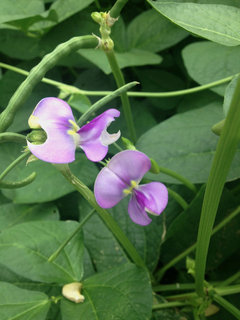
Next year I need to put in a whole lot more cowpeas, if not, just to fill in the space and inhibit weeds.
Here's a link with some good pictures and a story about this pea.
http://forums.gardenweb.com/discussions/2007520/penny-rile-a-cowpea-story
 11 years ago
Sigh, another thing I want to try. I have pole beans, bush beans, black eyed peas and PEPHs growing but NONE have produced. I've got a nice basil plant and had a good crop of cilantro, but otherwise this summer has been a bust. Forgot to mention, good crop of mosquitoes.
authereray
Original Author11 years agoThanks, Macmex, Your Penny Rile pictures look very much like the peas that I have, even the flowers are the same color. I'm sure mine are probably not Penny Rile. They were just scattered in with Purple Hull Peas that my neighbor had bought somewhere. I wish I knew what kind they were but they still taste really good. I was lucky this spring when everyone was put out with all the rain I had just gotten out of the hospital with a new knew knee so was unable to do much in my garden. But my daughter came and worked up half of it and planted a couple of tomato plants and some sweet corn. The peas came up all over one end volunteer and couldn't have been planted any better. Twenty okra plants came up volunteer and two mustard plants. All I had to do was pull weeds. I can't complain.
I haven't tried it but I have read that the leaves of the cowpea plant can be sautéed or boiled and eaten like greens. I have also picked young cowpeas before they form peas, (we always called them snaps), and cooked them like green beans, not bad. Also I like a few snaps cooked in with the peas. I would like to try the Purple Hull jelly that OkieDawn wrote about. My Grand Mother called Purple Hulls - Blue Hull peas, I don't where that came from.
If someone has poor garden soil or bad luck with their garden growing things I would recommend for them to try growing any kind of cowpeas as they are very easy to grow and take very little work as they can make even with grass and weeds growing up around them. I have proof of that right here in my own garden. Cowpeas are high in protein 23% and it doesn't take a very big space to grow enough for a family to live on if times get hard. People don't live off the land any more, if the grocery stores go empty what are people going to do?
- 11 years ago
Sounds like the Lord took care of you very well, when you couldn't work the garden! I completely agree about the usefulness of cowpeas. Unfortunately for me, I didn't grow up in a culture which grew or appreciated them. But, I've been learning.
After I posted that photo and my comments about the beautiful color of Penny Rile's flowers, I went out to weed my main garden and noticed... that the two other varieties I have going also had the same color to their flowers!!! Makes me wonder if I'm losing my mind! Oh well, they were all beautiful!
George
 11 years ago
Planted some Big Red Rippers (first time) in pots along my porch railing. I thought they'd all rotted in the May rain but they have perked up a bit and started really growing here in the late summer. Today I discovered 2 blooms and one whole bean pod! What a harvest! ...Some are growing up the netting/porch the way I intended and some are just vining along the ground pretty happily. Here's hoping I get a bit more of a harvest than 1 pod!
authereray
Original Author11 years agoKate, I planted Red Rippers years ago and I will bet that you will get more than one pod. They were good big pods and peas were as big as beans and the plants were big strong growers. They have a little bit of a strong flavor but are a good pea. My wife doesn't like strong flavored peas so I stopped growing them. But I liked them for the way they grew as they shaded out the weeds and grass.
- 11 years ago
Kate, My Red Rippers have seemingly come back from the dead in some drought summers and then produced almost until frost. I don't even really plant them every year. I just leave a few pods on the plants (I grow them on the back garden fence) in the fall and new plants sprout in that same area in the early summer. Mine have self-sowed and come back for 3 years in that spot, but the plants did rot and die this year (we had 39+" of rain in May/June, so I would have been shocked if they didn't rot and die). I expect yours will give you a good autumn harvest.
auther, I remember Iron and Clay cowpeas used to improve soil in Texas for decades. I suppose that variety goes back to at least the Civil War, and sometimes I see it sold merely as "clay". Any cowpea will do the same, but Iron and Clay grows a lot better in unimproved clay than most others.
I bet I've grown 20 or 25 different varieties of cowpeas since moving here in 1999, and any version of Pink Eye Purple Hull always will be my favorite, but I've enjoyed growing varieties that produce peas with differently colored pods and peas too. Red Ripper is one that my dad and his family grew in the early 1900s----likely in the 1920s and 1930s in red clay and some sand along the Red River just a hop, skip and a jump across from the SW corner of the county I live in now, and its' alternate name is "Mandy", which is a nickname my dad's siblings gave him. (I don't know why that nickname, I never asked and wish now that I had.)
To me, nothing looks prettier than row upon row of cowpeas in August all lush and green and producing heavily when everything else around is looking sort of tan or brown and tired and worn out. There is a purple hull pea farm in Thackerville and I love looking at their massive fields of peas as I drive by the farm. They do irrigate, so their fields are always gorgeous.
To me, nothing says summer like sitting down and shelling a big mess of peas.
Dawn authereray
Original Author11 years agoOkiedawn,
I wouldn't know about how good they would grow in clay but they grow really well in sand and have survived the last 5 years of drought without any care at all except for hoeing and pulling the weeds & grass out of them. I can't say for sure what I have. My uncle who is 95 told me when I showed them to him that they looked like Clay Peas. They do look like the pictures of Clay Peas that I have seen but they look a lot like the Penny Rile Peas that Macmex has posted also. What I like about them is that I don't have to do any work to grow, but pick them. My all time favorite will always be the Pinkeye Purple Hull. I wish I could see the Purple Hull Pea farm that you wrote about I'll bet it is something. I would like to thank every one for their input on this.
- 11 years ago
We are not big fans of cowpeas but I grew them a few years ago and saved seed, and I don't really know why. Summer was hot this year and I was looking for something to shade the chicken pen. I had big containers filled with good soil on the west side of the chicken pen, so I just dropped in seed of several different things. especially things that would offer shade. I put cowpeas in 3 or 4 of those containers and have watered them a few times but had never noticed any blooms. I went into the chicken yard today and happened to look through the fence at the plants...not really a vine yet..but covered in peas. I guess I slept through the blooming stage.
- 11 years ago
Auther, They might be from a cross of a couple of different varieties too, so might not look exactly like one or the other but could look kind of like both.
I never got peas planted this year because we had water standing in the garden for a couple of months. It didn't matter. Around mid-July a couple of pea plants sprouted in a pathway and then some sprouted in a tomato bed and started climbing the cages. I left them there because the tomatoes in that area were about done producing anyway. I haven't grown southern peas in that area in three years, but clearly there were some dry pea seeds lying around in the ground somewhere and I guess all the heavy rain woke them up and they sprouted. So, I've been thrilled to be harvesting peas when I didn't expect to have any. The Red Rippers out in the back garden never sprouted and I never planted the back garden at all. First it was under water, then it was too weedy and I just decided to leave it alone and let it be. Then, once the rain stopped it completely stopped and the back garden hasn't had any rain to encourage anything to sprout so all the weeds are dry and withered. Obviously I chose not to water it since it was just a bunch of weeds. I was hoping some of the Red Rippers would have sprouted, but they didn't. I guess I'll sow a bunch of new seed back there next year.
Dawn
authereray
Original Author11 years agoOkiedawn & soonergrandmom,
Your probably right about them being a cross of some kind. Once in a great while a purple hull will show up. No pink eye just a purple hull. I can't complain because they come up with out any work and furnish all the peas we want and have a very good flavor. But I would like to try those Speckled Purple Hull Peas.
Peas will grow fast in hot weather and few people notice the blooms, they only notice when they happen to see the little peas standing at the top of the vines. The Cow Pea saved the South after the Civil War & the Great Depression. If it had not been for Cow Peas many people would have starved. They are better than nothing even if you don't like them. Peas and cornbread ( no sugar added) with a side of mustard greens will stave off an empty belly.
- 11 years ago
Auther, I don't hate them and I do eat them a few times a year, but they just aren't my favorite thing. I'd much rather have a pot of pinto beans, but I do agree about the cornbread needing NO sugar. My husband likes cornbread with no sugar and made with corn only and no flour and likes it ground a little less fine than most commercial corn meal. We don't eat a lot of corn products now that so much is GMO, but I can't give it up entirely. I really don't have the space for growing my own corn to grind, but wish I did.
- 11 years ago
Those stories keep us in touch with another generation. I love the stories, keep telling them.
- 11 years ago
I have a cornbread recipe that is called Southern Cornbread in my cookbook and it has no sugar and no flour and uses buttermilk, and it is my husbands favorite. In fact, I made it for lunch. I have an electric mill but I didn't use it today.
Our main dish was this: Crumble and cook one pound of hamburger meat with onions and just before it is done add garlic, salt and pepper and what ever seasoning mix you would use for chili. Sometimes I make my own but today I used Williams Chili Mix which you buy in small packages at Walmart or in bottles at Sam's. Then I added 2 cans of tomatoes, 2 cans of drained kidney beans (or pintos) and 2 cans of hominy (or corn). We like pintos and hominy best but today I only had kidney beans. I also added about a cup of water so it would have a little more liquid. I cooked it for about an hour until all the flavors blended. Served it with hot cornbread and fresh Pico De Gallo and it was delicious.
I like the old stories and I fear we have lost a lot of knowledge and wisdom by not knowing or remembering what our grandparents knew.
- 11 years ago
Y'all are making me hungry just by talking about homemade cornbread.
I agree we are losing the knowledge our grandparents and their parents had about so many different handy and useful skills, particularly with regard to raising one's own food and processing/preserving it. Also, not many people scavenge "weeds" any more. My dad loved to harvest and eat lambs quarters and poke salad, and he remembered times during the Great Depression when they ate other weeds because eating weeds, however unappealing they might have been, was better than eating nothing at all. Tim's dad loved to harvest dandelion greens early in the season when they were young, and I think that came from his childhood as well. How many people nowadays even know which wild foods can be gathered and eaten and which ones cannot because they can be poisonous?
It is fun to walk down Memory Lane, especially when the memories are those of our parents and grandparents and are from a time we never knew, except through their stories. I remember my dad and his siblings all loved anything and everything pickled. I mean anything. If it was pickled, they would eat it and with great relish (pun intended). When we had family gatherings, the table had more pickled food than I even knew existed.
It really wasn't until I had long been an adult that I came to understand one way they survived the Dust Bowl Years and Great Depression on a sharecropper's farm with poor to no crops harvested (drought), a large family and virtually no cash (they bartered their own eggs, milk or butter with the local storekeeper to get things they couldn't grow like salt) was that my grandmother and my aunts canned everything (even weeds, pig's feet, chicken's feet, etc.) they could find because it gave them something to put in the root cellar and store away for winter. Those lesser/scavenged food items might have seemed unpalatable, but every one of them was hungry and ate it at times because it was all they had. They couldn't be picky.
How many of us nowadays could survive in those same circumstances? They churned their own butter, slaughtered and preserved their own hogs, raised chickens for eggs and only got to eat an occasional tough old chicken (stewed a long time to make it tender) when it was so old it quit producing eggs. They didn't plant nice, commercially grown fruit trees---who had money to spend on a tree? They gathered native fruit when they could find it, which in the Dirty Thirties wasn't very often because the rain didn't come for several years. And, they did it all without air conditioning. I preserve a lot of food from our garden every year, but I am a lazy spoiled wimp compared to them. They all worked so hard and still had so little to eat that every one of them was as thin as a rail. You'd think that life left them with bad or sad memories, right? You'd never know it to hear them talk about it. Christmas was magical because each of them got an orange and a couple of pieces of hard candy as a gift. That was their entire gift and the only orange and candy they had all year. They had wonderful memories of what I consider a very hard childhood that involved most of them going to school for only a few years and then quitting to work to support their family. Work back then meant hiring out to pick cotton all day for a dollar a day, and a work day was from can't see (sunrise) to can't see (sunset). Daddy said they were poor but they didn't know it because everyone else around them was poor too.
For all those warm memories of theirs, when World War II came, my dad and all his brothers couldn't leave the farm fast enough. Most of them went into the navy, although I think one or two may have gone into the army. Dad said the military saved them from starvation. It was the first time in their lives they had plenty to eat three times a day. I cannot imagine what their lives were like despite all those stories, but photos of them from after the war show them mostly at a normal, healthy weight, and before the war, they were very thin and lean. After the war, no one went back to the farm. Having learned what it was like to live in a city and eat regularly, they all chose the city life, though most of them always cultivated a garden and had fruit trees, and some had chickens and other animals. None of them, as far as I know, ever was hungry again, but to hear their stories, you'd think they had the most wonderful childhoods. They always appreciated what they had later in life and I think it was because times were so tough in their early years.
My Dad and his brother took my cousin and I once to see the house they grew up in. It was old and falling down, and was maybe 20' wide by 20' long. How did 9 people live in that tiny house? It never was painted either. Back then, painting a house was a statement that you had enough money for paint, which they and no one around them did. I never knew until a few years ago that having a painted house back then meant you were well-off.
The stories from my childhood are nowhere near as dramatic. Being a kid in the 1960s and 1970s was a piece of cake compared to growing up in the 1920s, 1930s or 1940s.
- 11 years ago
This is a great heritage. My mentor, as a teen, was a young man during the Depression. He told me many things about life back then and I greatly admired his resourcefulness. Here's one about a farm kid who goes into the Army:
_________________________________________LETTER FROM A
FARM KID (now at Camp Pendleton, San Diego, Marine Corps Recruit
Training)
Dear Ma and Pa:
I am well. Hope you are too.
Tell Brother Walt and Brother Elmer that the Marine Corps beats
working for old man Minch by a mile. Tell them to join up quick
before all of the places are filled.
I was restless at first
because you got to stay in bed till nearly 6 a.m., but I am getting
so I like to sleep late. Tell Walt and Elmer all you do before
breakfast is smooth your cot and shine some things. No hogs to slop,
feed to pitch, mash to mix, wood to split, fire to lay... practically
nothing. Men got to shave but it's not so bad... there's warm water.
Breakfast is strong on trimmings like fruit juice, cereal, eggs,
bacon, etc., but kind of weak on chops, potatoes, ham, steak, fried
eggplant, pie, and other regular food, but tell Walt and Elmer you
can always sit by the two city boys that live on coffee. Their food
plus yours holds you 'til noon when you get fed again. It's no wonder
these city boys can't walk much.
We go on "route
marches," which the platoon sergeant says are long walks to
harden us. If he thinks so, it's not my place to tell him different.
A "route march" is about as far as to our mailbox at home.
Then the city guys get sore feet and we all ride back in trucks.
The
country is nice but awful flat. The sergeant is like a school
teacher. He nags a lot. The captain is like the school board. Majors
and colonels just ride around and frown. They don't bother you
none.
This next will kill Walt and Elmer with laughing. I keep
getting medals for shooting. I don't know why. The bulls-eye is near
as big as a chipmunk head and don't move, and it ain't shooting at
you like the Higgett boys at home. All you got to do is lie there all
comfortable and hit it. You don't even load your own cartridges. They
come in boxes.
Then we have what they call hand-to-hand combat
training. You get to wrestle with them city boys. I have to be real
careful though, they break real easy. It ain't like fighting with
that ole bull at home. I'm about the best they got in this except for
that Tug Jordan from over in Silver Lake. I only beat him once. He
joined up the same time as me, but I'm only 5'6" and 130 pounds
and he's 6'8" and near 300 pounds dry.
Be sure to tell
Walt and Elmer to hurry and join up before other fellers get onto
this setup and come stampeding on in.
Your loving
daughter,
Alice - 11 years ago
George, Oh that is just priceless. Alice sounds really special! I do think the country folk who joined the military were more prepared for the physicality of it (like Alice was) than the city folks were.
The Navy taught my dad to swim by pushing him off a large ship in the Pacific ocean. Either you learned to swim really fast, or they fished you out of the sea and threw you in again. On the third time they threw him off the ship into the ocean, he learned to swim and got himself out of the water. Although he lived very close to the Red River as a child (they watered their garden for as long as they could in drought by hauling buckets of water by hand from the river), he never had time to learn to swim. There was no time for fun and games and swimming on the farm. The Navy taught him, but he never swam again after his military service ended. I imagine being thrown off a ship into the Pacific Ocean was terrifying when you knew you couldn't swim, and he certainly had no desire ever again to even stick his toe into a swimming pool.
Dawn authereray
Original Author11 years agosoonermom,
Cornbread made with buttermilk just taste better. Something I learned that you don't have to buy Williams Chili Mix, Just about any Chili seasoning spice will make just as good as a bought mix. If you read on the bottle most will have every thing in it to make good chili, surprise! The only other thing I add is a little more garlic powder & cumin. This is starting to turn in to a cooking channel.
authereray
Original Author11 years agoWhippoorwill peas & Cornbread,
I have heard many times of how back before and during the Great Depression some families ate Whippoorwill peas breakfast, noon and supper and little else. They thought cornbread was a real treat. I have had people tell me that after they were grown they never ate another cow pea they were so sick of them. But that was in the extreme. My folks never turned away from them and gardening. My folks lived and talked every day like it might happen again. I guess that is one reason that I still garden.

authererayOriginal Author