Software
Houzz Logo Print
lebsc

Help with soil test results

11 years ago

I recently received my results from Logan Labs and am in need of some suggestions for growing fescue grass in the Piedmont region of South Carolina (near Charlotte). The grass is currently doing OK but could be better. I had three tests performed due to the varying conditions around the house, which was recently built. Front yard is almost entirely fill; side yard is almost entirely natural existing soil but also has a subsurface septic drip system; back yard is a mix of fill and existing soil. Thanks in advance for any suggestions!

Comments (11)

  • 11 years ago

    You threw me there for a second with the lb/1000 square foot numbers, I thought I was losing my mind. :-) I'll translate some of the numbers back to pounds per acre in the discussion below, but always give you pounds per thousand square feet when I make recommendations since most of us work with that standard much more easily when applying things.

    EC: 7-9.8: Sandy silt, silty sand. It holds tolerable levels of resources, but the speed of drift will be a lot faster in the back than the front.

    pH 6.2, 6.4, 7.5: Well, that's all over the map. None of these are unreasonable and none are a barrier to a great lawn, it just means that we need to treat the soils differently, which I'll handle below.

    OM 4.5-7.6%: Variable between Good and Excellent. With your lower EC, I still wouldn't mind seeing this go up over time, but it's not an emergency. Certainly mulch mow, mow all your fall leaves, and possibly consider feeding organically.

    Sulfur 25-30: Normal range, with a bit less margin than the average but still entirely workable.

    Phosphorus 87, 43, 43: This is one reason I don't like pounds per thousand square feet, the granularity of the result here isn't wonderful. Still, all three answers are low (the back and the side are very low), and the target will be around 200 everywhere but the front, where it's 280. Setting the entire lawn to 280 isn't a problem, and we're not going to get there this year anyway. We use starter fertilizer, the cheapest you can find, to change this. Recommendations below.

    Calcium 65%, 51%, 50%: The front is perfect, the side and back are kind of low. This is impacting lawn quality. For this, we use a high-quality calcitic lime, so Encap, Mag-I-Cal, or Pennington Fast Lime. Cheaper limes work glacially slowly, require far more mass, and will make your already bad magnesium problem even worse. Recommendations below.

    Magnesium 20-24%: Very high. It's not going to set off lawn problems, but can make your soil tight and very solid, plus hard to dig. You'll want to avoid magnesium sources, which is easy--don't use dolomitic (cheap) limestone, and don't apply Epsom salt to any plant.

    Potassium 8-9%: It looks high, but this is really fine. I like a little extra potassium for cold, heat, disease, and insect resistance.

    Minor Elements: Fine, except for boron. Even iron is fine for a fescue lawn at a near-neutral pH (although color may suffer a bit out front due to the higher pH there).

    Boron 0.32, 0.2, < 0.2: Very low, deficient, deficient. Boron is used for photosynthesis and meristem development into adult cells, so this should be fixed. All three can be treated the same way, I don't overdo boron applications because that can cause a lot of problems.

    We use Milorganite as a carrier and 20 Mule Team Borax as the boron source. You can purchase 20 Mules at the grocery store in the laundry section. In a wheelbarrow or the like, dump the Milo. Spraying very, very lightly with water (I use a spray bottle like the kind people use to damp their clothes when they iron) will help the boron stick. Add the recommended amount of 20 Mule Team Borax and stir, spraying occasionally to get the stuff to stick to the Milo. Then apply over the recommended area. So if going for bag rate Milorganite (1 bag per 2,500 square feet), you'd add 10 tablespoons of 20 Mule Team Borax.

    Recommendations:

    September 1: Apply starter fertilizer at bag rate.

    September 15: Apply Encap, Mag-I-Cal, or Pennington Fast Lime at 6 pounds per thousand square feet to the back and side only.

    October 1: Apply starter fertilizer at bag rate.

    October 15: Apply 4 tablespoons 20 Mule Team Borax per thousand square feet.

    April 15, 2016: Apply Encap, Mag-I-Cal, or Pennington Fast Lime at 6 pounds per thousand square feet to the back and side only.

    Memorial Day 2016: Apply starter fertilizer at bag rate.

  • 11 years ago

    Now the overall. Raising the phosphorus will improve your lawn quality quite a lot, so that starter will help out hugely. It's going to supply enough nitrogen for a fescue lawn through fall, so no worries there.

    Other than that, review the general recommendations (mow high and reasonably frequently, water 1" at a time and reasonably rarely, and feed properly in very late spring and fall).

  • 11 years ago

    Wow, just following along here but kudos to you, this information (recommendations) I find invaluable!

  • 11 years ago

    Morpheuspa- thanks so much for the advice. One curveball - how does the schedule change if I want to oversees this fall? It's a relatively new lawn (1-2yrs) with some thin spots from late seedings (December 2013 and 2014 due to large fall hardscape/landscape projects) and also as a result of some brown patch I had to address over the summer which has finally abated. The grass looks pretty good but I'm hoping to get it to the next level with all of the big projects around the yard finally complete.

  • 11 years ago

    Let's modify the schedule a bit for your overseeding--I don't want to slam a new sprout with lime, although it'd really be just fine. Still, avoiding any possible stress is best and your soil conditions aren't that bad.

    The starter will actually be an advantage when you seed, and just don't do it after you start watering your new seed--fescue will drop an embryonic root very fast and there's no sense in traipsing all over the stuff.

    Near Charlotte, you won't be anywhere approaching ground freeze on November first and the calcium and boron will have tons of time to work in (boron really doesn't need that much).

    September 1: Apply starter fertilizer at bag rate.

    October 1: Apply starter fertilizer at bag rate.

    October 15: Apply Encap, Mag-I-Cal, or Pennington Fast Lime at 6 pounds per thousand square feet to the back and side only.

    November 1: Apply 4 tablespoons 20 Mule Team Borax per thousand square feet.

    April 15, 2016: Apply Encap, Mag-I-Cal, or Pennington Fast Lime at 6 pounds per thousand square feet to the back and side only.

    Memorial Day 2016: Apply starter fertilizer at bag rate.

  • 11 years ago

    Thanks for that, MorpheusPA. My seed won't be here until the 9th of Sept. Do you suggest putting the first application of starter down on 9/1, followed by seed whenever it arrives and then applying another round of starter 4 weeks thereafter along with the lime? Also, for detaching, overseeding, do you recommend aerating, verislicing or simply broadcast spreading the seed onto existing lawn? Presumably at a minimum I should take a rake to the areas that have some built up dead lawn material from the brown batch?

  • 11 years ago

    Applications could get a little complicated depending on your seeding time. Let's play this a bit by ear, and revise when you seed--whatever that date turns out to be.

    I'd drop the first round of starter on September 1--phosphorus takes forever to move into the soil. The second, about a month after the seeding date. Everything else is going to have to move the same amount as the two week margins between applications are pretty solidly required.

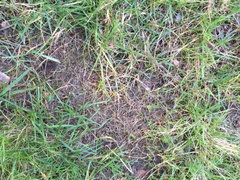
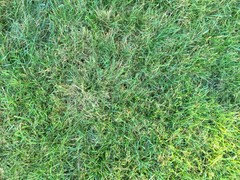
    I'd rake the dead areas gently, and might consider slit seeding a good idea depending on the thickness of the rest of your lawn (a photo would seriously help out here).

  • 11 years ago

    Thanks again - i've attached closeup and distant pics of the back/front/side yards. The best looking lawn is the front (from sod last Nov/Dec); next best is the side which is seed with the exception of the darker green sod strip on the bottom 1/3 of the photo (closeup is of the seeded portion); worst of all is the back which was from seed but I think they used some "shade" mix because they did it in December when the sun was low and didn't think it get enough sun for full fescue because the house shaded everything (the back yard faces NE). During the summer months, however, I get a good 3-4 hours of full sun on the back lawn and I think the regular fescue would do fine. With the exception of the front, the back and side are all on a pretty decent slope. There's some erosion where the grass seed didn't take well in the back but the side yard is pretty much stabilized.

  • 11 years ago

    The patches aren't huge, and overall you have a pretty nice lawn already--with some thin sections that could use a little help, sure, but nothing extreme.

    In thicker areas, the overseeding won't take very well as there's already adult grasses happily living there. No matter, the starter will help thicken that up a fair bit.

    In those spots, I'm thinking a gentle raking wouldn't be a terrible idea. Don't dig into the soil or anything, just try to clear some of the dead stuff. You don't have to do a very good job for seed to be perfectly thrilled with the new locale.

  • 11 years ago

    Sure thing. Since we're about two weeks later than the original plan, I've revised it below:

    September 1: Apply starter fertilizer at bag rate. You did this one as of September 13, so we're done with this and the rest of the schedule is revising around this date.

    October 15: Apply starter fertilizer at bag rate.

    November 1: Apply Encap, Mag-I-Cal, or Pennington Fast Lime at 6 pounds per thousand square feet to the back and side only.

    November 1: Apply 4 tablespoons 20 Mule Team Borax per thousand square feet. It's fine to do this concurrent with the calcium, a few days before, a few days after, whatever's convenient.

    April 15, 2016: Apply Encap, Mag-I-Cal, or Pennington Fast Lime at 6 pounds per thousand square feet to the back and side only.

    Memorial Day 2016: Apply starter fertilizer at bag rate.