Software
Houzz Logo Print
jungleexplorer

Conflicting soil reports!

Okay, I am going to start a new thread for this because the last thread was based on soil analysis that I am now doubting. I guess several years ago I bought some soil testing equipment and I completely for got about it. I stumbled upon it today and decided to try it out and the results were shocking. I did some testing with my own equipment and I got completely opposite results. Here are the two devices that I used.

1. Ferry Morse Dual Electronic Soil Tester

2. T.D.S. Digital Water Tester

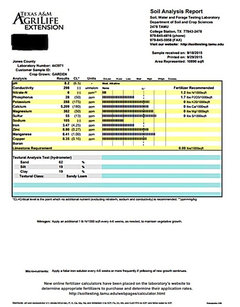
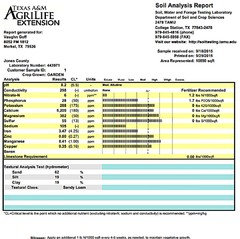
I sent off two soil samples to be tested by the AgriLife Extension of Texas A&M. The reports indicated that I had High pH and low Nitrates and really low Phosphorus. Today, when I used the electronic soil tester, it came back as low pH and extremely high NPK (Nitrates, Phosphorus and Potash). Exactly the opposite of what the soil reports said.

The A&M soil reports indicated that my soil had a pH of 8.3 (averaged between the two reports). My tester indicated that my average pH after testing ten spots was 5.1 (the lowest measurement was 3.8 and the highest of 6, but all the others were around 5).

So, I thought that the device might be defective. In an attempt to prove that the device was in error, I tested twenty, 4" starter pots that I have filled with Scotts potting soil and some 3 week old starter vegetable plants. The tester showed all these pots to have almost neutral pH (6.8 to 7) and perfect levels of NPK. This is exactly what you would expect out of commercial produced and balanced potting soil, so that seemed right to me.

Still in doubt I decide to run some test on my water to get better measurements. Filling a mason jar directly from the water in my Greenhouse, I submersed the tester probes in it. The results were a pH of 5.8 and NPK of extremely high. I know that I have hard water, but until today, I did not know how high. Using my T.D.S. Digital water tester I tested the water from the greenhouse. 824 PPM! Not that's hard buddy! It's amazing that it is still liquid.

Still in doubt, I got a glass of water from my drinking Watt's 5 stage R.O. system. The tester show a pH of 7 and just a tiny amount of NPK. Concerned that the tester was wrong for showing some menirals in the water that should not be there after going through an R.O. system, I tested the R.O. water with the water tester and it showed 66 PPM, (so it is time to service my R.O. system which I have been neglecting to do).

Still in doubt about the accuracy of my equipment I went to the store and bought a bottle of distilled water. This would be the final test. If it showed a neutral pH of 7 and zero minerals then I would know that my equipment was right on. The soil tester showed the distilled water to have a pH of 7 and not a trace of any NPK. The water tester showed that the water had, 0 PPM.

Okay so I know that both of my devices are working perfectly. But, how can this be? I am conflicted here on what the believe? It just seems illogical that some hand held testers can be more accurate then the advanced A&M soil testing lab. I mean, slightly different results would be one thing, but completely opposite results! What's going on here?

Comments (14)

  • 11 years ago

    How did you go about collecting your various soil samples? Different parts of the yard can have very different properties. Is it possible the results you got were all accurate, for where the soil came from?

  • 11 years ago

    Sorry, I forgot to mention that this is all testing done in a greenhouse.

  • 11 years ago

    Nil13. Normally I would agree with you that an electronic tester should not be trusted over a professional soil report, but there are two things that need to be looked at.

    First, is that I did not simply just use distilled water to test the accuracy of my tester. I perform multiple tests with several different substances including Scott potting soil. The fact that all of the tests revealed exactly what we would expect them to reveal including the test on the Scott potting soil which revealed it to have a neutral pH and ideal Npk balance, demonstrates that the tester is working and measuring the pH levels correctly.

    Second, the soil report showed that my soil had extremely high levels of sulfur. Now sulfur is a counter agent to high pH. Common sense would dictate that a soil that is high in sulphur should have a low pH. It seems contradictory for a soil to be able to have both a high pH and above critical level of sulfur. This fact kind of brings the soil report into question as far as its accuracy goes.

  • 11 years ago

    A&M vs. Bubble pack soil tester. That's a really, really, easy one.

  • 11 years ago

    High sulfur does not necessarily demand low pH. I'm not sure how that test is done but consider for example a soil based on gypsum rock. It should have high sulfates, which would have a different effect on soil than sulfide or elemental sulfur (for example). Just a thought.

    Generally speaking I would trust a lab with expensive equipment over a home tester. You did do some good tests there to check it out but you can't really know for sure w/o calibration buffers for pH. Also the NPK meter is adding up everything (somehow) so the fact your lab test showed low P is not necessarily incompatible with a high total NPK reading.

    How did you test the greenhouse soils with your meter? Stick the probe in or use a slurry? The best way to test for (pH especially) is a 50/50 slurry with distilled water. That ensures a consistent test absent from any effects of soil moisture (or lack of).

  • 11 years ago

    Thanks toxcrusadr. I have sent new samples in to be tested. The first samples were not collected by me and not done according to the instruction given on the sampling instructions given by Agri-life, so that was a concern, especially in light of the conflicting results. I trust Agri-Life more then the tester, but there were some concerns that the test raised and so I sent in another sample to do some more in-depth testing for texture and micronutrients as well. Also having my water tested. When the results get back, I should have a complete picture of what I have.

  • 11 years ago

    Good call on a repeat test. Hopefully you also tested some of the very same samples with your Ferry Morse tester for a comparison?

  • 11 years ago

    Okay. Got my water report back. Anyone see concerns with it?

  • 11 years ago

    I'm not as used to looking at water reports as soil so perhaps some others will have some advice. It sure looks like you have tons of dissolved solids (salts). The only bright spot is that the pH is almost neutral, rather than very high. I expect your water is coming from deposits that have plenty of sulfates, like gypsum, in addition to carbonates (limestone). Not surprised things get crusty after continuous watering in the dry heat!

  • 11 years ago

    Finally got back my soil report. What do yall think about this.


  • 11 years ago

    Even clicking on the report I can't read it. How does this report compare with what you were thinking?

    What are their recommendations?

  • 11 years ago

    Okay.I enlarged it.

  • 11 years ago

    It looks like the pH came back that same as the previous tests.