Software
Houzz Logo Print
gle2011

Landscape Idea Help

11 years ago
last modified: 11 years ago
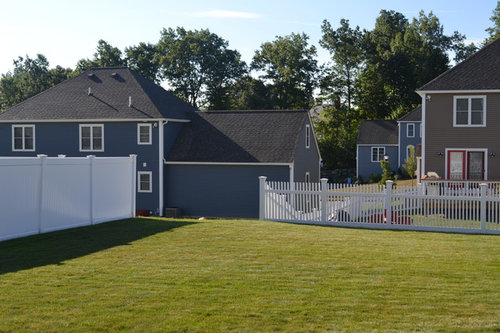
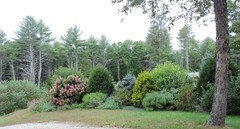
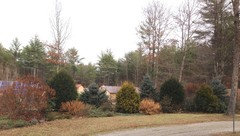
Please see the attached photos of our backyard and the shrubs we have available for transplanting use. Along with the plants we have available we'd also like to add a flowering tree or two.

We live in central Massachusetts, zone 5b.

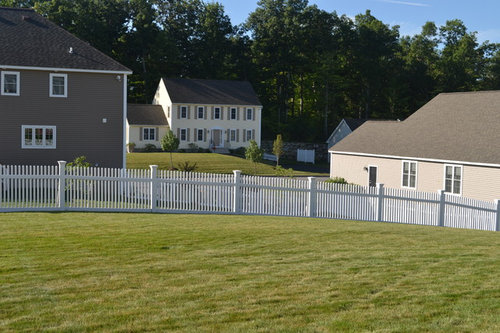
The first three photos show the white picket fence running the distance of the property line with the home behind us.

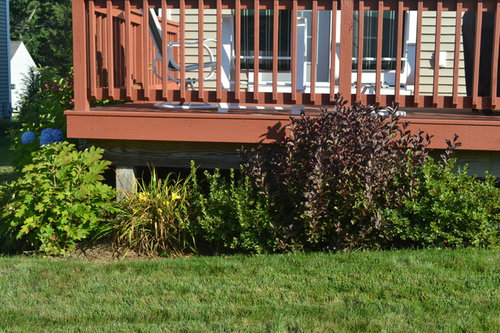
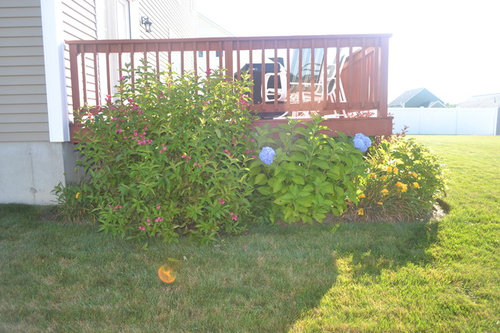
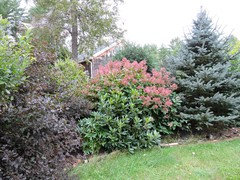
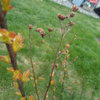
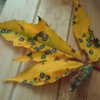
The other two photos are of plants we'd like to transplant from around the backyard deck.

The backyard is southern exposure with full sun.

The white picket fence is 80 feet long and is 60 feet from the back of the house.

The white privacy fence runs down the entire left hand side of the yard.

The opening between the two fences is approximately 15 feet.

The opening between the two fences is definitely an area we want to plant in to close off the opening.

We have no problem in building the landscape in stages.

Also, I am not sure what the best technique, precautions and time of year to transplant the existing shrubs.

Shrub inventory on hand.

(4) Endless Summer Hydrangeas

(2) boxwood hedges (not shown in photos)

(2) azaleas (not shown in photos)

(2) rhododendrons (not shown in photos)

(1) wiegela

(1) fine wine wiegla

(1) small Oak Hygrangea

(1) sand cherry shrub (not shown in photos)

and several yellow daylillies.


Thank You

Comments (10)

  • 11 years ago

    Best time of year to transplant shrubs is usually between the date they shed their leaves and when the ground freezes...maybe October. The ability to dig something up and move it straight to the new home without it having to spend time in a pot or refrigerator seriously improves success rates, in my experience. I think it is helpful to mark the soil line on shrubs with a marker beforehand, so you don't plant them too deep. I'd check out the Garden in the Woods plant sale.

    Also, consider your County Soil Conservation offices plant sale in the Spring.

    gle2011 thanked edlincoln
  • 11 years ago

    Fall is the best time to plant shrubs and trees. However, I'd wait until the temps go back to normal for this time of year. 90 degrees and no rain could be difficult conditions. You should be prepared to provide a good amount of supplemental water whenever you transplant. Do not amend the soil when transplanting. Just plant in the native soil and mulch around the planting. Do you know what kind of trees you want? Your landscape does seem to lack them.

    Steve

    gle2011 thanked Steve Massachusetts
  • 11 years ago

    It's a builders 5 year old development of 38 houses and they didn't leave many trees throughout the project.

    I like the flowering cherries and non-flowering with a nice natural shape (but looking for suggestion), being on the inside of the circle I don't have any woods edge to get rid of the leaves, so I am not looking to get any really large shade trees with alot of fall clean-up.

  • 11 years ago
    last modified: 11 years ago
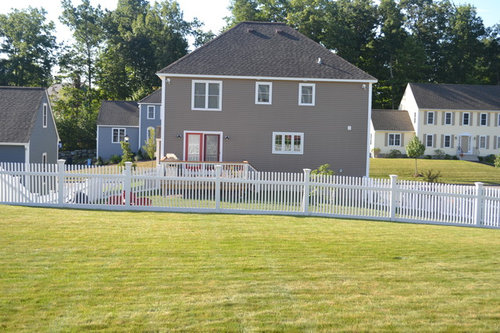
    It looks like you have a nice roomy back yard! If it were me I would install a section of fence in that gap, not touching but right next to the picket fence (which I assume belongs to your neighbors' house) on the one side and running up to the privacy fence on the other side. In any case, while I am not necessarily a fan of shade gardens I would become one! and I would plant a stand of fast growing Norway spruce on all sides inside the fences to afford some privacy and shade.

    Good luck with the project. It is sort of nice to have such a blank slate to start with. Have fun and take lots of pictures as your gardens evolve!

    gle2011 thanked spedigrees z4VT
  • 11 years ago

    Hi Everyone,

    Thanks for your responses.

    The blank slate is my problem. I enjoy doing the work, pretty good at caring for the plants, but have no visulization skills. Any help would be appreciated.

    diggerdee, not to change the subject but do you have any suggestions on fast growing shade loving plants? i have a very small summer cottage in southern coastal Maine which has an 8' to 10' hill behind it in shade to partial shade (some morning sun) that I am trying to find plants and shrubs that would hide the hill.

    thanks

  • 11 years ago

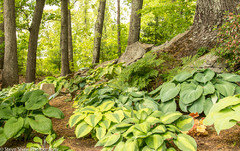
    You might want to plant some Hosta on that hill in Maine.

    Steve

  • 11 years ago

    Gle, you have a tremendous task here. But before you plant you need to plan. Think about what you eventually want for this back yard ..... do you want to keep the center of the yard open so kids or pets can run around? Do you want to put in a vegetable garden, a pool or a patio area some day?

    Edlincoln and Steve are spot on.... don't plant in all of this heat. Instead, this is the time to plan. Notice that I repeat myself! I suggest that you also post this in the Landscape Forum on GardenWeb. Include a site plan of your home and several different photos that show your house as well as the backyard from long angles. For example, take a photograph from the side of the house that shows the existing deck and the view into the back yard. If you have friendly neighbors, take a shot from their yard into yours to show another perspective. You will get many very detailed design suggestions from the folks on the Landscape Forum .... possibly even renderings of your yard.

    Dee is absolutely correct! This is a problem in visualization. You have a blank slate. Get lots of ideas and draw up some plans before you plant.

    Molie

  • 11 years ago

    Gle, I'm in southwestern CT, which is most likely much different than coastal Maine, but I grow quite a few things in shade. Of course there are hostas, which at first thought may seem common, but there are so many varieties that you are sure to find some that add tons of interest. Astilbes, heucheras and heucherellas, hydrangeas, tiarellas, ferns, boxwood, azaleas, toad lilies, primroses, sweet woodruff, cimicifuga and carex - all these do well in shade for me. In part shade (more shade than sun) I also have phlox, daylilies, lupines, deutzia, digitalis, rudbeckias, quince, campanula, rhodies, spireas, hakone grass, soapwort, geraniums, hellebores, penstemons, lilies, dogwoods (red twig and yellow twig), ligularias, hollies (deciduous and evergreen), clethra, itea, viburnum, dwarf alberta spruce, mums, pieris, bleeding hearts, lobelia, and even a few roses (Lyda Rose and Darlow's Enigma). I even grow some echinacea, sedums, daisies, agastache, irises, and other roses in my "sunny area" which gets about 5 hours of sun a day. Some of the above are in a very wet area, being moisture lovers, so they may not do well in your yard, at least not without supplemental water, but hopefully this is a list to get you started, if you go the shade route.

    Dee

  • 11 years ago

    As Molie said, what are your goals for the backyard?

    - Do you want to keep the center open for some of the activities she mentioned?

    - Do you have storage needs such as trash cans, lawn equipment, a compost pile, etc?

    - Do you have dogs that patrol the border of the property or need a run area?

    - Is the main goal simply privacy, and if so, do you want it year round or just in the warm weather?

    - Do you want some shade?

    - Do you want something in front of all of the fences as well as the gap eventually or do you think that planting strategically placed to block the views you don't want to see will be sufficient?

    - Do you like the look of a mixed border/hedge or do you want a row of one kind of plant with your mix in front of it?

    - Do you have deer issues?

    Look at all the pages of this linkto a search on the blog of Deborah Silver, a Detroit area landscape designer. Each of her rows of plants tend to be all of one kind, often stacked in layers, such as a row of arborvitae in back, a row of mid-height hydrangeas in the middle, and a low row of yew or boxwood in the front. You will see a similar structure in all of them but with different effects depending on the plants used - evergreens for winter interest, hydrangeas, roses, lavender or Russian sage, and perennials for floral interest. The use of a limited number of plants tends to give a more formal feel.

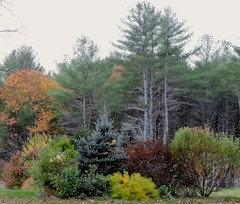
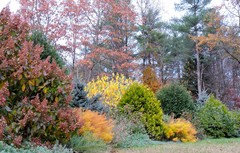
    In my rural yard I've used a mix of plants - shrubs (both flowering and evergreens), clematis (flowering vines) and perennials. My goal was blocking a work area from the main drive in all seasons, so I wanted interest in all seasons, but the realistically much of the interest is in spring and autumn. While I didn't want the formality of rows of plants, I did repeat certain plants throughout the bed so it doesn't look randomly scattered: blue spruce, gold arborvitae, green arborvitae, Amsonia hubrichtii, Rhododendrons, hydrangeas, catmint/Nepeta, and clematis.

    Late September, though it looks like this much of July and August; at times the hydrangeas are white and there are blooming clematis draped over various shrubs.

    Early November

    Winter, before snow - No snowy winter photos because the contrast between the dark evergreens and the bright snow doesn't make for a nice photo.

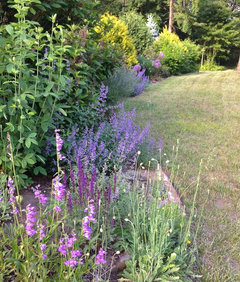
    Spring flowers

    I also have one border that has a row of all one type of evergreen, fronted by a bunch of flowering vines, shrubs and perennials in the spring.

    I would suggest you get a bunch of books from the library and wander through the web pages of a bunch of designers. Figure out what type of look appeals to you and what your goals are for your plantings. I learned a lot reading through Deborah Silver's blog, and I also like Tracy DiSabato-Aust's book, The Well-Designed Mixed Garden.

    Once we have some idea of what your goals are and what type of design appeals to you, you will get some more useful suggestions as far as design. Regardless, you will want multiples of some plants for cohesion, whether it is a row of a background evergreen or just repetition in your varied plants. I'd also suggest that you plan making the beds at least two or 3 plants deep to get the separation you want.

    I agree with others that fall is the best time for planting in New England, and often there are great sales that will help keep the budget lower.

    gle2011 thanked NHBabs z4b-5a NH