Software
Houzz Logo Print
rouge21_gw

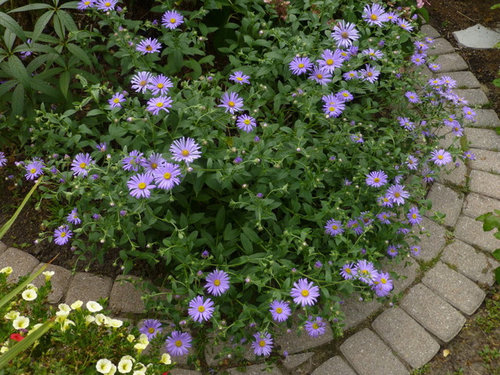
aster monch frikartii

I pruned it back earlier in July to reduce the amount of 'flop'. It is just starting to bloom now.

Comments (18)

  • 11 years ago

    I love it!

  • 11 years ago
    last modified: 11 years ago

    Great idea, Rouge. Will try the same technique myself with frikart's aster planted close to the front of a bed.

    Currently don't have any in our own garden. Have found them to be longer lived than many perennials, but only if they like the particular location.

  • 11 years ago
    last modified: 11 years ago

    This one in the picture is...4 years old. It has survived the past 2 very harsh winters.

  • 11 years ago
    last modified: 11 years ago

    Have planted several 'Wunder von Stäfa' and 'Flora's Delight' and several dozen 'Mönch', Rouge. All of those, or at least the ones in our garden, are now deceased. The longest lived lasted maybe 5 or 6 years.

    Just read that the Kemper Center for Home Gardening (in St Louis, Mo) as saying that Frikart's aster is not reliably winter hardy throughout USDA zones 5 and 6A. Think wet soil in winter can kill the plant. I'm thinking also that the drainage in our mixed perennial beds is not optimal either.

    It's a real pity because as several garden contributors (including you, I think) have pointed out, Frikart's aster has some very desirable qualities; not least the early (for our native asters) and quite long bloom time.

    Guess a point is that Frikart's aster is a hybrid of two European-Western Asian species of Aster. It just can't compete with some cultivars of our native asters in longevity (e.g. 'Alma Pötschke' - ironic! - another case of an excellent cultivar of one of our native plants being introduced by Europeans).

  • 11 years ago

    Thanks for that background SB...always learn much from you and others.

  • 11 years ago

    SB, I'm 6a and I've had Monch for 10 years. I've lost some for various reasons, but I've always had at least one plant going.

  • 11 years ago
    last modified: 11 years ago

    Thanks Rouge. Learned a lot about perennial gardening from you too; two ways (1) re things I really didn't know and (2) making me think about things I thought I did!

    Information = reality check, a2zmom; Certainly useful to others in your zone and with your growing conditions.

    In the context of your information, it's interesting to note that the USDA zones are based on only one variable (average annual minimum temperatures), whereas the Canadian Plant Hardiness Zones classification is based seven climate variables.

  • 11 years ago

    I had "Monch" years back as a real beginning gardener. I didn't know you could pinch or prune back mums and asters back then without sacrificing the flowers. Loved the color of the flowers but the plant was a flopper, as you mentioned Rouge. I may want to try it again now that I understand how to keep it from laying down.

    Linda

  • 11 years ago

    ..I love the way that plant is following the line of the brickwork, it's most attractive...

    ...as far as I understand it, and I presume this is the same the world over, but if you have one that flops, it's 'Wunder von Stafa' a sister seedling... if it doesn't flop it's 'Monch'... I have found over the years that it's best to order from a variety of suppliers, then you might get some of one, and some of the other...

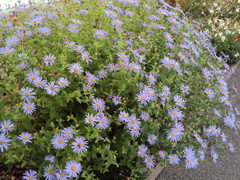
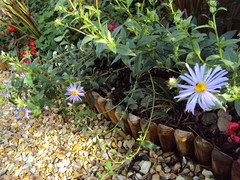
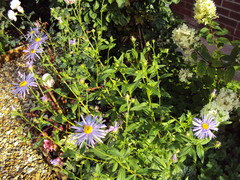
    ...here are some examples from my own garden.... I have what I believe to be both...

    ...'Monch'... upright and no flopping, despite heavy rain recently, enough to flatten anything, but at no time do any of these stems touch the ground... this is a group of 3 I've had for a few years... I don't 'Chelsea Chop' these either...


    ....this should be 'Wunder von Stafa'... it was bought under that name, as I specifically wanted a flopper here.... and it flops... however I bought 2, and the other one doesn't flop...


    ...this is the other one, bought as 'Wunder von Stafa'... but it's solidly upright, as 'Monch' should be, so I think they've sent me, inadvertently, one of each...


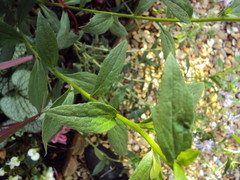
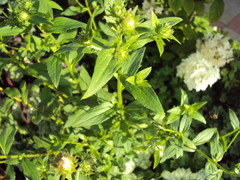
    ...another way I think to tell, is that the foliage on 'Wunder von Stafa' is darker, as here...


    ...with 'Monch', it's lighter...although more sun in this photo,, but when you grow both together, you notice the difference...


  • 11 years ago
    last modified: 11 years ago

    Nice that you have easy access to these comparison pictures Marlorena.

  • 11 years ago

    I know it's been a long while since I grew "Monch" and I do remember "Wonder of Staffa" and "Monch" being advertised as two different varieties, but I may have grown both, now that I think of it. That was back in the early 90's. I bought one/both, maybe not even at the same house. But I do remember thinking that they may have been the same plant with different names, kind of like Cranesbill Jolly Bee and Rozanne. Presently, I grow both Cranesbills, not side by side, but in different beds. They are very similar, if not the same, as I think of Aster Monch and Wonder of Staffa. Interesting discussion....

    Linda

  • 11 years ago

    I did have aster frikartii 'Monch' and also an amellus summer aster for many, many years in my zone 3 garden and found them both to be hardy and reliable. Though, last year, I removed them in desire of change and recently had come across 'Violet Queen' and think it'll nicely fit the bill for a compact long blooming specimen.

  • 11 years ago

    Appreciate the pictures, but I don't believe that it's valid to make statements, based on them, or based on anyone's garden, about real differences between 'Mönch' and 'Wunder von Stäfa'.

    The on-line history of the matter is that three picks were made by Frikart from his original cross, the first three he named Eiger, Jungfrau and Mönch. The first two were much closer to one parent, Aster amellus, than the last. Subsequently Frikart named a fourth pick from that same cross, Wunder von Stäfa.

    It seems that only one other person is reported to have made an Aster amellus - A. thomsonii hybrid; namely Bloom ('Flora's Delight').

    I've read several contradictory thing about the difference between 'Mönch' and the very similar 'Wunder von Stäfa', including more flopping or less and bluer flower colour or not.

    An article in the British newspaper the Telegraph (Aug 31, 2007): makes what I'd assume is a judicious statement on supposed differences between "Mönch' an 'Wunder von Stäfa': "Over the years there has been much disputation about the differences, or lack of them, between ''Mönch' and 'Wunder von Stäfa', especially because they both show variation in height and colour, depending on where they grow, even in the same garden".

    The journalist asked Paul Picton, who holds the National Collection of asters at his Old Court Nurseries, about differences."He (Picton) believes that 'Wunder von Stäfa' is identical to Mönch' in flower shape, size and colour, but at 75cm (30 inches) it is shorter growing, so does not need staking".

    Personally, I'd want to see statistical support for that difference, based on data controlled for the variables that make these cultivars vary when grown in different locations. Without that the most parsimonious thing would be to say they're both 'Mönch' ('Mönch' is the earlier name).

  • 11 years ago

    sunnyborders...

    ...all very interesting, thanks for posting that.... but just to say, in case of any misunderstanding....I'm not claiming to be any authority on the matter, but my comments are based not only on my own observations but they originate from the late rosarian and plantsman G.S. Thomas, from his book 'Perennial Garden Plants'...

    quote

    ..''a subsequent seedling was named 'Wunder von Stafa', this is less blue than 'Monch' with less perfect flowers, and usually needs staking....''

    ...take from it what you will but those were his writings from a few decades ago, and for me they simply confirm what I see for myself from the various plants I've grown over the last 20 years or so, under one name or the other...

    ..they seem generally confused within the industry and it is said that most plants sold here as 'Monch' are actually the other one... which must be why I hear people complain so much that their 'Monch'..flops...

    ...I think it is also true that 'Monch' suffers more in wet winters here, so nurseries find it difficult to propagate in sufficient numbers with this variety... hence, the other one is sent out I suppose...

    ..that's as I understand it from here...

  • 11 years ago
    last modified: 11 years ago

    linlily...

    ...just to comment on your cranesbills Jolly Bee and Rozanne.... this is another one that's been going on for years isn't it?... I've got 4 Rozanne's here.. I find that after about 3 seasons a single plant in good moist soil, will be about 4 foot tall and spread 6 to 8 feet wide... it's very aggressive... I've had to put 2 of them in dry soil and shade to stop their invasive tendencies... but they're not so great there I have to admit...

    ..my 2 Jolly Bee's are quite different, although the flower is identical.. they are prostrate spreading slowing across the ground only about a foot high, maybe 3 feet wide at the most... and much less invasive...quite gentle growers... that's how they are for me anyway...

  • 11 years ago

    a bit OT: I had one jolly bee survive and was very disappointed when it died and when it became unavailable because of a legal decision that they were genetically identical and that JB breeder had violated Rozanne's patent.

    Genetics, shametics...They are not the same plants in the garden and we are a bit poorer for it. Ocassionally one sees "Havana Blues" which is supposed to be a clumper, but mine did not survive a single winter, then I couldn't find it again.

    I think I'll post a separate thread.

  • 11 years ago

    SB, I agree completely that USDA hardiness zones are not that informative since they are based on temperature only. Obviously someone out west could easily be in the same temperature zone but since the rainfall pattern is so different, I would expect plants that would thrive for them would do poorly here. I'm in the northeast, growing on not too bad clay (ie, it can be dug fairly easily although you hit a lot of rocks). I've lost some of my Monch due to being out competed from other plants. It's badly in need of lifting and replanting which will happen in the spring.


    I do know that when I originally planted it, I had no idea what I was doing, lol. It was my first attempt at gardening and i dug holes, added back in compost and planted.