Software
Houzz Logo Print
robert_c_finnegan

Soil Treatment

11 years ago

While I'm waiting for the newly seeded area to fill in, I'm going to devote some time to the established areas.

Haven't had an opportunity yet to get to PA or Morristown for the soybean meal but did find a feed store that offers what I hope will be nice alternatives.

Has anyone heard of Blue Seal Safe-N-Simple Lawn Food?

Blue Seal

I think the store also sells alfalfa pellets

Of the two, which would be most beneficial?

My primary concern is adding more organic matter into the soil.

Now... I've already "soaped" the lawn twice over the last 5 weeks and would like to apply another dose. Too much?

Could I soap after throwing down the pellets or soybean meal or would they counter each other in some way?

Thank you

Comments (24)

  • 11 years ago

    The Blue Seal will be fine, but it's not 100% organic. Not that I can find an ingredients list offhand, but there's no way they're getting 4% potassium from an organic without it costing a fortune.

    I can't tell how good that'll be for raising OM, but any organic is generally reasonably good.

    Soap can go down any time without consideration for any organics, seeding, or most chemical applications (but there are a few where I'd delay the soap). That having been said, three times in 5 weeks is a bit much... I think I'd table the next soap application until October first to give the previous ones time to work in.

    Bob thanked User
  • 11 years ago

    Fair enough... I'll wait on the soap.

    The alfalfa pellets then... Along the lines if this: TS

    Or wait until I can get the soybean meal? Or... More Milorganite?

  • 11 years ago

    Alfalfa (roughly 2-1-1) would be nice for organics at the rate of 10-20 pounds per thousand square feet, plus an extremely gentle and minor feeding. Milo at 20 pounds per thousand (and 5-2-0) is somewhat poorer.

    Soybean's (7-1-2) a great feeding, and cheap, but pouring it on at much over 15 pounds per thousand can really smell. It's not so hot for massive volumes.

    For sheer organic mass, nothing beats corn (1.6-0.6-0.4). You can dump the stuff at 30 per K without excessive scent, but it's very low on the feeding. It does bring some gentle fungal defense to the table, though.

    While we argue about all of them, the most overlooked source of organics is...your lawn. Feeding well (organically or not) will increase growth, which will result in an extra 5 to 10 pounds per week of dry-weight clippings going down. Plus the roots slough off their feeder roots twice per season for a massive injection of organic matter.

    So really, if you want to wait for the soybean meal, that's fine. Your lawn will still thank you, and your organic matter levels will certainly rise. Slowly. But it's slow no matter what you do.

  • 11 years ago

    Thanks Morpheus...

    I wish I could say I followed what you wrote above but I don't understand at all. Maybe I'm combining two issues and that's throwing me off?

    You say Alfalfa is a minor feeder at 2-1-1 and Milo is poorer at 5-2-0. With a higher N value of 5, why isn't the Milo better? At 7-1-2, the soybean is great... That makes sense to me with an N value of 7.

    i want to get a Sept feeding down in the established lawn and would like to start a process whereby I'm moving toward Organic applications vs synthetics. I'm hamstrung at present because of availability of Soybean meal

    Should my focus at this particular time be on feeding or Organics? Can I get a fairly good, speedy application incorporating both? In early August I threw down some Milo at as close to bag rate as I could

    Sorry for the newbie questions but I'm at a point now where I recognize the buzzwords but not the acthalt theory or application . Not even certain my question is what I'm really after....?

    (What I DO know is the I want to wake up tomorrow and look out at a lawn that looks like yours... Short of sleeping in your basement, what are my options?)

    Thank you... Again

  • 11 years ago

    >>You say Alfalfa is a minor feeder at 2-1-1 and Milo is poorer at 5-2-0. With a higher N value of 5, why isn't the Milo better? At 7-1-2, the soybean is great... That makes sense to me with an N value of 7.

    My fault, I gave you half a thought that was clear to me, but wouldn't be to anybody else.

    Milo's a little poorer at organic enhancement in the lawn. It's a better feed; the two go hand in hand, for the most part. More nitrogen (more protein or other nitrogen-heavy items) means that there's generally less left over after the insects, bacteria, and fungi get done with it.

    Also, the higher the nitrogen, the smaller the amount you can put down without setting off a terrible smell. Corn, once the soil's been treated organically for a while, can easily go down at 50 pounds per thousand. Soy, even I pick up a miasma at 25 pounds.

    >>Should my focus at this particular time be on feeding or Organics? Can I get a fairly good, speedy application incorporating both? In early August I threw down some Milo at as close to bag rate as I could

    Feeding and organics are really synonymous if you feed organically--but I understand what you're saying here. The answer is...feed. Fall lawns are heavy feeders, and aren't very tolerant of being left to their own devices. Soybean meal and Milorganite are excellent choices for September and October.

    Your fall leaves are a fantastic opportunity to boost organic matter levels, and also free. You can also import leaves from any lawn that doesn't have weed or disease issues in the neighborhood.

    May, again, is a good chance to raise OM levels. At that point, cracked corn is a great choice, and the lawn is tolerant of a lower level of feeding during the late spring period. Although I'd still make sure to get a decent level of nitrogen/protein down, it's not nearly as critical as the fall applications are.

    >>(What I DO know is the I want to wake up tomorrow and look out at a lawn that looks like yours... Short of sleeping in your basement, what are my options?)

    That will take time, and it won't happen tomorrow. I can't remember if I read a soil test for you, but if not, get one. Poorly balanced soil won't support an extraordinary lawn.

    Feed properly (and organically is great) and mostly in very late summer through fall. Water correctly (something I'm guilty of not doing, I tend to let the grass get rather drier than I really should).

    Patience is required. Corrections and improvements do take time, even quite a lot of time depending on what they are.

    Bob thanked User
  • 11 years ago

    >>Morpheus -- just be sure to eat your carrots and spinach. We need you healthy so you can keep our lawns looking good!

    I'm always the one at parties camped by the vegetable tray, so I'm well-set on my own organic intake. :-)

    >>Sawdust is great for the lawn (I put it down at 50 lb/ksf, or roughly one bag per ksf). Per morpheus, it adds humus to the soil, which increases moisture holding capacity as well as nutrient holding capacity - increases the exchange capacity number you get from Logan. It "dissolves" into nothing after a watering, but takes upwards of a year (?) to break down.

    Yes, but it's not a miracle cure or anything. The speed of decay is so slow that it takes ages to work in, and all things considered you can get more of an organic boost from corn.

    The stuff's fantastic at mulching soils to slow water loss, and once it does work in you get a rather high percentage of humus out of it, but it takes a pretty long time. Even fall leaves are faster, and you can go way higher than 50 pounds per thousand with those for free or just the price of gas spent collecting them.

  • 11 years ago

    Good stuff... Thank you. Wish I started this years ago but...

    Ok, assuming (bad idea) I understand the logic of heavy feeding required now, i'm going to focus on feeding and , depending on what's in the shed, might just finish up whatever synthetic I have.

    Next month, another soap treatment and, maybe, another shot of N in some fashion.

    Plenty of trees in the yard so lots of mulching to be done. Just picked up a Gator mulching blade for my Toro... Not crazy about the OEM blade currently used but that could be a symptom of the mowing height. My compost pile is going to suffer from neglect but I'll figure something out

    Thanks again for input... May go window shopping at TS tomorrow and completely change my plan but, for now, I'm on a mission

  • 11 years ago

    >>Ok, assuming (bad idea) I understand the logic of heavy feeding required now, i'm going to focus on feeding and , depending on what's in the shed, might just finish up whatever synthetic I have.

    You got it. Use of synthetics during the organic transfer can really help you out (but isn't necessary), and this is the proper time for synthetic feeding. The synthetic helps bridge the gap until the soil develops the bacteria, fungi, and micro-arthropods necessary to efficiently process the organics.

    >>My compost pile is going to suffer from neglect but I'll figure something out

    There's no problem with sending half to the compost if you want. Plus you can always import a neighbor's leaves for your lawn and/or compost if you wish and end up with both.

    I also shred any financial information and compost that. The mass is nowhere near as large as the leaf mass on the property, but every little bit helps.

    Bob thanked User
  • 11 years ago

    Ok... Picked up 50lbs of cracked corn. Yesterday, threw down sythetic Fall fertilizer at bag rate.

    I'd like to continue the weekend with some lawn care - namely, throwing down the cracked corn.

    Is it that simple? 30 lbs per 1k sq ft? And then.. Just let it lay there? Continue watering as per usual and don't change anything?

    Any benefit to crunching it up further or does that defeat the purpose?

    So many questions....

    Thank you


  • 11 years ago
    last modified: 11 years ago

    Just a comment... I know morpheus is less concerned about this than I am, but if you have a choice of getting either cracked corn or corn meal, get the meal. Birds don't see the meal, but they go nuts for the cracked corn. Last time I used cracked I counted 60 birds at any given time in the back yard alone. Maybe in some neighborhoods birds are less of a problem?

    Oh, and you don't have to do anything special after dropping the corn.

  • 11 years ago

    The birds visit to eat the corn and stay to poo, so you get the organic material (now partially digested and coated in happy bacteria) back. I look at it as an opportunity to knock some unusual species off my Sighted This Year list.

    They can't eat, and can't find, anywhere near thirty pounds per thousand, so that's not an issue.

    So for me, they're amusing, useful, and fun, but certainly other people aren't quite so enchanted. Corn meal will take care of it if that's a problem for you.

    Corn meal is also better if you have a fungal issue you're trying to stop. It adheres to damp plants better, decays faster, and works faster. For preventative applications, either meal or cracked is fine. Time is not of the essence.

    Organics are easy to handle. Apply and ignore. They won't burn, won't do anything nasty if left without watering, and simply wait until they get wet to start decaying. I dropped 15 pounds per thousand of soybean meal on August 31. We haven't had a drop of rain, and that's fine.

  • 11 years ago

    I went to the store for something entirely different this morning but, despite the web site telling me it was in stock, they were high and dry.

    Although a nice morning fora a drive, I didn't drive 40 minutes to come home empty handed so I grabbed the only thing I could recall from yesterday's OM discussion: cracked corn.

    So just throw this down as is? Can I go a little heavier than 30/100? I have almost 1,300 sq ft plus some shrub/garden beds (a few hundred +)... would the entire 50 lbs we wasteful? Problematic?

    Thank you

  • 11 years ago

    50 lbs per 1,300 = 38.4 pounds per thousand, or 0.63 pounds of nitrogen per thousand.

    You'll probably be fine, but if this is your first big drop of material I might split that in half. Do about 20 per thousand now, then follow it up in a week or two with the remaining 18 per thousand.

    The only consequence at around 40 per K is that it might smell as it decays unless the soil is up to speed on organics. Once it is, corn (cracked or meal) can be applied at 60 pounds per thousand square feet with no problems.

    Bob thanked User
  • 11 years ago
    last modified: 11 years ago

    Will do... Thank you

    How quickly can I expect this to "break Down"? Hard to say given no detail on soil structure?

  • 11 years ago

    Hard to say. If soil resources are OK, the bacteria will have access to all the elements they need to grow and divide. In that case, and assuming normal rainfall, three weeks or so for it to break down far enough to become available to the grass.

    Severely whacked calcium, phosphorus, or other levels, or no rainfall, and the sky's the limit on decay time.

    Bob thanked User
  • 11 years ago

    In that case, given the neglect I've exposed my yard to, should be good to by 2020...


  • 11 years ago

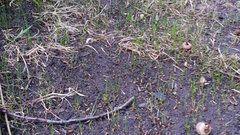
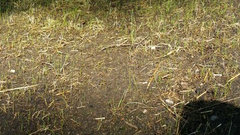
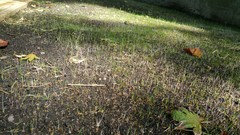
    Some baby lawn pics

    First 2 are from the area seeded with Hogan Par 5. 3rd pic is more shaded area seeded with Hogan Links

  • 11 years ago

    Microlife fertilizer will make u forget all that hippie yard food. Organic does not have to mean ancient. Pick a pre M to go with it & ur done.

  • 11 years ago

    >>In that case, given the neglect I've exposed my yard to, should be good to by 2020...

    Approximately. :-)

    Far faster than that, truly. It takes about a season for the soil biology to come up to speed, and after that you're good. Barring any chemistry issues in the soil, of course, which would require correction.

    Bob thanked User
  • 11 years ago

    I'll know more after testing in the spring, but when you say a season, do you mean a growth season? As in next fall (2016)?

    That cracked corn was really cheap and easy. Is that something that can/should be done routinely? Is there a point of diminishing return doing this or you can't have too much of a good thing?


  • 11 years ago

    A season really means about three months here--a literal season. By the end of fall, the bacterial and fungal masses will have increased significantly. Some of the insects take longer, and worms can take several years to increase their numbers from rare to a digging hazard.

    Cracked corn can really be done as much as you like, say monthly particularly in fall and late spring. Or only once or twice a year. Your choice.

    My top flight year was over 1,300 pounds of organic material per thousand square feet as an experiment to see if I could overwhelm the soil's ability to process organics. I couldn't; it almost overwhelmed my back's ability to put the stuff down, though! That was also over 30 pounds of organic nitrogen on the lawn. Do that synthetically and the salts will sterilize the soil for at least a year. Organically, the grass grew at an insane rate and I've seen California wildfires spread more slowly.

    Something in the middle is best, and I personally don't recommend corn for periods when the lawn needs a feeding. Soybean meal at fifteen pounds per thousand square feet is better for that (applied May 1, August 1, September 1, and October 1 [this one is optional]). That will supply all the nitrogen the lawn requires for the year, all else is gravy.

    Fill in with corn if you like, but it's a poor feeding for the lawn unless you're up in the 40-60 pound per thousand range (which, actually, you are). And when push comes to shove, that's what we're trying to nurture. If you were to also drop corn on April 15, August 15, and September 15 as an enhancement, that's great.

    Bob thanked User
  • 11 years ago

    Just a minor correction. I mentioned the max is 15#/k for alfalfa. That is morphs recommendation for soybean meal. Alfalfa is recommended at 20#/k.

  • 11 years ago

    When I say season I usually say growing season to mean the entire period from spring flush to the end of grass growth at the end of fall. But I'll always say growing season and not just season.