Software
Houzz Logo Print
treesaround

Backyard grass woes (crabgrass)

11 years ago
last modified: 11 years ago
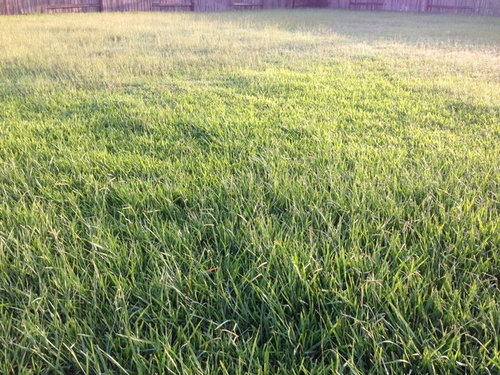
I've been battling this lawn for the past year and while I've at least managed to bring the grass that was left for dead (by the previous owner) back to life I now have a host of other problems that need to be dealt with. The main problem is crabgrass (other grass is St. Augustine). I would venture to say it makes up more than 50% of my yard now. Now obviously I'm screwed for the rest of summer but what can I do now to stop and prevent it from coming back? My plan was to go buy a crabgrass killer and kill off every single one of those nasty SOB's. Then I would apply a premergent (Scotts halts crabgrass preventer) to stop any new crabgrass from growing and a month later add my Scotts winterizer. Then around spring time apply the Scotts crabgrass preventer again. Sound good?

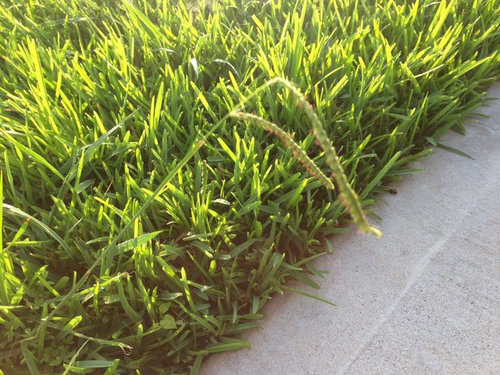
Also, I took pics (below) of what is currently bothering me now (overgrown because it's been raining everyday for a week). I don't know what this long stemmed grass is called so can anyone let me know what it is so I can deal with it too? Thanks.


Comments (7)

  • 11 years ago

    It always helps to know what part of the country you live in. What major city do you live near, or what zone are you in? How many square feet of lawn are you dealing with? Are you sure about "more than 50% crabgrass"? If my lawn were really like that I'd kill it off and start over from scratch. Your photos don't look that bad, though.

  • 11 years ago
    last modified: 11 years ago
    Hi Daniel,

    I live in Houston, Texas, zone 9. I'm dealing with roughly 14,000 square feet of lawn. It may not be 50% crabgrass but it's enough to make me feel as if its that much. Here is a pic of the crabgrass from a month ago. It's basically on the far side of my lawn but I can see it growing stronger by the the day. I know it will die off in the winter but I want to start killing it now as the grass stays around for a while in Texas and that means new crabgrass! LOL.

  • 11 years ago

    I have a lot to say about crabgrass in St Augustine, but unfortunately I need to be away the rest of the day. I think I'm attaching a video, but if it doesn't stay attached, here's the link to it.

    That video was put together based on rumors I had heard on the radio about a product from Florida. Turns out it was researched in Florida and there is a product on the market. The product has some deceptive advertising on it, so I am not going to mention it by name. Baking soda is the active ingredient despite what the container says.

    The problem with St Augustine is that it's very sensitive to many commonly used herbicides. But it is very salt tolerant, so using baking soda works against the crabgrass.

  • 11 years ago

    I'm back now for a bit. If you have areas where the St Aug is completely gone you can spray a herbicide there. Where you have a blend of crabgrass and St Aug, then the baking soda works very well. Be careful to not inhale the baking soda or get any in your eyes. When the baking soda dust comes out of the sock it is very very fine and drifts easily. Also you don't need to use old socks. Baking soda does no damage to a sock, so you can use brand new socks.

    Now the question is, How do you get crabgrass in St Augustine? Crabgrass is a summer annual plant that is very aggressive in completely unshaded areas and grows poorly where there is even minimal shade. The crabgrass seeds will sprout in warm soil that maintains a certain moisture level at the surface for 1-3 days or more. Year old seed germinates considerably better than same year seed. Seed rototilled from 2-4 inches germinates better than untilled seed. If you did any of these things last spring as the soil warmed up, then you were encouraging the weed.

    The easiest ways to keep crabgrass out of St Augustine are proper watering and mowing at the mower's highest setting. Tall St Augustine, with it's flat coarse blades, will shade out almost all grassy weeds but especially the low and slow growing ones like bermuda and crabgrass. As for watering St Augustine, if you are watering too frequently, you are really encouraging crabgrass. In general when the temps are below 70 degrees F, you should deep water once per month. When they get into the 70s, move it up to once every 3 weeks. With temps in the 80s, once every 2 weeks. With temps in the 90s, once every 7 days. If you get temps higher than 100s, I would try hard to keep it at once every 5 days but watch it to see if it needs water every 5 days. I just pulled some St Augustine out of the grip of death. I thought it was dead 3 weeks ago because of the golden color, but when I put water on it, it's still alive. So that's why I could resist watering more than once every 7 days even with temps above 100. Our temps have been in the high 90s for weeks and that area I thought was dead has not had any moisture since May. So what is deep watering? Deep watering is one full inch applied all at one time. Time your sprinklers by putting cat food or tuna cans in the yard and see how long it takes your sprinklers to fill the cans. The range will be somewhere between 20 minutes and 8 hours.

    If you see crabgrass establishing itself in bare spots. There are a few things you can do. One is to walk on the new seedlings to try and break them off. The second is to rake the new seedlings and get the roots out of the ground, and third is to spray liquid nitrogen fertilizer on them to burn the tender shoots. Salt water or baking soda dissolved in water might work just as well.

    St Augustine will spread out via stolons above the ground when the temps are below 85 degrees. Make the most of that time in your neighborhood. What I do is to drop organic fertilizer along the stolons as they spread out. Mowing high or low does not seem to affect the growth of the stolons. I gained several thousand square feet of new St Aug in 2 years in an area I literally never mowed.

    As for your other weed, you might go to this website and try to identify the weed. I didn't see anything with that seed head, but you might be able to narrow it down with the other characteristics. For some you might want a magnifying glass.

  • 11 years ago
    last modified: 11 years ago

    Daniel,

    Thanks so much for your post as it's very informative/ eye opening. The first thing that jumps out is my watering schedule as it looks like I'm watering too much (4 to 5 times a week, 30 minutes each zone). The problem is however in if you don't water that often the grass starts to yellow. Also, my backyard gets essentially no shade so seeing that crabgrass thrives in it all day really explains why it's such a beast to tame. I'm pretty sure some of my techniques did not help with the crabgrass but this lawn was already crabgrass ridden when I took it over. I've been debating on whether or not to try and kill off the crabgrass now or just let it die over winter. What do you think would be the best course of action? I've already bough Scotts halts crabgrass preventer which I'm going to apply soon (along with Scotts winterizer a few weeks later). I use Scotts Bonus S in spring and then their lawn food throughout the summer (about to apply the last treatment on the front, been omitting the back because of the crabgrass, smart or doesn't matter?). The methods I've used have worked great on the front lawn but it's a whole other story for the back. I did cut my back lawn at 3 inches in the spring but moved it up up to 4 in late summer but the damage was already done.

    I guess my pressing question now is, attack the crabgrass now or let it die off in the winter while applying preemergents thoughout the fall/winter?

    Thanks,


    Please excuse my grammar/punctuation as I've had a few drinks.......cheers.

  • 11 years ago

    Actually that was dchall that gave you the interesting information. Must've been the alcohol! :0)

  • 11 years ago

    LOL, damnit, foiled again by the boos! Sorry dchall and thanks!

Sponsored
Buckeye Restoration & Remodeling Inc.
Average rating: 5 out of 5 stars7 Reviews
Central Ohio's Premier Home Remodelers Since 1996