Software
Houzz Logo Print
tanisha102

succulent leaves

11 years ago
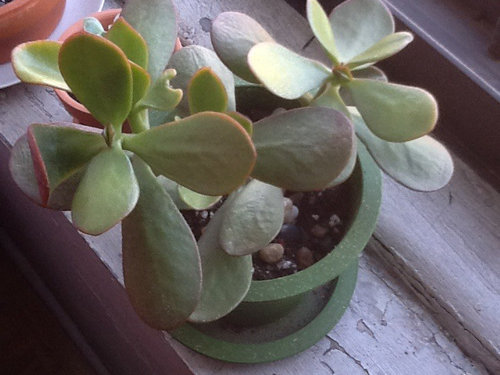
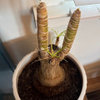
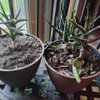
Can anyone help me with why my leaves look like this? the veins are showing and leaves feel soft. Not plum and thick. Is it too much water or light or both?

Thank you

Comments (13)

  • 11 years ago

    Agreed with Larry.

    If you've had this plant for a while, I don't think it has too much light (based on growth/colouration).

    tanisha102 thanked ewwmayo
  • 11 years ago

    thank you guys so much. i'll try the watering first. i just try not to over water them.


  • 11 years ago

    The usual regime for succulents is to water thoroughly until it drains out the bottom (it should come thru pretty quickly) and then allow to dry completely before watering again

    tanisha102 thanked GreenLarry
  • 10 years ago
    last modified: 10 years ago

    Before you resign yourself to the fact you're under-watering, let's explore your watering habits a little. Both over-and under-watering produce the same drought response, so you can't tell what's really going on by looking at a picture and w/o more input. In fact, a high level of salts in the soil can also cause a drought response ...... and while it's better to under-water than over-water because your plant tolerates 'too dry' better than 'too wet', your plant doesn't like to be allowed to dry completely, a condition that causes drought stress. Your plant likes to be watered just before drought stress becomes a limitation, which is to say when the plant is almost but not quite dry; so, what's accepted as the norm isn't always what's best for the plant.

    If you've been watering while you can still detect moisture in the soil, the odds significantly favor over rather than under-watering. If you're allowing the plant to remain dry for extended periods, I'd agree with under-watering. If, after you water your dry plant, the leaves plump up and the venation disappears, the conspicuous veins would be a symptom of drought stress, but if they don't disappear, they're almost certainly a genetic trait. Watering in small sips w/o flushing the soil causes salts from fertilizer solutions and tap water to accumulate in the soil. The result of that is an increasing inability for the plant to absorb water, so it's possible the plant might be dying of thirst in a sea of plenty.

    Soil choice is very important for your plants. Ideally, you would learn to build a soil that holds water inside of and on the surface of particles, rather than in between the particles. It's very difficult to over-water a soil like this, so it allows you to water thoroughly when you DO water - without concern roots will rot/die or root function will be impaired by soggy conditions and lack of air in the root zone. More on that if you have interest.

    Al

    tanisha102 thanked tapla (mid-Michigan, USDA z5b-6a)
  • 10 years ago
    last modified: 10 years ago

    My experience with succulents and cacti is to water well but allow the soil to dry between watering, and that's common practice amongst growers of C&S. Some plants are the exception but this plant, Crassula ovata, certainly is no exception. I've grown loads of them, some till they got too big to be kept indoors! If you lucky you might get flowers later. But I will say don't feed it when the soil is bone dry. Come feeding time it is best to water the plant then feed the following day. Otherwise those salts in the fertiliser will burn the roots and remain in the soil.

  • 10 years ago

    Fertilizing is another subject. I was talking about watering habits, and there are a good number of common practices born of bad habits that are perpetuated and learned by rote that should be allowed to die or at least be properly qualified when the advice is offered. Succulents, especially when they are wanting to grow robustly, suffer from being allowed to go dry, w/o question - just like other plants. Think about it. No water = progressive root death starting with the most important fine roots + the inability to carry on photosynthesis. I can't think of a perspective from which that can be seen as a good thing unless the intent is to force the plant into a consequential dormancy so it better tolerates adverse conditions for a sustained period. That would cover those plants that are better forced into a consequential dormancy to avoid root rot during extended periods where growth would normally be minimal to nonexistent due to light and/or temperature issues. If you'd said it's better to allow the plant to dry completely than it is to risk overwatering because your soil might be holding too much water, I'd buy it, but to say the plant likes to go completely dry is to say it likes stress, and I think you'll have a difficult time getting that to pass the sniff test.

    Too often, as is true in this case, growers mistake what a plant ably tolerates for what it likes. You'll find that jades perform best if they're kept evenly moist during the active part of the growth cycle and are allowed to become almost but not completely dry before they're watered during time spans when photoperiod and temps dictate a quiescent rest period. It's sort of difficult to disagree with something that makes so much sense. Not to wax anthropomorphic, but do we allow ourselves to become completely dehydrated before we drink a glass of water? No - it throws the function of our entire body completely out of whack.

    Al

  • 10 years ago
    last modified: 10 years ago

    Oh dear....Al, we are human beings, not xerophytic plants! Experts have been cultivating their C&S this way for years, and it works, obviously! Think of the environment in which they live. Does it rain every day? No it doesn't. Do they suffer? No they don't! They have evolved to survive in such an environment.

  • 10 years ago

    Well, this is staying slightly from the original topic, but I do agree drought stress results in the death of fine rootage.

    For Tanisha's plant, it is a matter of the plant doing better or worse than it could be.

    For other succulents like Faucaria and other mesembs, this often leads to the dreaded 'instant mush' death seemingly overnight.

    tanisha102 thanked ewwmayo
  • 10 years ago

    Thank you all very much. I watered groot, that's his name and he's doing much better. Pics to follow later. I'm out and about now. But thank you all so very much. You guys are way better at this than I am. But with all your wonderful info, I too shall be one day.

  • 10 years ago

    If you measure suffering in terms of a plant's inability to realize its potential due to an insufficient water supply, then YES - plants allowed to go completely dry do suffer. When roots die and the plant is unable to carry on photosynthesis due to lack of water AND nutrients essential to the process which are transported in the nutrient stream, it's not even close to an ideal situation. Succulents/jades are known to TOLERATE drought, which by no leap of logic can be construed to mean they like it.

    Al

  • 5 years ago

    I have had my Jade plant for 15 years, it was 5ft tall and about 3ft wide. I followed every rule. I got my soil from a succulent nursery, I let it dry out, and watered it until I seen it come out the holes. Yes, I had good drainage. Then he got root rot, I don't know what I did wrong. I cried like I lot a child :(

  • 5 years ago
    last modified: 5 years ago

    Did you fully repot the plant on a regular basis, Dawn?

    Plants die slowly when they are chronically unable to produce more food/energy during photosynthesis than they use during respiration. This can result from mechanical injury, but more often it's a cultural influence that demands the plant should deal with stress at or beyond the limits genetically determined by Mother Nature.

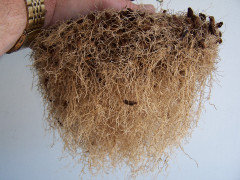
    A full repot includes bare-rooting, root pruning, and a complete change of soil. During root pruning, the grower should concentrate on removing large roots not attached to the plant in the immediate vicinity of the soil line. These roots serve only as plumbing, and aren't really needed as anchorage in conventional container culture. The fine, almost microscopic, hair-like roots are the ones that do almost all of the plant's heavy lifting. A pot stuffed completely full of old large roots leaves little space for fine root colonization, better to remove them (large roots) every 2-3 years during a repotting session. A healthy root system is a prerequisite to a healthy plant. We can't have the later w/o the former.

    The following image is not a jade, but it illustrates what kind of root system is generated when large roots (except at the soil surface or just under) are managed to the plant's best advantage.


    I'm not making the diagnosis your plant succumbed for the reason I outlined because there's not enough background info, but my experience has shown that most houseplants as old as yours are suffering so much stress from tight roots they're being limited to realizing only a VERY small fraction of their potential. For Joe/Jane average houseplant keeper who doesn't repot, it's not unusual to see plants so close to the (energy in/ energy out) break even point that more than 90% of their growth/ vitality potential is lost and their eye appeal suffering.

    Also, when a plant's systems get badly out of balance, the whole organism begins to wobble like a top. At that point, it's very susceptible to pests and diseases because the plant's own chemical defense mechanism are a by-product of the plants metabolic function. That's why it's said the best defense against bugs and disease is a healthy plant.

    I hope you find another you can care for as much as the one that was lost.

    Al