Software
Houzz Logo Print
hawkeyext

Planting based off an old soil test

11 years ago
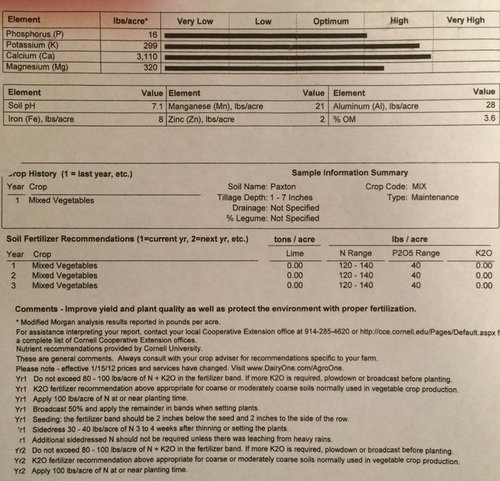
Hello,

I just started renting out a small piece of land and received this soil test dated February 2012. I'm going to plant garlic here in the next few weeks and am wondering if I should lay down some fertilizer. I'm not familiar with how soil degrades or improves over time and just curious how helpful this test is and wondering if anyone has any ideas on what I should do (if anything) to the soil before planting the garlic. I'd imagine there is not enough time to get another test. Thanks for any advice.


Comments (13)

  • 11 years ago

    Garlic likes a loose, organically rich soil so at the very least I would work some compost into the planting bed. That should supplement the existing soil nutrients sufficiently to get the bulbs established for winter.

    Garlic appreciates a fair amount of nitrogen, so in spring as new stems emerge you will probably want to top dress with a high nitrogen fertilizer - blood meal, alfalfa meal, urea, etc. Or, I have a garlic growing friend who swears by using lawn fertilizer and produces amazing crops. Just make sure it is a straight fertilizer and and not a weed and feed product.

    hawkeyext thanked gardengal48 (PNW Z8/9)
  • 11 years ago
    last modified: 11 years ago

    I can't read the soil report but I would be concerned about two things.

    1. It is a few years old - likely no longer accurate.

    2. You have no idea what, if anything, has been done or added to the soil since that report.

    You should be able to get another soil test done in time for planting and even IF you already planted at least you would have an idea what needs to be done.

    hawkeyext thanked gumby_ct
  • 11 years ago

    Click on the photo of the test - it will enlarge it to a readable size.

    Yeah, the test is a couple years old but all the essential nutrients tested at optimum or high levels so unless there was some seriously heavy cropping going on in this bed, nutrient levels should be more than adequate. pH is fine, OM is a tad low but adding compost should bump that up nicely plus provide the N boost that is probably needed (as it almost always is, as mobile and temporary as that element tends to be).

    I am not a huge proponent of frequent soil tests (unless a large agricultural operation) as they tend to be unnecessary based on most home gardening situations and overly complicate what is really a very simple premise. 9 times out of 10, unless a baseline test (like the above) shows the nutrient mix to be completely out of whack, routine annual applications of OM (as in compost) will maintain the soil nutrient load at proper levels.

    Sure, you could have another soil test done if you want. But it's an added expense, it will most probably not tell you much of anything different that what the old test shows and it can delay your planting until you wait for the results. And this is prime garlic planting time, right now. Or you can go ahead and add a decent quantity (3-4") of compost, mix in well and plant your bulbs. Based on some 25 years as a horticulturist and professional gardener, I'm almost 100% certain they'll be fine :-)

    hawkeyext thanked gardengal48 (PNW Z8/9)
  • 11 years ago

    Clicking on the image is of no help to me.

    OP does not provide a location or size of the planting area.

    Soil tests in CT done by CAES are FREE, I am reasonably certain many other states have a similar program.

    Certainly you can plant w/o any testing but getting garlic in the ground today I think are the least of the worries.

    IF it was your own home (or land) and you knew the history I think it would be a diff story. But renting? Does that mean community garden? Farm land? Or what?

    In any case <You have no idea what, if anything, has been done or added to the soil since that report..>

    IF it were me, I would not add anything more than compost without a complete professional soil test.

    You can. OP can. I would NOT is all I am saying.

  • 11 years ago

    I'm wondering what you guys think a soil test proves? PH isn't likely to change much. It read right down the middle so it would have to change a lot to make any difference.

    I'm pretty sure that a soil test would tell you to add organic matter and Nitrogen. so I'll tell you to do that for free. It's easy to apply Nitrogen any old time, so I would just mulch and plant.

    hawkeyext thanked kokopellifivea
  • 11 years ago
    last modified: 11 years ago

    How can you be certain the report shown is, in fact, for the planting area the OP has in mind? Seriously, if you were renting this plot would you give a hard copy report to the landlord?

    A soil test can actually save you time & money - why would you apply things the soil doesn't need?

    Applying too much N can be a problem - we don't even know what plants or N level in the soil and already applying more N?

    When planning a garden the first thing you should do is choose a location that gets the amount of sun the plants you want to grow will want. So that is location, location, location. No sense going further (like spending labor & money) if the sun don't shine.

    2nd thing is a soil test - for the reasons stated above. It is just considered SOP for gardening 101.

    To be sure - you can certainly start any garden without doing either of the above, your call, your time, your money.

    hawkeyext thanked gumby_ct
  • 11 years ago

    Well, you can play N by ear. Given that the soil evidently hasn't been planted for a few years it can probably take a light dose. If the plants appear needy, more can be added very easily.

    Compost would be an ideal start as stated above if OP has any.

    I don't see any significant expense. Anyone who gardens has a source if N around somewhere or gets some sooner or later.

    hawkeyext thanked kokopellifivea
  • 11 years ago

    You can make lots of assumptions -

    Let's assume the plot has been gardened since 2012 and we don't know that it hasn't, do we?

    Let's assume the soil has too much N already and you add more?

    Let's assume the previous gardener was like you and over applied everything. I see 4 nutrients in the HIGH range and one of them touching VERY HIGH.

    Let's assume there were problems and that is why the previous gardener left this plot.

    Finally, Let us all assume the OP doesn't want to garden that way OR s/he wouldn't have posted the question.

  • 11 years ago

    Hello all,


    Thank you for the informative discussion and advice.


    From what I gathered the farmer last planted flowering plants here. For the last few years he mostly concentrated on flowering plants in a nursery, although he did some vegetables from time to time. I am not sure when he last planted here and he is on vacation for another week so I won’t know for awhile.


    I live in Westchester County which does not have an extension center, so there is no option for free soil tests. I could ship it out for a fee, but again I don’t think I’d receive an answer anytime soon. I will look in to that.


    I’d like to add in a layer of compost, but worried about the expense. (I will probably suck it up and do it though.) I read to lay the compost down for a week or so before sowing and my garlic should be here any day now.


    The field is 85 feet by 120 feet to which we spent all day tilling an area that is 35 feet by 65 feet. We purchased 14 pounds of garlic to which I calculated we could do:


    Twelve 50ft rows with garlic spaced 6 inches apart.


    I could either space the rows 1 foot apart for an area 24ft wide, or 2 feet apart for an area 36 feet wide. (This is with each garlic row getting 1ft of space.)


    I just started “my” farm working out of their greenhouse this summer growing herbs and leafy greens. It is heated so we are going to grow year-round and since there is so much land available I would just like to try growing something over the winter. Being this is my first time I’d like to start small and thought this would be a great test and learning experience without having to spend too much money.


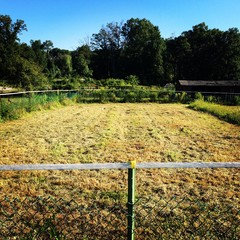
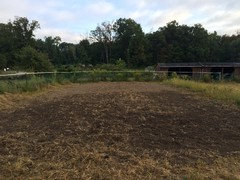
    Here are two pictures taken recently. The first is after it was mowed, the second after it was tilled and we started to water.


  • 11 years ago

    "A soil test can actually save you time & money - why would you apply things the soil doesn't need?"

    As the suggestions above were to apply OM in the form of compost, I hardly think we can automatically assume that is something the soil doesn't need. The soil test shows OM to be on the low side and since OM is never a permanent amendment, routinely adding more in reasonable quantities is an expected response.

    In all my years of gardening and reviewing soil tests, adding N is virtually always recommended. Like OM, it is never a long term amendment and because of its mobility and transience in the soil, almost always needs to be supplemented. And garlic thrives in a high N environment, especially when it starts pushing foliar growth in spring.

    "2nd thing is a soil test - for the reasons stated above. It is just considered SOP for gardening 101."

    Really? Says who? Yes, a soil test is often recommended if there are big unknowns. But there are not big unknowns with this plot. We DO have a soil test, if not particularly current, so we know pH, we know OM is on the low side and we know other primary nutrients are adequate or more than adequate (with the exception of N for the reasons stated above). Nothing is grossly out of whack and I see no compelling reason to obtain a new test.

    I have NEVER had a professional soil test done in any of the gardens I've had and I've managed quite well. In fact, just routinely adding compost annually or semi-annually has provided all the nutrient supplementation required to grow strong, healthy, productive plants and eliminated the need for any other fertilizers or amendments.

    Soil test were developed for agricultural purposes, where heavy cropping readily depletes soil nutrients. That's why most contain recommendations for amending that are in pounds per acre. How necessary they are for a small home garden or an ornamental landscape is up for considerable debate. I stand by my contention that if the soil is of reasonable tilth and fertility - as this appears to be - then they can be an unnecessary complication and a huge source of confusion. Look at how many questions they generate on this forum and even with the issues discussed on this thread!

  • 11 years ago

    <How can you be certain the report shown is, in fact, for the planting area the OP has in mind?>

    <You can. OP can. I would NOT is all I am saying.>

    <Let's assume there were problems and that is why the previous gardener left this plot.>

    <Finally, Let us all assume the OP doesn't want to garden that way OR s/he wouldn't have posted the question.>

    <To be sure - you can certainly start any garden without doing either of the above, your call, your time, your money.>

    Have we gone FULL circle?

  • 11 years ago

    Twice each year UCONN offers free soil testing for homeowners, in Connecticut. North Carolina has a fee assessed on fertilizers sold that helps pay for soil testing for North Carolinians, otherwise most all others charge fees for this service. Cornell apparently charges $50.00 for this service now.

    That soil test indicates the soil pH is in range for most all plants (6.0 to 7.0) and the other major nutrients are in the high range so even though this test is about 3 years old there should not need to be any need to "fertilize". The organic matter is a bit low ( 3.6) and optimal is in the 6 to 8 percent range so the addition of organic material, compost, shredded leaves, any other form of vegetative waste, would be a good idea.

    So, why have a soil test done? A good reliable soil test is one tool in the gardeners bag, as useful as a hoe or spade.

    http://www.your-vegetable-gardening-helper.com/soil-testing.html

    In addition to that soil test these simple soil tests can also be of use.

    1) Soil test for organic
    material. From that soil sample put enough of the rest to make a 4 inch level in
    a clear 1 quart jar, with a tight fitting lid. Fill that jar with water and
    replace the lid, tightly. Shake the jar vigorously and then let it stand for 24
    hours. Your soil will settle out according to soil particle size and weight.
    For example, a good loam will have about 1-3/4 inch (about 45%) of sand on the
    bottom. about 1 inch (about 25%) of silt next, about 1 inch (25%) of clay above
    that, and about 1/4 inch (about 5%) of organic matter on the top.

    2) Drainage. Dig a hole
    1 foot square and 1 foot deep and fill that with water. After that water drains
    away refill the hole with more water and time how long it takes that to drain
    away. Anything less than 2 hours and your soil drains’ too quickly and needs
    more organic matter to slow that drainage down. Anything over 6 hours and the
    soil drains too slowly and needs lots of organic matter to speed it up.

    3) Tilth. Take a handful
    of your slightly damp soil and squeeze it tightly. When the pressure is
    released the soil should hold together in that clump, but when poked with a
    finger that clump should fall apart.

    4) Smell. What does your
    soil smell like? A pleasant, rich earthy odor? Putrid, offensive, repugnant
    odor? The more organic matter in your soil the more active the soil bacteria
    will be and the nicer your soil will smell, to a point. Too much organic matter
    can be bad as well.

    5) Life. How many
    earthworms per shovel full were there? 5 or more indicates a pretty healthy soil. Fewer than 5,
    according to the Natural Resources Conservation Service, indicates a soil that
    is not healthy.

    kimmq is kimmsr

Sponsored
Peabody Landscape Group
Average rating: 3.5 out of 5 stars8 Reviews
Franklin County's Reliable Landscape Design & Contracting