Software
Houzz Logo Print
aegis1000

What happened to my Iceberg ... ???

10 years ago
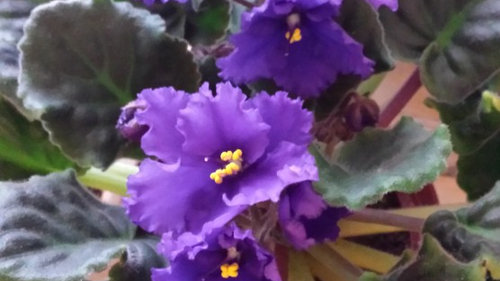
Iceberg - September 2015

All trace of white is gone ...

Comments (20)

  • 10 years ago

    Hmm, I'm thinking maybe it's genetic? Or a mutation? My violets have bloomed (and re-bloomed) different colors before, and sometimes with colors missing (especially the chimeras - a couple flowers will be stripped, but then it'll have a lot of flowers that are solid too).

    My rob's June Bug even has a spot of pink in it's flower - it's supposed to be all white, haha :)

  • 10 years ago

    I think I commented that it was pretty but had too much blue and was "off" before. That is what happens to them then. They go all blue. They are an unstable plant. I don't think you said if it was birth marked, but often the blue and white ones may do that. I could not get one from a leaf without a birth mark, you must watch Arctic Frost for birth marking, Spectacular does it - I'm not sure what else. Well Optimara Tennessee did it once but so far the one I've grown from a clean leaf looks okay.


    Diana

  • 10 years ago

    Haha, you beat me to the joke, fortyseven_gw!

    Oh yeah, and I'm almost positive that blue is dominant over white. Which is why these things happen sometimes.

  • 10 years ago
    last modified: 10 years ago

    Yes, blue is dominant over white! And violets names with various words for snow seem to be popular choices with this upstate New York hybridizer who resides near a snow belt region!

    I have this violet. Its color does vary with bloom cycles. The person who gave it to me knows how to make a bloom more white than blue. There is magic involved that I have not learned, so mine tend to be more blue than white. That is part of the fun, just like melting snow, it is different every day!


  • 10 years ago

    What a great attitude to have about it. If you ever learn the secret and you're able to pass it around (even though a great magician never tells), I'd love to hear it.

  • 10 years ago

    I am beginning to wonder if bloom stem propagation is the way to go with some of these or if that won't work either. I wanted Iceberg since there is a photo of it looking correct in my window from maybe 9 years ago but lately it looks like any recent photos are off or you can't tell of you are getting a plant like the photo or not. I am sorry to mention Lyons so much but many of the ones have been theirs. It is not like I want my plants to get birth marks and go off. Ma's Ching Dynasty birth marked but I can't say I was too fond of it anyway. Diana

  • 10 years ago

    I just recently heard of stem propagation, and I'd love to try it since I don't always have the best of luck with leaves. I'm still not TOO sure about how it works (I've had trouble finding a good guide), but if you've tried it, would you mind sharing any tips with me? :)

  • 10 years ago

    I know you are disappointed in losing the white, but can I say that it is STILL a beautiful violet!??! I love the fringe!

    Could this be a case of the white was lost due to warm temps? Like variegated foliage will do sometimes? Just wondering. Rosie

  • 10 years ago

    I agree with Rosie - it's still beautiful.

    But if it really did go away from the warm temperatures, then it literally... "melted". Lol, I'm still laughing about that joke. A+++ to you, fortyseven_gw.

  • 10 years ago

    Ohhhh, poor Iceberg had a meltdown! Joanne you really did nail that joke! Well, I still want to see what happens when it gets a little cooler! Rosie

  • 10 years ago

    Violet Barn has good instructions for bloom (or blossom - never remember which they call it) stem propagation. I'd never done it either so I tried it on Arctic Frost. It is generally used on chimeras but Pat Hancock wrote an article suggesting it for fantasies (so I heard anyway) and I got frustrated and used it with Senk's Big Bells since I apparently found the leaves awkward to set. I have done chimeras now too. So I don't know if it is a good idea on ones that are know to go off or not. Diana

  • 10 years ago
    last modified: 10 years ago

    Rosie,

    Horticulturists have explained when a plant is stressed, it will revert to its strongest parent, the solid purple-violet.

    I don't recall what brings the white out, it could be temperature related. But not sure if it is too much or too little. My Iceberg did the same and looked exactly like that one pictured above during a cold spell last winter.

    Whereas, one of my Cora's bloomed mostly all white in the summer. But a Rita has to be grown cool to keep the white.

    I have several blues and whites with the idea of snow in the name, including Arctic Frost.

    I had a Maine, directly from Selective Gardener, that was mostly white. It did not match the photo. It was supposed to be blue and white.


  • 10 years ago

    No kidding????? Wow. And here we go again. Is it that you cannot hybridize a "stable" AV??? An oak tree doesn't change because it is stressed. Neither does an aster. And to me outdoor things should be more stressed than indoor things!

    OR, do we take too good care of the violets or other indoor plants? Honestly it is really giving me something else to think about! I have a Gryphon Begonia in a 10 inch pot. That plant gets no care during the winter. Loses all its leaves. Bone dry. All winter. Because I put it in a very low light spot. (violets take the window seats) You talk about stress? Now that is not normal for it #1 to get that care and #2 to not change a thing when it starts growing again in the spring! Leaf shape is the same, grows fast, blooms and gets full to the point that I really could cut it back, start new ones and they would not change a thing! And that is just ONE of the examples I could give about plants at my house.

    Honestly I really don't understand violets changing, reverting, sporting etc at the drop of a pin.

    I find all of this very interesting! I will never understand plants. Rosie

  • 10 years ago
    last modified: 10 years ago

    Oh, no, it is just violets. They are so far removed from nature, with the tinkering and manipulation, as to not really be "natural." People made a hobby of them.

    Jeff Smith seems to be the main person who writes about this, so he is quoted often.

    He said the african violet is unstable so that is why it can adapt so easily. It just might not hold onto the changes. There was an interesting photo that showed a violet display in NJ that had something like 15 different blooms that came from the seeds of a single cross.

    It has also been crossed with other species. This information used to be kept secret when hybridizers were doing this as a business.

    The violets that do the best are the older varieties of blues and purples. Second seem to be the lilac colors.

    Like roses, I love them and admire them vicariously through books or other people's collections or public gardens. I have no room or need to grow more than a dozen, although I would like to.

    If I had not gotten caught up in this hobby, I would have had no more than a dozen house violets. As a friend says, it is like eating potato chips. I think it is because there are others also caught up in the hobby so people make it interesting to talk to.

    I certainly never did it with Christmas cookies!!

    Joanne

  • 10 years ago

    Oh Joanne you and I think so much alike. But those Christmas cookies,,,,,yummmm. Oh yeah and potato chips also!

    Thanks for all that info. I guess I never really thought about how many different ways someone could unstabilize a plant!

    You're right, it is fun and interesting to "talk" to others about violets. Especially when there is a forum like this!

    Unfortunately I am not just addicted to violets, although they ARE by far my favorite houseplant. But outdoor trees, shrubs, plants, flowers, ahhhh so much and so little time! Rosie


  • 10 years ago
    last modified: 10 years ago

    Though I cannot grow ALL African Violets well, ... there are a multitude of varieties that I can grow.

    When I was exploring roses, ... it was disheartening to discover that the plants which bear the perfect Hybrid Tea roses we are all familiar with (from florists at Valentines and other times), ... would NOT grow well in my Midwest landscape ... and that either the winters, the diseases, or the insect pests would destroy or hopelessly disfigure them. That is, if one was averse to a rigorous spraying program.

    And, of course, this spraying is no light thing. It is even recommended that one wear Hazmat clothing when performing the necessary spraying and to be very careful to guard one's eyes, nose, and throat from the chemicals.

    So, I became committed to a non-spray garden (though I have discovered that I will have to spray ... less rigorously, perhaps, ... my tomatoes to guard therm from fungal disease as well). Fortunately, there are a few different options for successfully growing roses where I live without the meed for spraying.

    I, too, disdained the Knockout Rose selections for a time, especially when those offerings only supported single-flowered options. I became aware of and planted particularly disease-resistant varieties, such as Carefree Beauty, and Quietness, along with a host of other offerings developed by Dr. Griffith Buck for Midwest landscapes. I also planted Carefree Wonder, Fairy Rose, Bonica, and, ultimately, some pink Knockouts. I couldn't bear to think of my roses only blooming once a year, so I steered clear of most of the Vintage Roses (though I did plant Mystic Beauty, which was derived from the beautiful vintage rose, Souvenir de la Malmaison).

    Carefree Beauty

    I also planted a half-dozen varieties of David Austin's rose, which have been all the rage for the last 20 years or so.

    Being a novice at roses, I promptly killed most of my initial rose plantings, either to winter-kill, or to disease, or to my own misplacement of the shrubs.

    But a few plants remain, ... I have a couple Carefree Beauties, a Fairy rose planting, and a few recovering Knockouts. I've had great success the last few years with Gene Boerner, which provides blooms all season long. I also have a few remaining Austin Eglantynes, which bloom for me each year.

    Gene Boerner (with Knockouts)

    I added a Champlain rose this year, which should be hardier through the winter.

    It seems that pink is the color of choice of the most vigorous disease-resistant rose offerings, though the initial Knockouts were red, of course.

  • 10 years ago
    last modified: 10 years ago

    Thank you, these are beautiful, refreshing photos and descriptions to enjoy. The colors are lovely. It is nice to read about this experience with planting and colors.

    I realize now why one rose in our garden does so well, whiIe all the others have issues. It is a Knockout in an orangey-red color, with double petals. It is pest and disease free, has bloomed well all season. It is a good height. The foliage is attractive, looks healthy. I could not understand why it was also so drought resistant, thinking it must be in a spot where it got more water, but that seems to be another trait it has. It is quite amazing, actually.

  • 10 years ago
    last modified: 10 years ago

    i got a Cora that was mostly deep purple with just a touch of white on the edges. It is in a room where it gets a lot of humidity. After a recent heat spell, the deep purple has faded to a light orchid color on many of the top petals of the blooms. It might be fading to white in a few more days.

  • 10 years ago

    Oh Joanne, got a pix??? Rosie