Software
Houzz Logo Print
xiangirl

GMO...big deal?

Testing · More Info

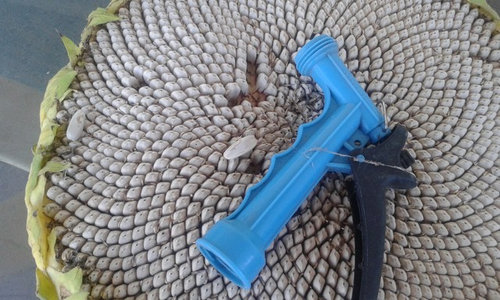
Look at this beautiful Mammoth Sunflower. Why didn't the birds want these seeds? The shells are empty. Beautiful large shells...but nothing to eat on the inside. My daughter waited all summer to roast these and eat them! This is what GMO can mean. How sad.


Testing · More Info

Comments (5)

  • 10 years ago
    last modified: 10 years ago

    Other people have had this problem occur, discussions can be found on the web. Likely a pollination issue. Have you seen any pollinating insects buzzing around the flowers this summer? How many seeds did you check? I believe that throughout the summer the sunflowers bloom and seeds develop from the outer perimeter in towards the center, so check several rows of seeds in a line going from the outer perimeter through to the center.

    "This is what GMO can mean." - In relation to what? Is the variety of sunflower you grew a GMO variety? If yes, may I ask why are you growing a GMO variety and why you think the GMO part is what caused the failure? Or are you thinking that GMO bt field corn being grown around you is killing off the pollinators in your area? This is a possibility. Aerial spraying of insecticides on nearby crops is another possibility. For that matter, you may already have a low population of pollinators due to years of bt corn fields and field spraying in your area (my situation). Anyway, no pollinators, no seed. If there are viable seeds in the outer areas of the sunflower heads but not in the inner areas, I wonder how that relates on a timeline relative to when bt corn in your area tassled and/or when field spraying started. Plants tell their stories, we just need to learn how to understand their language.

    Lots of ways that GMO stuff is bad, but I believe a person should research and disprove all other likely possibilities before simply putting the blame on GMOs. Find the problem and resolve it if it is within your means to do so, do not just settle on placing blame as it doesn't resolve anything.

    I feel bad for your daughter, but tell her even long-time gardeners like me have disappointments and failures, it is part of the gardening experience and should make a person more determined than ever to succeed. She should not give up, she should try again next year but observe the sunflowers more closely while in bloom to try to solve the mystery if the problem happens again.

    (post edited 09.21 for clarification)

  • 10 years ago

    I hate GMOs and have them all around me but I still have tons of pollinators. There are sometimes 3 dozen bees on one plant. Did you have bees on the sunflowers?

  • 10 years ago
    last modified: 10 years ago

    The double whammy of fields of bt corn along with aerial spraying of insecticides has decimated pollinating insects around here, so much that I have noticed a marked decrease in yields of insect-pollinated fruits and veggies here in the last 10-15 years (for example, no decent harvest of apples, pears, tree cherries, plums, apricots in approximately a decade). I have been seriously thinking of getting a couple of honey bee hives, but the major problem with that idea is the likelihood that they will get killed off every year for the very same reasons, forcing me to acquire new hives. Having to do this would be a major hassle and would be cost prohibitive.

    I may do it once anyway as an experiment. Who knows, a significant improvement in production might justify the several hundred bucks spent each year to purchase new hives. I would sure like to somehow pass that cost on to the area farmers for them killing off all my good bugs.

  • 10 years ago

    soilent_green Thank you for the information. I admit I assumed that with no "meat" in the seeds that it was a GMO designed so that if the seeds were replanted, the results would be no meat forcing the consumer to buy new seeds.

    All the other sunflowers in the backyard were pollinated and I've had many pollinators. We just had one Mammoth Sunflower make it to maturity. The Soraya sunflowers matured nicely. However, the adjacent pepper plants, cucumbers and melons have had very few. Maybe the Soraya was just too enticing. Can the Soraya look like chocolate cake and everything else look more like liver and onions to the pollinators?

    Yes, we have so much aerial spraying. There were less pollinators overall this year. I especially noticed when the monarda bloomed. Usually it's covered in insects, but this year just a sprinkling.

    I will check the outer layers of seeds when I get home. I'll keep my fingers crossed.

    Heidi

  • 10 years ago
    last modified: 10 years ago

    "We just had one Mammoth Sunflower make it to maturity." - That was likely the problem. The sunflower wiki states, "But for a sunflower to produce seeds, it needs pollen from a different sunflower."

    A new question then arises regarding why the Soraya sunflowers did not cross pollinate with that mammoth sunflower (this would have given you viable seeds but you would have lost your pure mammoth strain had you replanted any of those seeds). Both varieties are non-hybrid, non-GMO open pollinated varieties of helianthus annuus so cross pollination should have occurred. There could have been some kind of insect pollinator problem, but I would discount this if the Sorayas were successfully pollinated and have seeds.

    I suspect the likely issue was that the timing was off in that the two varieties bloomed at different times which eliminated the chance for cross pollination to occur (this happens all the time with my intentional corn cross-pollinating experiments). This could have happened because the varieties have different days to maturity (DTM) or it could have happened because the seeds of the two varieties were planted by you at different times, or more likely a combination of both. Staggered planting dates can help "time" two varieties for cross pollinating with different DTM, or could make the timing even worse if unintentional (or in your case was never a necessary consideration). Lastly, it could have been a distance issue if the two varieties were planted far apart from each other but this is doubtful because they would have had to have been at least a half mile apart to have minimized interaction, according to the isolation distances table.

    Needless to say it would have been better to have had more than one mammoth plant succeed in blooming. Ultimately this was the main problem that you had and happily is the easiest to resolve next season. Always overplant and thin...

    Helpful links follow for your daughter to read and learn about sunflowers (assuming she is old enough). Tell her that reading and learning is a very important way that we can all become better gardeners. :-)

    http://creationwiki.org/Sunflower

    http://ouroneacrefarm.com/guide-to-growing-sunflowers/

    http://www.proflowers.com/blog/how-do-sunflowers-reproduce

    Happy Gardening!

    -Tom

Sponsored
Peabody Landscape Group
Average rating: 3.5 out of 5 stars8 Reviews
Columbus' Reliable Landscape Design & Contracting