Software
Houzz Logo Print
sharon29841

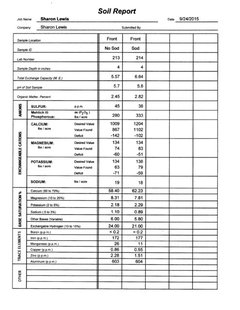
Logan Labs Soil test - 2015

11 years ago

My lawn didn't seem to do very good this summer. Started out good then went down hill from there. Here is 2015 soil test and 2014 soil test. I followed Morphs plan, but I guess with my terrible soil it will take years to get results. Thank-you for any help.

Comments (13)

  • 11 years ago

    Sharon, I don't see the 2015 test. Could you try posting it again?

  • 11 years ago

    It didn't upload. I'll try again

  • 11 years ago

  • 11 years ago
    last modified: 11 years ago


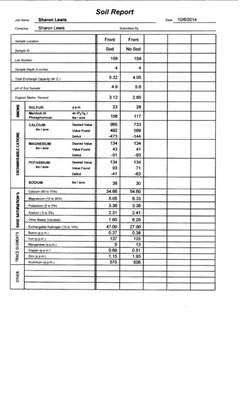
    This is 2014 soil test.

  • 11 years ago

    Gotcha! That's a nice change in one year, but there's still some work to do.

    Your soil has gone from "WTF" to "not that bad," however, so severe grass problems as caused by soil chemistry really aren't in the cards any longer. We'll want to know more about what went wrong this summer to diagnose it for you!

    Both plots are now more than close enough to fold together into a single test.

    Exchange Capacity 5.6/6.6: Sandy with some silt, so the soil will tend to drift pretty fast and will need soil tests every year or two.

    pH 5.7/5.8: While still a bit low, these are moving into proper range rather nicely. We'll nudge this along under calcium, magnesium, and potassium below.

    OM 2.4%/2.8%: Sampling differences probably account for the change over the year, plus some of what I used last year did burn off a little organic matter. Both are in the Fair range. Always mulch mow, mow all your fall leaves, and consider importing leaves that are on the street if you wish.

    Sulfur 45/38: Both reasonable, with somewhat less margin than last year. That's normal post a major chemistry adjustment and it'll drift back down over time.

    Phosphorus 280/333: It looks like I overshot a bit, although these numbers will drop as the phosphorus moves deeper into the soil profile. These are perfect levels for a lawn, however, and no phosphorus is required or desired, but you don't have to avoid phosphorus either.

    Calcium 58.4%/62.2%: Approaching optimal range. In a lower capacity soil, I'd like to push these to the top of the range. We use Mag-I-Cal, Encap, or Pennington fast lime as the calcium source. Others will be too slow or require too much material in this instance. Recommendations below.

    Magnesium 8.3%/7.8%: Much rosier than last year! This should be nudged along again, and this is probably the last nudge on it. We use Epsom salt for this, available at your local drug store in the bath or First Aid sections. Recommendations below.

    Potassium 2.2%/2.3%: This drifted down a bit from last year and I'd like to kick it back up considerably. We use potassium sulfate, available at most landscape or garden shops (or they'll order it for you). You can get it online as well.

    Minor Elements: I'm still staring at that copper, but it's just barely in tolerable range and we have a lot of other things to be doing this year again. Boron is deficient and mentioned below. Iron's improved nicely.

    Boron <0.2: Deficient. We use Milorganite as a carrier and 20 Mule Team Borax as the boron source. You can purchase 20 Mules at the grocery store in the laundry section. In a wheelbarrow or the like, dump the Milo. Spraying very, very lightly with water (I use a spray bottle like the kind people use to damp their clothes when they iron) will help the boron stick. Add the recommended amount of 20 Mule Team Borax and stir, spraying occasionally to get the stuff to stick to the Milo. Then apply over the recommended area. So if going for bag rate Milorganite (1 bag per 2,500 square feet), you'd add 12.5 tablespoons of 20 Mule Team Borax.

    Iron 175-ish: This has risen by 50 PPM and is in the range that it'll produce nice color on a generic lawn. You can certainly continue with Milorganite use to keep improving the color if you like, iron isn't toxic until truly ridiculous levels.

    Recommendations:

    October 1: Apply 4 pounds per thousand square feet of Mag-I-Cal, Encap, or Pennington Fast Lime to both areas.

    October 15: Apply 2 pounds per thousand square feet of Epsom salt in both areas. Apply 5 tablespoons (not a misprint) of 20 Mule Team Borax per thousand square feet.

    November 1: Apply 2 pounds per thousand square feet of potassium sulfate.

    April 1, 2016: Apply 5 pounds per thousand square feet of Mag-I-Cal, Encap, or Pennington Fast Lime to the "Front No Sod" area. Apply 3 pounds per thousand square feet of Mag-I-Cal, Encap, or Pennington Fast Lime to the "Front Sod" area.

    April 15: Apply 2 pounds per thousand square feet of potassium sulfate.


    sharon29841 thanked User
  • 11 years ago

    I think the weather was a big part of my problems this summer. It was so hot and dry here in South Carolina and I had trouble getting my watering right .

    Thanks for the quick response. Last year I did skip 1 potassium application cause I got the wrong kind. It was like a powder and it didn't spread very well. But over all it is getting better thanks to you morpheuspa!!

  • 11 years ago

    Thanks!

    Yeah, this summer was a kicker all around. The south baked. The northeast drowned. Problems showed up that I rarely see on people's lawns!

    The grass should recover considerably as fall moves along a bit and, hopefully, rainfall resumes. If there are strange patches or weird things going on, though, definitely give us photos.

  • 11 years ago

    Ok I feel better now since I'm not the only one!

  • 11 years ago

    What does copper do?

  • 11 years ago

    http://www.gardeningknowhow.com/garden-how-to/soil-fertilizers/copper-for-the-garden.htm

    That's a bit oversimplified, but good for an overview. What they don't directly mention is that copper is involved in the photosynthetic process, so having too little means the plants are less efficient at producing food.

    On Logan tests, the target is actually around 1 to 2 PPM.

    0.5-ish isn't terrible, but a boost wouldn't be a bad idea once we get the other issues out of the way. At this point, I'm hesitant to send it in there to fight it out with the rest of the resources.


    sharon29841 thanked User
  • 11 years ago

    Thanks for the information . That explains it good .

  • 11 years ago

    Morpheuspa, Reading this forum , I realize now I didn't get a sample of my soil the right way. I dug down 4 inches and took a sample from there. I didn't take a slice of soil. Do you think I should re- test?

    Also , you were right about my lawn recovering. We are getting lots of rain now . My lawn looks amazing now thanks to you Morpheuspa