Software
Houzz Logo Print
owlnsr

Rainfall effects on fertilizer

11 years ago
last modified: 11 years ago
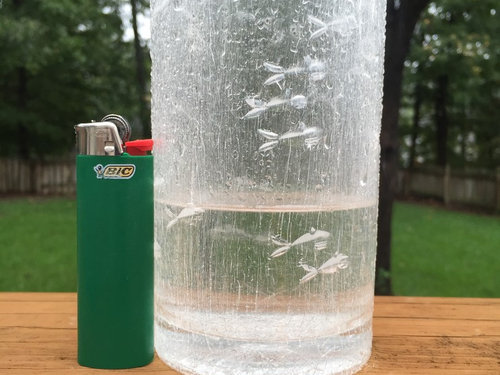
It's been very dry here in Central Virginia.

i overseeded Titan RX into my backyard on September 12 to thicken up the thinning KY31. I applied a cheap starter fertilizer on the same day as overseeding: Ace Hardware's store brand. (See this link for the bag label): http://www.kellysolutions.com/erenewals/documentsubmit/KellyData/ND/Fertilizer/Product%20Label/ACE_GREEN_TURF_STARTER_FERT_20_27_5_5_11_2009_2_35_34_PM.pdf

As I mentioned, it's been a dry late summer/early fall here. I have a sprinkler timer that has watered multiple times per day and I've had fantastic germination.

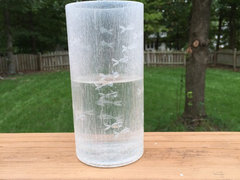
This weekend, we've had the first rain since I put down the seed. Over the past few days, we have received a steady, slow drizzle/light rain. I don't have a rain meter so I placed a drinking cup outside.

I'm not sure if I should be just placing an inch ruler next to this or if the amount of rainfall. I placed a standard lighter next to the cup to scale the image.

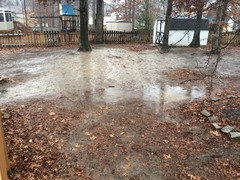
it is still continuing to rain, and the forecast calls for rain everyday next week. The lawn is incredible soggy right now, from weeks of sprinklers + rainfall this weekend.

Anyway, all of that for a question:

If this rainfall continues at the same rate --- or increases --- I'm assuming that the fertilizer I applied is probably going to be pulled so far down into the soil that neither the established nor new grass will be able to utilize it.

Would it be a safe bet to apply a round of fertilizer after the rain clears up and the ground hardens back up?

Comments (24)

  • 11 years ago

    Did you get a soil test? This is the only way to truly know what your lacking.

    That said.. Most fertilizers have a mixture of slow and quicker release components to them. You should be good until mid October. I would do a soil test today. Send it to Logan labs so morph can assess it.

  • 11 years ago

    While I did go into the reasoning below, in your case, the fertilizer has been down for 15 days. The grass has absorbed the nitrogen, and there's no danger of leaching because very little remains. The phosphorus has bound up and is safe from leaching.

    Phosphorus doesn't leach. It's very strongly soil binding and easily forms non-soluble compounds. It can erode off, but it won't leach easily, and 2" of rain isn't going to be significant.

    Under just-fertilized conditions, it actually depends on the nitrogen source.

    Urea leaches very easily until it hydrolyzes (reacts with water), which takes 2 to 4 days after initial moisture touches it. Post that, it's ammonium carbonate which is extremely resistant to leaching, and post that it starts to flip through nitrate and nitrate forms, which leach. Urea is prone to atmospheric losses if left on the soil surface in warm or alkaline conditions as it flips to the ammonium form, so watering it in within a few days with at least a quarter inch of water is recommended.

    Any ammonium source will go the same way urea does, except that it doesn't require the hydrolysis and is relatively resistant to leaching immediately (but relatively prone to loss to the atmosphere in warm or alkaline conditions).

    Nitrate (common and leachable) and nitrite (rare and leachable) sources will both get lost. Neither suffer significantly from atmospheric loss.

    When placed with starter fertilizer, which generally uses a monoammonium phosphate source for the phosphorus (because it's very cheap, very effective, and very harmless), urea and ammonium losses to the atmosphere are significantly reduced. Ammonia is lost less easily as the pH of the soil surface drops, and MAP (monoammonium phosphate) can temporarily reduce the soil surface to a pH of 5 or below.

    End of science lesson. :-)

  • 11 years ago

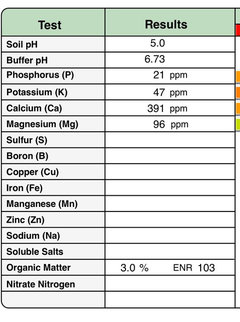
    I had a soil test done last year when i did a total renovation of the backyard in August. It was our first fall in the new home.


    I'm on my iPhone, so the best thing I can do is open the PDF of the soil test, take a screenshot, and upload it here.

    this was from last year, 8/2014:


    Between that soil test and today:

    Fall 2014:

    Rototilled the backyard twice (once to kill the weeds, fallow a little over a week, the second time to kill the new sprouts)

    Spread the first application of lime along with Scotts starter fertilizer and the Ky31 seed.

    about 6-7 weeks later, I followed it with the Scott's fall weed and feed. For the final and then a Scott's Winterguard.

    Spring 2015:

    I applied the second half of the recommended lime.

    I did an application of Scott's turf builder + Halts Crabgrass Control in the middle/late spring.


    summer 2015:

    During the summer, I applied 1 bag of Milorganite in June, July, August.


    Early fall 2015:

    spread Titan RX and Ace Starter Fertilizer


  • 11 years ago


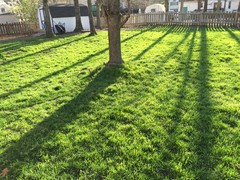
    This was the backyard in March.


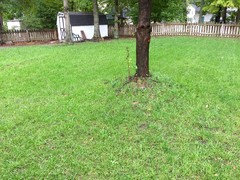
    Here is what it looks like today; not as thick because of the scalping to overseed. Hard to see all the pretty Titsn RX coming in but it's there and I can't wait for maturity!


  • 11 years ago

    It'd be wise to get that redone through Logan, which will give you a lot more information than was included on that test. Plus you'll want to make sure that the pH has come up to something reasonable with a good calcium, magnesium, and potassium balance.

    Overall, the overseeding plus old lawn look good, but I'd love to see what your iron numbers look like. Color seems a bit pale for a late-September lawn with a good fescue--which isn't a problem by any stretch, just an aesthetic thing.

  • 11 years ago

    It may have been the camera lens on my iPhone. It looks a lot darker in person.

    I've also been spotting quite a few grubs cruising the surface of the lawn (as we discussed in my other thread).

    I have been been applying some of iron via Milorganite. However, I agree that a retest is due.

    When I applied lime, I did use dolomitic lime. I am wondering if that might have something to do with the coloring? That does have magnesium in it, right? My test showed what seems like a pretty high amount of that.


  • 11 years ago

    >>I've also been spotting quite a few grubs cruising the surface of the lawn (as we discussed in my other thread).

    I'd definitely try to get a picture, because that's really rare. I also suspect some sort of slug or mollusk.

    In small numbers, slugs aren't a problem. In medium to enormous numbers, they're easy to get rid of.

    >>When I applied lime, I did use dolomitic lime. I am wondering if that might have something to do with the coloring? That does have magnesium in it, right? My test showed what seems like a pretty high amount of that.

    Yes, that can alter coloration as dolomitic limestone tends to be rather slow and hesitant to perk down through the soil, giving you a zone where iron isn't very available.

    Your magnesium levels look kind of average if I'm estimating your EC off the pH/buffer pH correctly (a sand-silt soil). Possibly on the low side, but average-ish. So adding it from dolomitic limestone (which features quite a lot of magnesium by weight) may have been a slight mistake.

    I'd definitely get that soil test, although at this point it can wait for spring. We're getting too late in the year to correct a soil very much.

  • 11 years ago

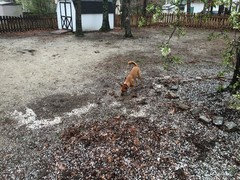
    Will do a soil test for sure. We've come a long way since what it was like when we moved in.

  • 11 years ago


  • 11 years ago

    Dang! That's a transformation!

  • 11 years ago

    +1 DarkTower. From...that...you now have a pretty nice lawn already!

  • 11 years ago

    Update:

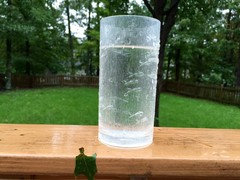
    I'm not sure how much water evaporation has occurred. Here is where the cup is sitting now.

    And now here is a hurricane on the way to Richmond. Hearing reports of possibly 10 inches of rain on the way.

    We are supposed to get 4-5 inches of rain before the hurricane rain even reaches us on Sunday. I hear we could get another 4-5 inches from that, if not more. this is on top of the 4-5 inches we've had in the past few days

    Morph, I know you mentioned that the P and K from the starter fertilizer was bound up in the soil, but would the sheer volume of this rainfall in such a short period of time change that?


  • 11 years ago

    >>Morph, I know you mentioned that the P and K from the starter fertilizer was bound up in the soil, but would the sheer volume of this rainfall in such a short period of time change that?

    Not unless it erodes. P grabs on like a whole bunch of molecular pit bulls. K isn't quite that aggressive, but that four inches there barely moved it.

    Nitrogen, of course, is long gone and iron is expelled or firmly bound into rust. But neither of those is critical and, with Joaquin on the way, I don't recommend adding any N or Fe right now. You'll just lose it again.

    Plus we have the remains of Ida re-strengthening in the Atlantic and following behind Joaquin. Hopefully she'll go somewhere else.

    owlnsr thanked User
  • 11 years ago

    Yeah I thought about putting some nitrogen down today --- the only dry day we have had. But I don't want to risk (a) runoff, (b) excessive growth during all this mess. Temps have still be in the 80s and this constant moisture has probably created a perfect storm for lawn fungus and/or disease. (Probably doesn't help that I had the lawn so moist for about 3 weeks prior to this during over seeding)

    Unfortunately, it's been a while since I've cut the lawn. We had zero rain today. The lawn was "dry" . That is, most of the blades were dry but the ground was damp and not very firm.. Kind of felt like I was between a rock and a hard place: cut on the highest setting (and risk opening older plants to disease) or don't do anything (and risk older plants smothering thr new plants).

    I opted for the later and set the mower on the highest setting; a lot of young grass was damaged from the mower wheels but that's better to me than losing even more to being smothered. Those tall fescue blades were just too thick, fat and long... Some 6-7 inches, some of which were just laying straight down in the soil (trapping some young stuff in between!). If I went another week for this incoming cluster of rain to clear, I might as well have kissed my lawn work goodbye,

  • 11 years ago

    That looks a million times better than when you moved in!

    owlnsr thanked reeljake
  • 11 years ago

    Thanks, reeljake!


    so, I bought a ph test today just to see how much the level has changed since last year's test.


    lets assume it's low; I have out a lot of organic stuff out (coffee grinds mostly), mulch leaves, mulch grass clippings. Had 2 trees removed during the summer so lots of sawdust (I tried to get the larger wood chips outta there).


    The purpose of lime is essentially to raise the ph level toward one that favors grass. This is primarily done through calcium, yes? If so, would I be better off just using something like Jonathan Green's Mag-I-Cal? That applies straight calcium which accordingly goes to work faster.... I don't mind the extra expense if that were to be the only main reason to use agricultural like instead.

  • 11 years ago

    Home pH (and any other chemistry) tests are notoriously unreliable. You tend to get the pH of the test water at worst, and a mingling of the soil pH and water pH at best. In either case, the actual pH is unknown.

    It also doesn't give you any indication of how to fix it. Calcium, magnesium potassium, sodium, sulfur, and aluminum all influence pH (Ca, Mg, and K being the most common), and a flat number doesn't tell you which one or how to fix it.

    That's why I strongly recommend the Logan Labs or UMass soil test. They'll provide ion amounts and saturation percentages which will clearly indicate how to correct the soil properly.

  • 11 years ago
    last modified: 11 years ago

    Got it. I guess I'm interested in knowing if applying straight calcium is a more direct route to getting the same effect as lime?

    Oh oh and here's the cup today:

  • 11 years ago

    Even the fish on the glass have had enough. :-)

    I'm not a hundred percent clear on the question. Straight calcium isn't readily available, it'd react immediately with water from the air to form calcium hydroxide (and hydrogen gas). Or burst into flame at any spark and flash to calcium oxide and calcium nitride. Neither reaction is safe.

  • 11 years ago

    Er, wait a second, you might mean the Mag-I-Cal. That's calcium carbonate--also a component in cheaper limes, although those tend to have a lot of calcium oxide and magnesium compounds as well.

    Technically, application of calcium carbonate is applying lime. The stuff's more powerful and reacts faster than calcium oxide. But calcitic limestone (calcite) is, optimally, pure calcium carbonate.

    So lime, Mag-I-Cal, Encap, these all mean the same thing. Cheaper limes tend to be dolomitic, however, which contains a high percentage of magnesium, and that aforementioned calcium oxide, which is slow. Sieve ratings also vary widely, whereas the recommended limes I talk about all tend to pass 200 mesh easily, so they react faster--no form of calcium is all that soluble in water, so a large surface area to volume ratio is necessary.

  • 11 years ago
    last modified: 11 years ago

    The Jonathan Green has a product called Mag-i-Cal which they market as a "Calcium Fertilizer" and they claim that one bag equals 10 bags of lime.

    Im trying to determine if and when I need to raise the ph, if lime is only used because of its calcium. And if not, what type of benefit would using lime provide that the calcium in Mag-I-Cal wouldn't? / what reasons would i have for using lime besides the calcium?

  • 11 years ago
    last modified: 11 years ago

    Calcium carbonate is, chemically, a double hitter. The calcium dislodges (acidic) hydrogen in the cation sites, allowing it to be flushed out of the soil if it can be. Which, if not, the carbonate reacts with it to form carbolic acid. That's unstable and breaks down into carbon dioxide (acidic, but boils out over time) and water (neutral).

    Calcium oxide just delivers the calcium, and only very slowly as biologically processed or weathered in.

    But Mag-I-Cal actually is lime, it's just calcitic lime. So really, I find that statement on the bag to be rather deceptive on its face if the user takes it to mean that the stuff isn't lime. I get what they mean, though, and if you look at the amounts I recommend, 18 pounds per thousand square feet over a year is a real rarity. 9 is more likely. 4-7 is common. The stuff really is pretty powerful; I'd need to recommend five to ten times as much of regular limestone.

    On very rare occasion I'll recommend a lesser limestone. In that case, it's only to limit pH and calcium resource drift on a soil I know is going to do it. So a slow tap source of calcium can be useful there, and it's something I do in my gardens.

    owlnsr thanked User
  • 11 years ago

    Carbolic acid is what plants create by exuding carbon dioxide into moist soil. Carbolic acid is very weak (you drink it in carbonated water), but it is strong enough to make nutrients and micronutrients available to the grass.

Sponsored
Innovative & Creative Custom Closet Designer Servicing Franklin County