Software
Houzz Logo Print
bg_nelson

Quick Fire Hydrangea won't grow

11 years ago

I planted a Quick fire Hydrangea 2 summers ago. It is on the north west side of the house and gets dappled sun in the afternoon. The problem I am having is this plant has not grown at all and this summer I only got two blooms. If it was growing slowly I wouldn't be concerned, but it has not grown at all. Still looks like the same size as when I bought it. I thought this plant would get big! What am I doing wrong? Is it in the wrong location? Could it be something with the root ball? Should I move it? Can I move it this late (early October, zone 4)? Any advice would be much appreciated.

Comments (14)

  • 11 years ago
    last modified: 11 years ago

    Here are some the basics for hydrangeas. Compare them to your situation and see if any of them could apply...

    * first off, this has happened to many persons before. Some shrubs take off after a few years and others almost immediately. My hydrangea with this issue was a mophead called Glowing Embers. In some of these very few cases of slow growth, it takes the plant several years (3 or more) to grow a good root system and a that's what will make it take off.

    * location: make sure that the plant gets a few hours of sun and is not planted in deep shade; deep shade = few blooms. Bright full-time shade is fine. Morning sun and afternoon shade, or dappled sun, are fine. Afternoon sun in many northern gardens like your Z4 is fine because the summer sun is not as strong there as it is here. But afternoon sun conditions should be monitored so they do not dry out the soil or so they do not cause the leaves to suffer. Also, make sure that water does not collect and-or drain poorly in this location.

    * planting: make sure that the plant is not planted below the soil line or that it is planted with roots circling around the pot's sides (these stunt growth and kill the shrub eventually)

    * maintain 3-4" of mulch at all time so you do not have to water often and to protect the roots in the winter.

    * water: maintain the soil evenly moist. Periods of dry-wet-dry can kill flower buds, leaves, roots and basically stunt growth. Once the plant goes dormant, continue watering at a reduced level (say once a week or once every 2 weeks) until the soil freezes.

    * apply fertilizer in moderate quantities like 1/2 to 1 cup of organic compost, composted manure or cottonseed meal in Spring and then some liquid seaweed, liquid fish or coffee grounds during the rest of the growing season. But stop fertilizing at the end of June so the plant will go dormant on schedule.

    A soil test now and-or every 5-10 years can also be a good way to check if the levels of nitrogen, phosphorus and potassium are good in your soil. Too much nitrogen (ie, too much fertilizer) can result in lush green leaves and no blooms. But too much N might also produce a lot of growth (which is not what you are seeing). Too little potassium or phosphorus can produce little growth and a soil test can tell you if that is the case.

    QF is a wonderful, hardy and strong paniculata so, it is surprising to me that yours is not growing leaps and bounds. But, I can also see a scenario where its roots are pruned to prepare for shipping and the roots are cut too much so, I would wait at least 3 years before replacing it (maybe another QF from another source just to make sure).

    There is 'usually' no need to concern yourself with the root ball. Three exceptions that I can think of... When planting, circling roots that are not pruned may continue circling and growing and stealing all the minerals from the rootball, eventually causing stunted growth and even death. When transplanting, you want to make sure that it does not break and spill allover creation. And when watering, you do not want the root ball to dry out as it will begin to repeal water instead of absorb it. You have not mentioned any watering or leaf drying issues so I do not think the root ball is causing a problem.

    So far, I do not see a reason to move it. And moving it without having "a feel" for what is the problem may not help so, see if any of these things makes you feel like one of them is causing the problem and which ones you can rule out

  • 11 years ago
    last modified: 11 years ago

    In zone 4, H. paniculatas are fine in full sun, and I think yours are probably in too much shade. I don't water mine most summers including this season which was drier than usual, but in general we get good rainfall and I mulch my gardens well so they don't dry out, though they are well-drained. I grow Pinky Winky in a spot that gets sun from about 2 hours after sunrise to less than an hour before sunset and it has grown to 8' tall x 12' wide. My QuickFire is in the same bed, though it gets about an hour of midday sun. It is about 6' tall and wide. Both were planted in the fall of 2009 as tiny plants and have grown vigorously every year, though by now they are starting to slow down. While as Luis says, many plants take a few years to settle in and grow, that hasn't been my experience with my two H. paniculatas. I would give yours more sun, a good organic mulch, and enough water that the soil isn't soggy, but also doesn't dry out. I agree with Luis that you may need to check soil nutrition as well, though it may be fine.

  • 11 years ago

    I am disappointed with my quick fire. I just planted it this year, and it did not bloom. It is advertised to bloom every year. I have a limelight that I planted at the same time and it is gorgeous.

  • 11 years ago

    So gorgeous! I have 6 quick fires - 4 from fall 2014 & 2 from late summer 2015. All were bargains & very dried out. The first 4 looked good this yr but not many blooms. Don't think mine are getting as much light as yours. U have part sun or more like full sun?

  • 11 years ago
    last modified: 11 years ago

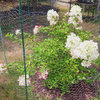
    nicholsworth55, my Quickfire is in almost full sun, though it gets about an hour of dappled shade midday (you can see the trunk of the wild cherry that provides the shade right in the middle behind QF.) This one was planted as a barely rooted twig in fall of 2009 and got to this size in 3 or 4 years. It's one of my favorite plants.

  • 11 years ago
    last modified: 10 years ago

    I can see why! Would be a favorite of whoever had it. Mine are new but doing well. My biggest problem is shade. Even when I put something in a spot I think is sunny I'm kidding myself. I would be happy with 1/3 of your blooms and size.

  • 11 years ago

    NHBabs, your plants look amazing. What is the purple flower you have growing with the QF hydrangea?

  • 11 years ago

    The purple flower is Little Bas Clematis, a plant that is hard pruned over the winter (so I don't have to look at a dead vine in the hydrangea.) I loved the combination, but the voles ate Little Bas, so I am replanting with vole protection for the clematis. I like planting clematis that aren't too densely leafed where they can grow into shrubs without providing too much shading.

  • 10 years ago

    here is my quickfire it was in bad shape when i bought it at year end clearance 5 yes ago this pic is 3 yrs ago


  • 5 years ago

    I bought my Quick fire and planted in full sun with mulch. Watered every day and looks like it's dying leaves falling off. It had tiny little blooms when I got it. I'm not sure it's going to make it. I live in MN and the week after i planted was 90 degrees each day! Any suggestions? Will it come back next spring. Was in a 5 gallon pot when it was planted.

  • 5 years ago
    last modified: 5 years ago

    They tend to shed some bottom foliage in the hot summer months, especially if bought now and planted in the hot summer months. Their root system is not that big so, monitor the soil by inserting a finger into the soil and watering -the soil, never the leaves so they do not get leaf spots- if the soil feels dry or almost dry. When watering, use enough water to get the soil moist at a depth of 8".

    It is quite rare for it to have small blooms as it normally blooms very early in the summer months so enjoy those few blooms. If they dry out and turn brown then so be it. Do not panic and let it simply use the nutrients to develop a larger root system instead.

    Make sure that the plant has 2-4" of organic mulch at all times, which will conserve soil moisture and provide future nutrients as the mulch decomposes. I would not fertilize it anymore and instead, wait until after all danger of late frosts has passed in spring 2022 to feed it again.

    All paniculatas are deciduous so it will eventually lose foliage in the fall 2021 but it will leaf out back in the spring 2022.

    Since the plant is not yet accustomed to getting this much direct hot sunlight (it was probably in part shade the plant nursery), consider providing some temporary shade in the afternoon and-or evening.

  • 5 years ago
    last modified: 5 years ago

    Does it get a.m. sun? You didn't say. Much to my surprise, I am finding hydrangeas like more sun than is recommended for color and growth.

  • 5 years ago
    last modified: 5 years ago

    @colliegirl1

    You don’t say where you are. In my central NH garden my panicled hydrangeas like Quickfire, Pinky Winky, and White Diamond get all day sun (from when the sun hits the garden until it goes down behind the trees along the river bank several hundred feet to the west) and they thrive, even without added water once established. In Luis’s part of TX, they need supplemental water and afternoon shade to do well.

    How much sun hydrangeas like depends on both location and species. Panicled hydrangeas like the most sun, smooth hydrangeas such as annabelle, incrediball, and invincibelle spirit like afternoon shade in my area, and both bigleaf and mountain hydrangeas (the only ones that are blue but also come in pink, white and green) and are the most sensitive to too much sun, especially in hot climates.

Sponsored
Wannemacher Interiors
Average rating: 5 out of 5 stars26 Reviews
Customized Award-Winning Interior Design Solutions in Franklin Cnty OH