Software
Houzz Logo Print
jungleexplorer

Can you prune cherry tomatoes?

This is my first years to grow tomatoes. I grew three different kinds, one of which was a cherry tomato. That thing grows like a vine! I planted it in in April and it is all over the place now. It only produces tomatoes out at the tip of each branch. For future reference I was wondering if it was possible to prune back a cherry tomato plant?

Comments (18)

  • 10 years ago
    last modified: 10 years ago

    Prune back? Where do you live?

    If you live in a climate where winter will kill the vines, unless your goal is to restrict the numbers of fruit, I wouldn't 'prune back' tomatoes.

    If your goal is simply to manage the growth of the vines, then you can do maintenance pruning. As the plant is growing, you decide which branches you prefer to keep. These branches will bear fruit. Conversely, you clip off the branches that you don't wish to produce fruit.

    Once a branch, or any part of the vine has set trusses (the fruiting limb of the tomato vine) and fruit, 'pruning it back' only limits the plant from producing.

    So, yes, you can prune, but if you live in a climate where the plant will not survive the winter, don't cut branches 'back' unless you want to lose the potential fruit. Instead, selectively prune for preferential branches as the plant grows.


    You can 'top' a branch at any time, but in the climates I outlined above, there is not time for the plant to produce a new truss from an old branch. New trusses will only come from future branch growth. Topping will usually encourage more vigorous secondary branching.

  • 10 years ago

    So what your saying is, if the plant will survive the winter, then you can prune it back and it will sprout out new branches from the old ones, right? I do not know if it will survive the winter or not. It is in a greenhouse and if this is a mild winter, then it might survive. I have a really long growing season here, and I was thinking more along the lines of pruning it midway through summer when it is too hot for it to produce and maybe it might come back in the fall. This plant grew branches 15 feet long in all directions. There was no way to contain it.

  • 10 years ago

    Unfortunately, I have not grown tomatoes in climates where the plant has time to live as a perennial. I clarified the distinction on seasonal norms because you didn't say where you lived or would be growing. If I had known the circumstances that you just explained, because I haven't tried that method, I wouldn't have commented. Hopefully, someone who grows in climates where tomatoes do live more than a season will chime in and help you with your question. Good luck. :-)


  • 10 years ago

    As long as you don't prune it back to a nub and you have enough warm weather left for it to get some good new growth before it's too cool to grow vigorously, it should be fine (assuming everything else you're assuming about your greenhouse/mild winter). At least from my experience though (which is different from yours in that it's outdoors and in a very mild winter climate), I have better production planting new tomatoes at about the time you'd normally plan on pruning the older ones than trying to coax the older ones along. It might be a good experiment for you to try next year to see which works best for you?

  • 10 years ago

    We often get frost-free winters here and it's tempting to just cut toms back and let them regrow, but the butchery seems to set the plant back into a months-long coma and it never (NEVER) recovers well.

    Here, that is. It's very dry and the sun is very strong here, and a year-long growing season is not necessarily paradise. I don't try to directly save old tomato plants any more.

    Clone 'em; layering is easy. You knock some of those long vines down to the ground and dump dirt on them, leaving some greenery exposed, and in a month you have hairy new roots growing along the buried stem. You can even pull them up to look if you dare. Sever this from the momma plant, prune severely to get the best growing tip, and you have your clone, EZ-PZ. The shock/setback you get from this is much milder than trying to renovate a plant that's gone old, bald and woody.

    Here.

  • 10 years ago

    Thanks all for the great info. I was just curious and you answered my question wonderfully. I have some new tomatoes in the ground that I hope can do something before it gets too cold here. I usually don't see freezing temps until late November here. One is a 4th of July, so I will see if the 45 day claim is true. I also planted a Great White, Arkansas Traveler, Sun Gold and Pink Ponderosa. They are all abut 24" tall now. Temps are mild outside (upper 70s) but hot in my GH since I shut the cooling system down. I am interested to see just what the temperature difference will be once it gets down into the 40s and 50s, and also if it will freeze over night if temps drop below 32 degrees. It's a learning year for me to be sure.

  • 10 years ago

    You are growing all indeterminate varieties aka vining tomatoes. What you describe in terms of growth and production patterns is normal for them. So if you want to keep them contained, if you don't want 10-12 feet long vines for some reason then grow determinate varieties. Better yet grow varieties bred for greenhouse growing.

    Dave

  • 10 years ago

    Dave, thanks for the advice. This is my first year growing tomatoes and using a GH. Lot's of learning to do. I have heard these terms, "determinate and indeterminate" before and I am not positive of their meaning. I thought they meant that one plant will produce all it's fruit at one time (Determinate) and the other will produce fruit little by little throughout a season (Indeterminate), or something like that. If I understand what you are saying correctly, you are saying that determinate means "Bush style tomato" and indeterminate means "Vine style tomato". Am I understanding you correctly?

    At any rate; the varieties I chose were based on my research for tomato varieties that were recommended for my region, with the exception of the 4th of July and the Sun Gold, which I bought because for my fall garden because of the 45 day to production claim (4th of July) and the wonderful taste quality claims (Sun Gold).

    I actually have many varieties of tomato seeds that I intended to try. My hope is to find one or two that do exceptionally well in my region and eventually just grow them. Here is a list of my tomatoes seeds. I would like to stick with heirloom varieties, but if Hybrids is my only choice, that's fine as long as I can collect and grow seed and they will grow true. No GMOs. Which ones do you recommend and why?


    Heirloom

    1. Black Krim
    2. Yellow Pear
    3. Brandywine Red
    4. Cherokee Purple
    5. Roma
    6. Marglobe
    7. Italian Market Wonder
    8. Great White
    9. Black Cherry Rutgur’s
    10. Pink Ponderosa
    11. San Marzano
    12. Green Zebra
    13. Delicious
    14. German Johnson
    15. Marglobe Supreme
    16. Bradley
    17. Beefsteak
    18. Arkansas Traveler
    19. Brandy Wine Pink
    20. Mortgage Lifter
    21. Striped Cavern

    Hybrid

    1. Juliet
    2. Sun Gold
    3. Celebrity
    4. Heatwave 2
    5. 4th of July


  • 10 years ago
    last modified: 10 years ago

    Here's the FAQ on the difference between determinate and indeterminate. http://faq.gardenweb.com/discussions/2766765/what-is-the-difference-between-determinate-and-indeterminate-tomatoes

    If you want to save seeds then stick with open pollinated and heirloom varieties. You can save seeds from hybrids but you won't know exactly what you'll get the next time you plant. And home gardeners aren't able to get GMO seeds so no worries there (I'm not even sure if they have GMO tomatoes anyway).

    I can't help with variety choices.

    Rodney

  • 10 years ago

    Your understanding of the differences is over-simplified and in your situation the focus needs to be on the different ways in which they grow - non-vining, shorter, fuller plants. As an alternative the GH can be adapted/modified to cope with indeterminate varieties much larger and taller growth. For example 15 foot long vines vs. the more common 10-12' is often a result of too little light exposure and overly warm growing temperatures.

    With a few exceptions all the varieties on your list are indeterminate varieties and some of them, assuming you don't want to sacrifice fruit production, will be down right huge plants even under ideal growing conditions. So I'd suggest more in-depth research on the specific variety growing patterns before choosing which to grow. Then plan to adapt your GH and your plant support system to accomodate those particular varieties.

    Dave

  • 10 years ago

    Thanks Dave. My first goal is to find a variety that will grow and do well in my region. So far growing tomatoes here has not been a success story. Sure I might get a few tomatoes off a plant in a season, but I want plants that thrive here. The greenhouse is my attempt to give the plants a better chance in my region. When I say my region, you have to understand that the county in which I live is about harsh as Death Valley. I just my first rain in 6 months yesterday; 0.9 inches! Woohoo! That's actually heavy rainfall for my area. Most people that live and grew up here think the idea of growing vegetables here is a really good joke. When I went down to the county extension for advice, they literally told me that I found a way to do it they would appreciate it if I would volunteer for the county to teach others.

    My point is, I don't live in a climate where I can simply pick and choose what I want to grow. I have to find what can grow first. It get's frustrating when people that live in wonderful climates like, Washington state try to give me advice when they have no concept of the adversities of drought, heat, low producing water well, near 1000 PPM water hardness, up to 90 MPH winds and insect plagues that I have to deal with.

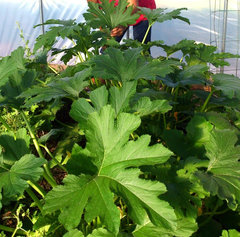
    Take for example these gorgeous Zucchini plants I grew this year. Can believe that I had an infestation of aphids so bad that they sucked these plants dry?


    My Greenhouse · More Info


  • 10 years ago

    OK. If your County Extension cannot be of any help, then how do you expect people like me ( from Washington State !!!) to help you ? . hehe


    But on the question of pruning : IFF it is for the purpose over wintering or height control .. are 2 different things.

    Although tomato plant is said to be perennial but it is not like, eg, hydrangea, to be even a better bigger plant next year. So overwintering it has no advantage (IME). I would rather plant new plants (from seed or cutting).

    Pruning for the purpose of plant management is different issue with different varieties. Generally Determinate plants are better suited for this purpose and there are some indeterminates that have more compact growth habit. But the harsh climatic conditions complicates thing here and it is not possible for me ( from State of Washington !!! LOL) to make recommendation. But somebody from Arizona and SW Texas might be able to do so. .

    Sey

  • 10 years ago

    I am very envious of you Sey. You are so lucky to live in such a wonderful climate. I meant no I'll towards people that live in such climates. I was emphasizing that I don't of the luxury of choosing from the wide range of vegetable varieties in the world, but am limited to the few that might be able to survive where I am at. I have looked far and wide in my region for vegetable growers to get advice from, and have found any. Thanks for the advice.

  • 10 years ago

    Wow where do you live in zone 7 where the conditions are so difficult?

    You have a number of issues to deal with but honestly, varieties of tomatoes is one of the least. No variety will do well in an artificial environment that isn't well controlled. And south of zone 5 summer green house tomato growing is, at worst almost impossible and at best, totally dependent on infinitely controlled and flexible environmental controls in that GH. Just ask any of us who grow in greenhouses. :)

    Most quickly find it to be cost-prohibitive given the massive automated ventilation systems needed (like triple what shows in your pics), the automation needed to roll the sun screens off and on several times a day, the misting and humidification systems, and the electricity bills all required to keep the summer temps down, the humidity up, while allowing sufficient light for the plants. Fall and winter growing is 10x easier and cheaper in the southern climates.

    One solution is converting the GH to a screen house as temps rise. Another is roll up sides on GH such as your pictures show. Another is swamp coolers.

    Pest issues are much easier to control in the GH than outside so can't understand how just aphids, which are easy to control, could take down a massive zucchini plant.

    Point being separate the GH management issues and the pest issues from the tomato variety issues and deal with them separately. Solve the first 2 and it won't make much difference what variety of tomatoes you choose to grow.

    Dave

  • 10 years ago

    You are correct Dave about certain problems a GH presents. In my case though, my GH temps remained relatively close to outside temps during the summer, but with much higher humidity level in the Gh, which was my intent. As far as the aphids, yes there are many chemical ways to control them, but if I wanted chemical laden vegetables, I would buy them at the store. I tried many organic methods to control the aphids with no effect. I tried buying thousands of ladybugs, using neem oil, spraying them off with water and others, all to no effect.

    The thing is, that while the aphids massacred certain plants, they were not able to significantly harm other plants right next to them. My Kale, Collards, Basil and Pepper plants were not significantly harmed by the aphids.

    But, while the aphids were disastrous for certain plants, they also provided a solution to one of the my bigger problems in my GH, which is pollination. Before the arrival of the aphids, none of my fruit bearing plants were putting on fruit due to the lack of pollinators in the GH. After doing a ton of research about GH pollinators and coming up with nothing but manual pollination, which was not doing very well. Then the aphids showed up and shortly there after my plants began setting fruit. It took me all summer to figure out why. After trying all organic methods to deal with them I did finally stumble upon the Monterey LG6135 Garden Insect Spray which is supposed to be organic and I used that. It did knock down the aphids for a good while, but my plants stopped setting fruit.

    So after going back over my observations and also doing some research, I think I have figured it out. The sugar ant population in my GH is directly proportional to the aphid population. I did not know this, but it appears that the sugar ants "Farm" the aphids. It also appears that it is the sugar ants that have been doing the job of pollination for me. It's just my theory at this point based on my observations and some research.

    So, if my theory is correct, then I need to find plants that are aphid resistant, because I need the aphids to draw the ants to do my pollination. If not, I am reduced to growing non-fruit bearing plants in the GH and that is not satisfactory for me.


    As far as growing in the GH vs growing outside goes. I have tried for many years to grow outside with almost no success. One 90 MPH winds gust can strip an outdoor garden bare. That's not to mention grasshoppers that one year reduced an acre of corn to nubs (they ate leaves, stalks and all). To control grasshoppers I have a large flock of feral game chickens, but they also love to eat garden vegetables and since they can fly like pheasants, there is no way to keep them out of and outdoor garden.

    So as you can see, I have many, many obstacles to growing garden in my region. I live in Central Texas, but that alone tells you nothing about my climate, because I live in a micro climate that gets, less then half the annual rainfall of areas around me just 10 miles away. I also live on sort of a hill that is open and exposed to much higher wind speeds and gust then the people around me. So, while I technically live in Zone 7, that tells you nothing about my climate.


  • 10 years ago

    I just wanted to report back here. I pruned my cherry tomato way back to 3 feet the day I posted this (Oct, 7th). It rapidly began growing back and has grown more then 5 feet in the last month and has put on flowers and fruit. Thought this might be of interest to some.

  • 10 years ago

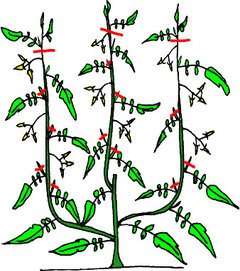
    With vining type of plants , cutting back the main and keeping several side branches one can have a bushy plant similar to determinants. Obviously several branches cannot grow as tall as the main branch. There is a technique know as French Pruning.


Sponsored
Industry Leading Kitchen & Bath Remodelers in Franklin County, Ohio