Software
Houzz Logo Print
gfish6

Rubber Tree Pruning

11 years ago

Hi –

I’d like some guidance on how and where to prune my rubber tree. I’ve had it for years, never pruned it and love that it has grown into such a lovely, tall and healthy tree. However, the tree is curved – particularly the branch on the right side of the following picture. I’m wondering if I should cut off the branch that’s very-curved, and if so where should I cut it? If someone could indicate – i.e., draw -- where I should cut on the below picture, that would be really helpful. I would certainly hate for my rubber tree to look not-as-good or not-as-full as it does currently, but I would prefer the curviness be straightened out.

Please note: Although this tree is pictured outside, it typically resides indoors.


Comments (21)

  • 11 years ago

    I would prune all 3 trunks to different heights. The thickest trunk would be tallest, the middle trunk (thickness would be about 2/3 as tall as the tallest, and the thinnest trunk would be 1/3-1/2 the ht of the tallest. It's prolly not prudent to do any pruning now unless you live near the equator or S of it. Where DO you live, gfish? How do you feel about a shorter planting?

    Al

  • 11 years ago
    Thanks Al! I live in North Texas. Is now not a good time to prune for me? I'm not thrilled about having a shorter plant but if it's best I'm willing to do it. Thank you both for your feedback!
  • 11 years ago

    If I were you, I'd make a plan and stick to it. Tree stuff usually happens rather slowly, so you need to allow for that. You don't have to cut the plant back, but what will you do when it's 7 ft tall and has no branches, or you wake up in a few weeks & there are 2 branches flopped over and lying on the floor? I always want people to choose the way they want to grow, even if I sometimes plant seeds that sprout into alternate viewpoints. I'm earnest when I say, if you find it hard to part with some of the top growth (next June) there's no need to part with it. Strategically, it's the best move because it will shorten the weak trunks and in doing so make them stiffer and self supporting. It will add balance to the composition, while forcing new branching (which doesn't appear yet to have happened). Keep in mind that growth (of your plants) isn't really much of an accomplishment. If you can keep from killing them, they grow. What IS an accomplishment, is maintaining an attractive plant in good health. Do that and the plant will do the rest.

    Very briefly, if I had your tree I would plan for a repot in mid-Jun of 16. A repot is more involved than potting up, so we can talk about that if you aren't familiar with the difference between the two. The plant would go into a soil I wouldn't worry about retaining water so long it kills roots and inhibits root function. More on that if you like. After the plant resumes growth, I would cut it back as described. The plant will immediately respond and will be taller and much bushier than it would have been if you didn't have a plan and just left it to its own devices. There's more we can talk about if you like, but what do you think?

    Al

    gfish6 thanked tapla (mid-Michigan, USDA z5b-6a)
  • 11 years ago

    If you don't want to lose the height, you could cut about 1/4 of the two long branches down. They would still be taller than the middle.

    If it were my tree, I'd cut them all down about half way to produce some nice branching. These trees tend to grow very tall and are fast growers.

    No matter what you choose, you can do some cutting now or wait until Spring to 'really cut.' The tree would have the summer to grow back and would look a lot better.

    Jane

    gfish6 thanked jane__ny
  • 11 years ago

    Thank you Al and Jane!

    Al -- I've read one of your posts in which you explained the difference between repotting and potting up, and I appreciate you offering to help me with this. I'd like to take you up on that, and I'll plan to repot in June '16 as per your suggestion.

    I like what you said regarding accomplishment with this plant and would like to shoot for maintaining a healthy, attractive plant versus it just growing. Is there anything I can do now with this plant, or will it be better to wait until June?

  • 11 years ago

    When someone suggests cutting back in 'Spring" that really should be qualified. There's a BIG difference between Spring the 21st of March, and Spring the 21st of June. One is a poor time to do significant work on trees (cutting back [as opposed to something light like tip-pruning] and repotting), while late spring (mid-June) is about the best time. That's because the plant will have recovered a lot of energy between it's lowest energy point (early spring) and its most robust growth period (mid-Jun - mid Aug). Repotting winter-weak plants in early spring finds them languishing during long recovery periods, while repotting an already robust plant just prior to the peak growth period finds them rebounding from the work faster than at any other point in the growth cycle. That's important, so I'm glad you decided on a June repot.

    In all honesty, from the perspective of energy status, leaving the plant intact is best for the plant until you're ready to work it come June, but if you just can't stand not doing 'something'; tip pruning won't hurt. The problem with that is, at this time of year the back-budding will probably be limited to new branching in the top leaf or two of each truncated stem. Doing it when the plant is growing hard and has lots of reserves will garner a much more enthusiastic response.

    Al

    gfish6 thanked tapla (mid-Michigan, USDA z5b-6a)
  • 11 years ago

    Having lived my entire life in NY, Spring is always late May or June. In NY or any cold climate I would never suggest repotting in Spring (March).

    However, I did repot 'some of my orchids' in late March/April when I see signs of new root growth. I do not want to damage roots and like to repot when plants are in 'growth mode.' Usually the longer days, stronger light will spur growth.

    My large plants had to wait until I could do it outdoors and stay out for the summer. It was usually in June. I would repot the plants which would grow outdoors over summer once the weather settled down and provided comfortable night temps. Large container plants were always repotted outdoors due to convenience. It was always impossible to do this indoors.

    Thanks for the correction, Al. I tend to think of plant seasons by growth or dormancy. Not the calendar.

    In Florida, I have repotted my 'dirt' plants in March with great results. March is warm, sunlight is getting longer and the plants begin to grow vigorously. I don't know what March is like in Texas.

    Use your judgement and watch for new growth. That is when I decide to repot any plant.

    Jane

    gfish6 thanked jane__ny
  • 11 years ago

    The annual growth cycle of all plants are inextricably linked to the annual calendar, unless we go to great pains to totally control photoperiod and photoduration.

    You might want to consider including some clarification then, about when 'spring' is - lest someone mistake your meaning and repot too soon. The onset of 'good growth' shouldn't be considered to be an indication it's a good time to repot houseplants. When houseplants start to grow in earnest after a long winter of using energy reserves, they're too weak to bounce right back from the stress of heavy work like cutting them back hard or repotting.

    When growers think "spring" as it relates to repotting (as opposed to potting up) or heavy pruning, try to remember Father's Day or the summer solstice as a target date.

    Al

    gfish6 thanked tapla (mid-Michigan, USDA z5b-6a)
  • 11 years ago

    Thanks very much Al and Jane! I appreciate both of your feedback.

    I'll wait to do anything until June, and Al thank you for explaining the rationale for that. It makes sense.

    Another question -- in June, would it be okay for me to completely cut off the branch that is the most curved so that it may grow again without curve?

  • 11 years ago

    From the picture, it's difficult to determine which branch you're talking about, but I suppose it's sort of moot as to what you can do with any individual branch. If you cut a F elastica branch/stem back so far there are no longer any healthy leaves on the branch, there's no real guarantee approaching 100% probability that the branch/stem will back-bud on bare wood. If you leave a couple of healthy leaves on the branch/stem there is almost a 100% probability the branch/stem will back-bud from the dormant buds in those leaf axils. If the tree has a lot of energy reserves and you cut it back hard (no leaves on branch) in summer during the most robust growth period of the growth cycle, the odds it will back-bud on bare wood also rise significantly, so if you read what I said carefully, you'll see that the tree's state of vitality AND when you cut the plant back determines to a very large degree how enthusiastically it will respond.

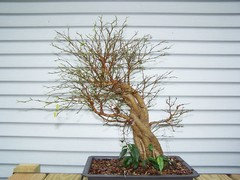
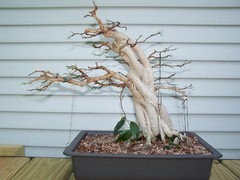
    After you cut the plant back and it responds by back-budding, you can choose one of the new branches as that trunk's new leader and guide it into a favorable position - like a bonsai practitioner might wire poorly positioned branches into a more favorable attitude. This before and after picture of a F benjamina is a good illustration of before and after 'guidance' of branches into more favorable positions:


    Al

  • 11 years ago
    Thanks again so much Al for all your help with this! I understand and will do as advised. I'll plan to get back in touch with you to prep for the repot around May if that works.

    Thanks again and hope you have a great day and weekend!
  • 11 years ago

    Got your message. I had to come back to the thread to refresh my memory, so figured I might as well answer here where I could refer to the picture.

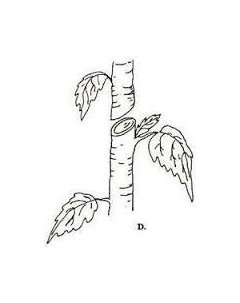
    If you're going to prune now, picture in your mind that you'll be pruning about 1/2" above where a leaf is attached so the thinnest branch will end up 1/2 the ht of the fattest branch, and the middle branch, in thickness, will be half-way between the shortest and tallest branch.

    You asked what the "growing tips" are? They are where elongation occurs at the end of the branch. They're often referred to as the apices or apical meristems. A chemical that inhibits buds from forming behind the growing tips is eliminated when you cut them off, which allows back-budding to occur in the crotches of leaves behind where you cut off the branch tips. So, even though the branch you cut the tip off can no longer extend, the new branches that grow from the branch you cut WILL extend. In order to make your tree very full, you'll allow the new branches that form to grow 3-4 leaves, and then cut them back to 2 leaves. New branches will form in the crotches of those 2 leaves, and you'll let those new branches to grow to 3-4 leaves and then cut those back. Repeating that cycle over and over, keeping your tree healthy, and giving your plant the best light you can, is the best way to maximize its fullness.

    Helpful?

    Al

    gfish6 thanked tapla (mid-Michigan, USDA z5b-6a)
  • 11 years ago

    Very helpful! Thanks Al :).

  • 11 years ago

    ..... my pleasure. Take care. Let me know if you think there might be anything else I can help you with.

    Al

  • 11 years ago

    Thanks so much Al. I appreciate your generosity of knowledge! I do have another question -- I'd like to cut the thickest branch (branch to the far right in the picture) the most to make it the shortest because it is most curved -- would that be problematic? Wondering because you recommended making the thickest branch the longest.

  • 11 years ago

    It poses no problem from the perspective of the plants physiology or well-being. It just looks unnatural to the eye to have a taller branch thinner than a much shorter branch. If you're fine with that - no problem. To be honest, you're going to end up with curves/angles in all your branches because the new branches that occur will not follow the same spatial planes as the part you removed.


    When you cut the end of a branch off, a new branch is going to form in one or more leaf axils (crotches) behind the cut. These new branches will grow at an angle to the main branch. The one in the picture looks like it's going to grow at about a 45* angle to the main branch. If it would be to better advantage that the branch in the picture grew to the left instead of to the right, that could have been accomplished by pruning just above the lower leaf on the left. THEN, the new branch that forms will grow to the left instead of to the right. With some mechanical guidance, you can make the branch grow in the direction you want it to grow.

    More advanced bonsai practitioners can make branches grow wherever we want them to. We can even take an established branch off the right side and move it to the left side of a tree by using a sophisticated grafting technique that takes about 2 years to accomplish. If the tree is deciduous, we can even thread graft, which is accomplished by allowing a thin branch to grow long. When it's long enough and the leaves have fallen, we drill a hole in a branch or trunk and thread the thin branch through the hole and push a small piece of wood into the distal hole so it's pushing the thin branch upward. Very quickly, the cambial tissues grow together and the thread graft is established. At that point, we sever the branch at the back side of the tree. Presto - a branch right where it was needed. This only works on trees with buds that are fairly small in relation to the diameter of the branch.

    Sorry - I'm off track, but I thought that might be of interest to you. Getting back to your short trunk - fat trunk dilemma ...... if I wanted to do what you are planning, I would prune the trunk you want to, and NOT prune the thinnest trunk at all. I would let it grow w/o any pruning until it became thicker than the other trunks. The more leaves on a trunk/branch the faster it thickens. After the now thinnest trunk became the thickest, I would prune it to a favorable ht in relation to the other trunks. You, however, have the wilting issue to address, so that option is sort of off the table, but you CAN utilize that strategy once your plant recovers if the trunk thickness thing bothers you. I prolly shouldn't have said anything because you'd likely never have thought about that. Still - it's good to know you have options and there are ways to fix issues and take control over how your plant grows and what it looks like.

    I hope you had a good weekend, and I hope that made sense to you.

    Al

    gfish6 thanked tapla (mid-Michigan, USDA z5b-6a)
  • 11 years ago

    Hi Al --

    Thanks again for all this good information! It did make sense and I cut my rubber tree as suggested. Also -- interesting about the bonsai practitioners. Sounds very advanced.

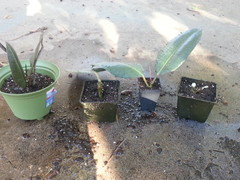
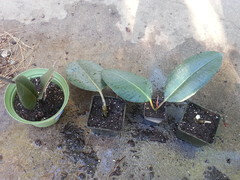
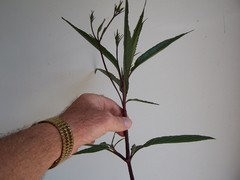
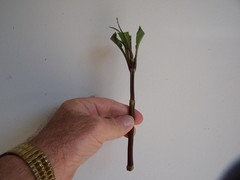
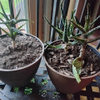
    Since I just cut or pruned my rubber tree, I now have a long rubber tree branch (I only cut the thickest, very crooked branch) and I would like to propogate additional rubber trees from it. I'm not sure if I'm doing this right though. Below are some pictures of my attempts with this so far. I saw another post wherein you recommend using perlite or vermiculite as the medium in which to insert the rubber tree cuttings, but I just put these cuttings in potting soil because I don't have perlite now. Related to that, how long can the just-cut branch from the big rubber tree live before going in soil or perlite? Would it be helpful to put them in potting soil in the meantime before getting perlite, or would another medium (e.g., water) be preferable?

    Regarding the pictures below, I'm wondering if these segments of the branch are too big for propogation or are cut appropriately? The green pot on the far left contains a piece that I've been trying to propogate for a while -- i.e., it's been in the pot like that for approximately 2 to 3 weeks. I put pieces from the just-cut segment in the other three pots. There is still a good amount of branch left and I could likely propogate more little rubber trees. I had a good weekend, and I hope you did too!


  • 11 years ago

    The plant you've already started, I would leave as is. For the 2 plants in the middle, I would cut all 3 leaves straight across the main vein so you're removing 2/3 of each leaf and leaving 1/3 of each leaf still attached to the cutting.

    If leaves can't get enough water to carry on photosynthesis and produce the growth regulator auxin, the slowed flow of auxin across the abscission zone (where the leaf stem attaches to the branch) an abscission layer will form and the leaf will be shed and the cutting will likely fail. It's better to reduce the leaf surface to reduce transpiration to guard against the cutting simply collapsing.

    I do that as a matter of habit with almost all cuttings I start.


    For F elastic, you want to take the cuttings with a VERY sharp tool that won't crush the stem. Cut through the stem just a little below a leaf node and remove the leaf from that node and the one above. These 2 nodes should go into the soil. Above the soil there should be one or 2 leaves, each reduced by about 2/3 for intermodal cuttings. For tip cuttings, I would have 2 nodes in the soil and 1 reduced leaf + the branch apex above the soil.

    If you're using a water-retentive soil, it's important that the container is deep enough that the cut end isn't immersed in the soggy layer of soil at the bottom of the pot. Cuttings need to take in oxygen to strike (make roots) and inserting them too deeply into soggy media pretty much insures they won't.

    Al

    gfish6 thanked tapla (mid-Michigan, USDA z5b-6a)
  • 11 years ago

    I agree to cut those big leaves in half or smaller. Put those pots in a bright window and don't overwater. Not the greatest time of year for rooting but if you have enough light and warmth, you might get lucky.

    I don't know the Texas climate, but in Florida March and April are quite warm. I have no problem repotting or pruning at that time.

    It is recommended to prune trees/March in February in Florida.

    Northeast is a different situation. But Texas climate might be more like Florida. Not sure.

    You can always email if you'd like to discuss what I have done in the past.

    Good luck, very nice tree.

    Jane

    gfish6 thanked Jane