

Overseed or Start Over?
Hi,
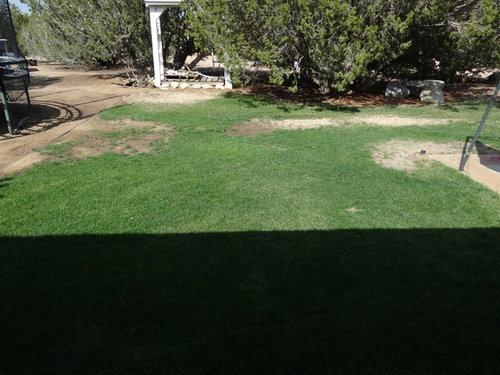
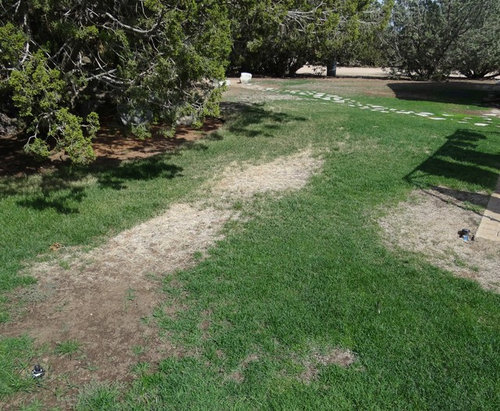
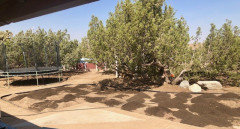
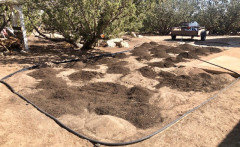
We live in Oak Hills (the high desert area of southern California). I believe it is zone 8b. We have a Kentucky Bluegrass lawn that is in poor shape. Due to the drought, we had to cut back on watering but even before that, much of the lawn had died off. We probably mowed it twice this summer because it hardly grows at all. This side that is mostly dirt now seems extremely compacted. We rented a professional aerator but it made no difference. When the lawn was originally planted, about three years ago, we brought in about three truckloads of top soil.
We had hoped to reseed in the fall but got sidetracked by re-roofing and car repair projects. I know that we should probably have the soil tested but if we have to send the sample in the mail, it will be too late to plant once we get the results. Home Depot sells a do-it-yourself test kit. However, that kit doesn't seem to test for salt in the soil. Someone suggested that too much salt could be the problem. Should we break up the soil and add some kind of sand or amendment? We have a friend who makes bio-char and worm castings. I believe his product costs about $25 per bag. We probably wouldn't be able to invest more than $150 in amendments so maybe that wouldn't do much good? How far should we dig down to break up the compacted soil?
We are considering switching to tall fescue or a fescue/rye/KBG mix. Either way, I assume that we would have to remove the existing lawn completely? If we overseed, would we have to use 100% KBG to avoid a patchy looking lawn? Does anyone have a suggestion for a particular brand and seed type? I
have been reading that the best seed is obtained through mail order.
Again, due to the time constraint, we would prefer to buy locally but we don't want junk seed. Any help would be appreciated.
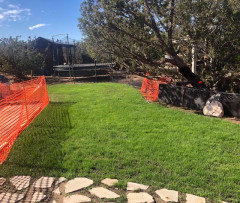
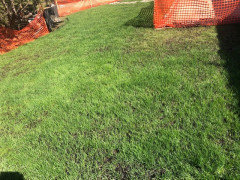
Here are a couple of photos. In the second photo, the area beyond the walkway is pretty much nothing but dirt now.
Comments (70)

kendog2
Original Author10 years agoMorpheus,
Thank you for posting the article about the effect of salt on KBG. We purchased our original seed according to recommendations from this site. It is Magnificent 3 (Midnight/II, Moonlight, Bedazzled). I have also read that the Moonlight SLT is the most salt-tolerant of the KBG grasses but it sounds like tall fescue would be more salt-tolerant than Moonlight SLT. Is that correct? Since applying the soybean meal and alfalfa that Dchall recommended,
along with extra water, I see shoots of new grass in the bare areas.
I'm still on the fence about whether to tear out the lawn or keep trying
to make it work.I was considering ordering a 50% mix of Bewitched for its drought tolerance and Moonlight SLT. Would 100% Moonlight SLT work better because of its salt-tolerance? I prefer a darker color but as you pointed out, it would probably blend poorly with the color we have now. In that case, maybe replacing the entire lawn with tall fescue would be the best option.
I have nothing against fescue lawns. We chose KBG because my brother-in-law recommended it. He had tall fescue and hated it so much that he replaced it with KBG. His fescue had broad leaves and coarse texture. The edges were brown and it was not pleasant to walk on. He convinced me that Kentucky Bluegrass would be much more beautiful with narrower, softer leaves. I have seen tall fescue lawns that have narrow leaves but I'm not sure what type they are. I think most people here plant Marathon. Is there another type that you recommend or should we buy whatever is in stock at Home Depot? I noticed that Williams seed has lots of different varieties of fescue that I've never heard of.
If we replace with tall fescue, should we use a sod-cutter or Round-up or both?
Dchall,
Yes, it could be that the fescue lawns look great because the homeowners ignore the water restrictions and the salt is flushed out. I don't know how much the lawns are watered. It is interesting to learn that Juniper trees can have such a negative effect on pasture land and streams. We love our Juniper trees because they're green and we don't have to water them. They are also tolerant of salt.
Sorry for the long post and thanks to both of you!
- 10 years ago
I'm not a fan of fescue myself (for its inability to repair damage) and not an expert. Somebody would have to chime in with recommendations on that. But I can say that modern well-bred fescues are as soft and fine-bladed as you could want. They don't disappoint in the appearance department!
I'm not certain of your exact climate all the way over there, but it may be a bit late to seed (certainly it is through most of the rest of the nation). Not to mention that I'd really like the gypsum to have time to work!
The extra watering is helping to dilute the sodium down, plus supplying enough water that the plant will simply keep using it to rid itself of sodium buildup. For now, that'll do.
Related Professionals
Tallahassee Landscape Architects & Landscape Designers · Rome Landscape Architects & Landscape Designers · New London Landscape Architects & Landscape Designers · Niles Landscape Architects & Landscape Designers · Minneapolis Landscape Architects & Landscape Designers · Reno Landscape Architects & Landscape Designers · Springfield Landscape Contractors · Hilton Head Island Landscape Contractors · Pullman Landscape Contractors · London Landscape Contractors · Shreveport Home Builders · Hannibal Home Builders · Anniston Home Builders · South Bend Home Builders · Montrose Home Builders 10 years ago
Your brother may have had an unimproved fescue like K-31. That stuff gives all fescues a bad name. Fescue is a bunch grass meaning it grows in clumps. It makes a lawn when you plant enough seeds that the clumps are close together. KBG, on the other hand, spreads and forms a dense mat of sod. If you have any problems with fescue during the year, it will die and leave holes where that or those particular fescue bunches were. Those spots will require overseeding in the fall (every fall). Fescues remain green all winter, so they do have that going for them. Many people mix KBG with fescue seed to try and get the best of both grasses. Note that every time a fescue plant dies, the KBG will move in to fill, so eventually these blended lawns end up being KBG.
kendog2
Original Author10 years agolast modified: 10 years agoThank you again, Morpheus and DCHall. It is pretty late to seed but we did seed our present lawn on Nov. 1st Yesterday our high temperature was 86 degrees. Today, the high will be only 69 and tomorrow 58 degrees, increasing to 70 degrees by next Sunday. We don't usually have such dramatic temperature swings. Generally, we can expect an average of 68 degrees dropping to 61 by the end of the month.
I applied the gypsum last Thursday, Oct 29th and have been watering generously. I will wait two weeks before applying the Epsom salt and potassium sulphate with lots of water and two more weeks before applying the borax/milogranite mixture per your instructions.
DCHall, I found out that our water doesn't have excess salt. One of our sons has a fish tank so he checked on that a while ago.
I ordered three pounds of KBG seed from Williams Seed Co. It is a blend of two pounds of Moonlight SLT and one pound of Bewitched. We visited my brother-in-law on Halloween. His new lawn (planted in May) is Scott's 90% perennial rye and 10% Kentucky bluegrass. It looks amazing. My husband said that he didn't know a lawn could look that good. He thinks we should add perennial rye to our mix. I don't mind doing that but I imagine it might make the newly seeded areas look even worse with the existing lawn. Maybe we don't care though. I might even be wreckless enough to throw some tall fescue into the mix on the bad side of the lawn just to see what happens. If it turns out badly, we can tear it out completely and re-seed next fall. .
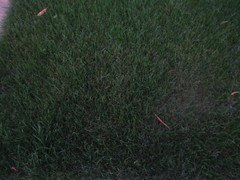
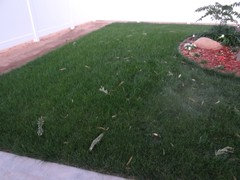
Here are some photos of my BIL's lawn, taken when it was almost dark. (The leaves are from his beloved Mimosa tree.)
- 10 years ago
Be very, very cautious when mixing PR seed into bluegrass and/or rye. Although less of a problem when babies, as they age the PR will poison and kill the other grasses, so lawns that start above about 10% PR by count (50% by seed mass when combining with KBG) tend to end up PR dominated.
It's often easier just to skip it, although a pure PR lawn can be absolutely gorgeous.
Your weather is actually still just fine for planting and will be fine for sprout until at least November 30th from your weather report!
kendog2 thanked User kendog2
Original Author6 years agolast modified: 6 years agoSo, it is now 4 years later. We ended up removing our lawn completely. We are planning to re-seed with tall fescue but the lawn size will be reduced from approximately 1500 sq. ft. to 550 sq. ft. We will not be seeding as close to the house or in the shaded area to the right of the walkway. The ugly broken concrete walkway will be replaced after the lawn is established. We didn't have time to work on the soil this summer so we are now in a hurry to seed before it cools off too much. We brought in 2 yards of compost. I'm planning to add one more yard since the soil is very sandy and according to the soil sample from 4 years ago, it contains no organic matter.
We plan to add another 18 pound of gypsum which we hope will prevent the soil from compacting as hard as it did with the other lawn. (We had tried aerating with a rented core aerator but that did nothing.)
I have read through all of the wonderful advice I received on this old thread. I'm wondering if before seeding, I should work milogranite, Epsom salts, potassium sulfate and starter fertilizer into the soil in addition to the compost and gypsum or would that be too many additives at once? I expect that you guys will tell me to get another soil sample but I'm not willing to do that due to time constraints and because I doubt that much has changed since the last soil sample was taken. We have had very little rainfall so I expect that the soil is still extremely salty.
- 6 years ago
"I expect that you guys will tell me to get another soil sample but I'm not willing to do that due to time constraints and because I doubt that much has changed since the last soil sample was taken."
Exactly. Then the safest thing to do is nothing. Apply Milorganite atop the soil when seeding if you wish, or the starter. But skip anything else.Get the soil test next year and adjust the soil at that time.
So for right now, when seeding, apply the Milorganite up top--or the starter fertilizer. Not both as both contain a lot of phosphorus that you may or may not need. Personally, looking at what you're working with, I'd recommend the Milorganite as a slower tap of nitrogen and some organic material. The starter would be a waste.
I'll withhold opinion on digging in the compost as it's too late now. But for lawns, that's going to cause...issues...as it decays off. Fortunately, the worst of those is bumpiness. Usually.
I'd get a good soil test before doing anything since you don't really know what the soil needs--and blindly adding resources (particularly Epsom salt, but anything, really) isn't a good idea.Working those in also isn't necessary and, in the case of the starter and Milo, would be a bad idea. The starter's nitrogen is meant to be applied to the surface, and the Milo will suck all the oxygen out of the soil profile when it starts to decay. That will poison any plant that tries to grow in the soil for the next few weeks.
Generally that's not a gigantic issue with small amounts of Milo except with really delicate plants. Like...seedlings.
kendog2
Original Author5 years agoThank you so much Morpheuspa,
Your input is much appreciated. I thought that working the gypsum into the soil before seeding would help prevent the soil from compacting again but I will forgo adding it per your advise. Our natural soil looks just like dusty sand. It doesn't seem like it could hold any moisture at all. The compost we used is rich and black. I'm hoping that it will help the new lawn retain moisture. However, it doesn't sound like you approve of adding any compost at all.
We need to bring the soil height up another 1/2" or so. At this point, the soil is probably nearly 50% compost. Should I refrain from using any more compost and just use our sandy soil to get to the correct height (about 1" below the concrete patio)?
I will skip the starter fertilizer and all other additives. So the milorgranite will not poison the seedlings when applied to the surface, only when mixed into the soil?
Thank you again. Understanding how to amend soil is a much more complicated science than I ever imagined. I will get another soil test done next year.- 5 years ago
Compost? I love compost--added up top, in amounts up to about a quarter inch at a time.
Dug in, it's going to settle as it rots and leave you with a bumpy surface eventually. Well, sooner rather than later, really. While raising organic matter levels otherwise takes far longer, it doesn't cause those problems.
In gardens, adding compost really isn't an issue. You don't walk it or mow it. On lawns, a one inch drop for a wheel rut is a major issue...
To raise anything further, use something as close to your natural topsoil as possible (roots don't like moving between soil types, although small additions don't matter, up to about a half an inch) with as little organic matter in it as possible. Most landscape places can sell you top soil to that spec. The OM will rot off, again, settling over the years, in addition to the normal soil settling.
Milo's great up top with seed or seedlings in amounts from minimal to about double bag rate. Dug in, since it needs oxygen to decay, it'll tap the soil of oxygen and start generating some nasty chemicals as it decays anaerobically. The easy solution is, simply, to not dig it in and always apply it up top. :-) I use the stuff myself occasionally (this year, due to The Virus, in large amounts) and like it.
And yes, amending soil is about half science...and half art. :-) kendog2
Original Author5 years agoThank you so much for your quick response and detailed explanation. It is much appreciated as we hope to seed by the end of the week. I'll skip adding any more compost then and use topsoil or if topsoil is too expensive, our natural soil. We dug the compost in with a shovel instead of using our rototiller but I think it is still pretty fluffy from being turned over..
I'm guessing that we'll need to water at least a couple of inches to get the soil to settle properly. Once it is settled, we may have to add even more soil before putting on the seed and milorgranite. I'm grateful that it is only 550 sq. ft. I can't imagine the amount of work and expense that would be involved to install a large lawn.kendog2
Original Author5 years agoI added some soil but I think the level may sink after the soil settles. Should I water it a lot before seeding to get it to settle before deciding whether to add more soil? I'm pretty lost on how much to add to get the final grade.
I have read several tutorials on seeding grass. They all say to rototill or dig in the amendments, rake, sow the seed and add a topper. None of them mention watering or flattening the soil before seeding. Should it be left loose to settle on its own? It seems like that would result in uneven settling and a lumpy lawn that may not be the desired height. I am aiming to get the soil to about an inch below the concrete patio.
Should I use a long 2 x 4 to level the soil and make sure it is sloping correctly? I'm not finding this easy to do evenly with a rake. I read that one shouldn't use a roller after seeding because it creates indentations that will collect water. Is that true?
- 5 years ago
"I expect that you guys will tell me to get another soil sample but I'm not willing to do that due to time constraints and because I doubt that much has changed since the last soil sample was taken."
Nothing has changed except you added gypsum, Epsom salt, potassium sulfate, borax, and...you brought in new soil. Other than that, nothing's changed.
Where did you read the tutorials which suggested rototilling? I'm curious what else they suggested. Were they written by High Desert authors or someone from Iowa or New York? Were they in books or magazines? One of the issues with tutorials is they are not interactive. I have a problem with YouTube lawn gurus for that same reason. They are not held accountable for what they say. When morph and I (and others) say to not rototill, we have been judged by our peers on these forums. We have to support and defend our position. I used to live across the street from a nice lady who writes articles for a living on any topic. Her process is much more geared for production than it is for accuracy. Were the tutorial authors gardening specialists or professional article writers?
I would drag a 2x4 wired to a piece of chain link fencing with a bag of soil or something on top to help level the piles of soil.
"I read that one shouldn't use a roller after seeding because it creates indentations that will collect water. Is that true?"
If you rototilled first and did absolutely nothing to settle the soil, then yes, it's true. If you have done at least some settling with water and adding more topsoil to the low areas, and watering, and adding still more top soil to the low areas, then you should be able to walk on the soil without leaving footprints. Well it should be looseish at the surface, but you should be able to walk on it without sinking in at all. Then you can roll the seed down.
- 5 years ago
Well, you'll see people here recommending rototilling, but they're usually not in the field and quoting the same "quantity" over "quality" authors without having much real-world experience. And we're not shy about countering them, either. When they get nasty, we're also not shy about countering that, either. They know who they are. :-)
Plenty of things get published. Some of them are even true.
A half-full roller can always be used (well, on a dry or slightly damp soil; it's a problem on a wet soil), before or just after seeding, to settle things, if you want. It's not necessary if the soil settled after a good watering or rainfall, but you can do it if you want. kendog2
Original Author5 years agoDchall_san_antonio and Morpheuspa,
Thank you so much for your replies. You are both awesome. Let me begin by clarifying that we did not and do not plan on rototilling. Years ago, threads posted by you two convinced me that rototilling isn't appropriate when planting a lawn. We turned the soil over with a shovel to mix in the compost. I wish we could have avoided adding the compost too but we have been so overwhelmed with so many projects that we haven't focused enough effort on repairing our soil.
"Nothing has changed except you added gypsum, Epsom salt, potassium sulfate, borax, and...you brought in new soil. Other than that, nothing's changed."
Yeah, I get that. It was a dumb thing to say. I just want to put the lawn in before it gets cold and fix any issues later. I realize that it may not be the best course of action for a perfect lawn but being a perfectionist is the reason that many of my projects just don't get done.
I have read numerous lawn seeding tutorials that suggest rototilling. That doesn't mean I believe that it is good advice and no, none of them were from people in the High Desert. I would not be surprised if they were written by professional article writers and not lawn experts since the websites seem to have items for sale. Perhaps the articles are used to draw traffic to the websites.Here are a couple of links:
https://www.outsidepride.com/seed/grass-seed/fescue-grass-seed/planting-fescue-grass/
https://www.thisoldhouse.com/lawns/21017148/how-to-seed-a-lawn
Since our lawn area will be very small, it was pretty manageable to use a shovel to mix in the compost. If we were doing a huge area, I can't imagine how that would be an option. For a large lawn, I might have been tempted to use our tractor and disc harrower or maybe a power rake to cultivate the soil.
"I would drag a 2x4 wired to a piece of chain link fencing with a bag of soil or something on top to help level the piles of soil."
Thank you. That sounds like a great idea, especially since we happen to have some chain link fencing laying around:)
I walked back and forth over the soil to try to settle it. Next, I will water, drag over the soil with the 2x4 and chain link fence, add soil to the low spots and repeat until it gets to the point where walking on it doesn't leave footprints.
We have not received any rainfall since February or March. I hope that changes soon but in the meantime, watering is our only option.- 5 years ago
You can easily bring in a lawn on just watering. Been there, done that, had the worst drought in 15 years while renovating my lawn. Because of course I did.
- 5 years ago
I have a feeling you're going to have a great lawn...and then you're going to complain about it, LOL. If you want to have a perfectionist lawn, stick with it and feel free to ask questions here.
- 5 years ago
Because both of us have perfectionist lawns and complain about them constantly. We're kind of used to it...
kendog2
Original Author5 years agoMorpheuspa,
Haha, good for you. Yeah whenever I feel a touch of guilt about installing a new lawn during a drought, I justify it by reminding myself that it is 1/3 the size of our former lawn. During the past year, I have had to water our California Juniper trees occasionally to keep them alive. No small job since we have 80 trees on our 2 1/2 acres. I hope we get a lot more rain this winter.
dchall_san_antonio,Thank you. I hope so. Probably will complain but I might be too busy obsessing over the many, many other projects that are waiting to be tackled such as replacing the broken concrete with a 4 ft. wide paver walkway. Thank you so much for being willing to answer my questions.
Hope you both have a blessed day!kendog2
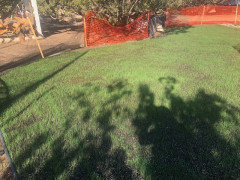
Original Author5 years agoI'm back to complain now. It has been two weeks since we seeded the lawn. We used a drop spreader at the recommended setting but the seed was distributed a bit more unevenly than I had hoped. There are a few bare spots which I lightly re-seeded by hand yesterday.
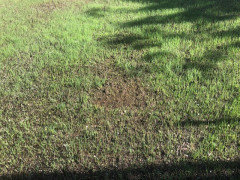
However, my big gripe is that for the past two nights, rabbits have been feasting on my baby grass. They mowed it down to within a quarter to 1/2" in a few spots.:( We have a temporary fence up to keep our dog out but it is doing nothing to stop the rabbits. I have attached photos. Do you think the grass will grow back or should I re-seed the damaged areas?
I have been researching how to prevent rabbits from destroying the lawn and have come up with a few ideas. Please let me know if you think any of these methods will work. I am also open to other suggestions. Thank you.
1. Eliminate the rabbits that are currently feeding on our grass. For this task I have hired a hitman - our college-aged son. I suggested that he use his shotgun but he informed me that it would do more damage to the lawn and sprinkler system than I would want. (I admit that my desire for revenge might be getting out of hand.) The Terminator will be using his pellet gun.
2. Sound repellers. Unfortunately, a large percentage of Amazon reviews state that they don't work.3. Motion-activated sprinklers. Expensive and many bad reviews on these too.
4. Rabbit/deer repellent. This stuff is foul-smelling if I recall correctly. It might be worth using while the lawn is getting established but I don't want our back yard to permanently smell like a dead corpse.
5. Live traps. We have a cat trap and an identical trap that is smaller (maybe for squirrels). What
type of bait works for rabbits?6. Body Grip 220 kill trap. Do these work? This might not be safe to use as we have a Husky dog. Maybe lock him in his kennel overnight?
7. Set my sprinklers to go off every few minutes for a few seconds all night long? Probably not practical.
8. Spray a solution of water mixed with ginger and cayenne pepper. Would this burn the lawn?
9. Fox or coyote urine. Expensive. Does it work. Does it smell bad?
10. Permanent fence. A chicken wire fence would be ugly. Not sure if there are more attractive types of fencing that would keep rabbits out.
Other: Ammonia? Vinegar? Blood meal? Garlic?Strong deodorant soap bars in socks?
- 5 years agolast modified: 5 years ago
Your grass will most likely recover from the "mow" they're giving it, but let's try to keep the rascally rabbits from attacking it further.
Most methods are...problematic. I try to refrain from "removing" the problem permanently due to the fact that we all share the space and the rabbits actually do serve a purpose here. Eventually, they'll provide a bit of a free grasscycling service, and poo on the lawn.
This is a very good thing as it provides ample free organics which amplify the health of the soil. So we'd kind of like them around long-term. I actively feed them on this property.
As you noted, most of the methods are expensive, difficult to use, unreliable, unsafe, or problematic.
I've got two that work.
One, feed the lawn with Milorganite. It's about time anyway, so that's good. They hate the smell. This isn't completely reliable, and doesn't last that long, but it buys some time and encourages the lawn into growth. That short-mown bit will repair very quickly.
Two, in areas where they're really nailing it, you can spray yourself with the following, which is cheap to make and very, very reliable (I use it myself in my gardens, on a property overrun with rabbits and other herbivores that I refuse to control). ETA: Your dog is more likely to be neutral or slightly attracted than repelled. /ETA
1 gallon water
1 Tbsp Tabasco sauce (get the cheapest; I use McIlhenny as it shares with the food cabinet)
A few drops of Elmer's or other white glue (I use dollar store stuff; optional, but helps with sticking, and it tastes bad due to the synthetic polymers in it)
1 tsp any dish soap (I use Dawn, but whatever, it helps with sticking and again, tastes bad)
Put in 1 gallon sprayer.
Spray very lightly over anything you want to protect from deer, rabbits, etc. 1 gallon in my sprayer easily protects my entire garden (2,000 square feet) several times over, but if you want to go heavy, this will not burn plants even applied to heavy runoff.
If you want to use a backpack or other sprayer and protect large areas, feel free, the recip doubles or halves easily. Respray after rainfall, although the rabbits will eventually learn that the area protected tastes bad and not come back for a while.
kendog2
Original Author5 years agoThank you so much Morpheuspa!
I bought the Mcllhenney tabasco sauce and mixed it with the other ingredients. My sprayer was malfunctioning so I had to dig out my backpack sprayer. I finally applied the mixture and the milorganite late last night. The spray came out pretty heavy. I should have adjusted it to a much lighter spray. Before I realized it, I had sprayed the entire gallon over my 560 sq. ft. lawn.
Since I overseeded a few days ago, I need to keep watering several times a day. Should I apply the tabasco sauce mixture every evening then? My son noted that it contains 30% salt. Taking into consideration that our soil was 22% sodium a few years ago and is probably not much different now, will it be harmful to apply a lighter spray of the tabasco sauce mixture every night?
Should I use weed and feed at some point?- 5 years ago
With the overseeding, I'd not respray until that sprouts--you'll be spraying constantly. That's just annoying and problematic in terms of effort (plus a bit expensive).
Fortunately, that 30% is dietary, so the sodium is actually not that bad, but I still wouldn't be doing it nightly just re: the effort. Use the Milorganite for now, hope for the best, and use the Tabasco when the seed finishes sprouting and you cut back to every other day watering.
It won't take long for the rabbits to figure out that this grass? This grass is horrible.
You can feed at Day 30, but don't use Weed and Feed. Really, ever. It's not effective. Spray for weeds. Right now, W&F would kill young grasses, they're too young to deal with it, and the W&F is always applied at the wrong time of year and in the wrong amounts to work effectively. It's best in terms of feeding to feed on Memorial Day, Labor Day, October 1, and when growth stops (new installations do differ).Weed spraying can be done whenever necessary on mature lawns and is best done on the spots where it's necessary.
kendog2
Original Author5 years agoOkay, sounds good. I will hold off spraying again until the new seed sprouts. I'm relieved to know that the sodium isn't that harmful.
What should I use to feed at Day 30? More Milorganite or something else?
Since Weed & Feed isn't good, I will probably just pull the weeds. On such a small lawn, I don't think it will be an overwhelming task.
Thank you again for your invaluable advice. Have a great day!
- 5 years ago
Weed n feed is one of those "too good to be true" products. The best times to use herbicide are mid April and mid September. The best times for fertilizer are late May, early September, and later fall. Using wnf products mismatches at least one of the products timing. Further, wnf products are notoriously hard to apply according to the directions.
- 5 years ago
Sorry I signed in under the wrong name above. That is my comment about wnf.
kendog2
Original Author5 years agoThank you! That makes perfect sense. Probably similar to buying paint and primer in one product. It appeals to people who don't want to work very hard but may not yield the best result.
- 5 years ago
Exactly. You can use acrylic as a gesso, but it's no substitute for actual gesso. Combination or substitution products always seem to be a disappointment, although there are certainly a few exceptions.
kendog2
Original Author5 years agoOur lawn is thickening up and looking all right in some areas. In others, it is still quite thin. I didn't see any of the new seed coming up so I overseeded again a couple of days ago, which means that I'll need to continue watering several times a day. Our high temperatures are forecast to remain steady at 79 - 83 degrees for about 6 days, then suddenly drop to the mid 50's.
My main concern is that one section of the lawn appears to be dying. It is extremely thin and turning yellow. I have no idea what is causing this. The last photo shows a close-up of the dying area.
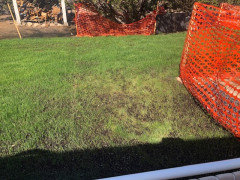
Could it be any of these?1. Too much milorganite?
2. Too much water?
3. Too much compost causing root burn?
4. Too heavy application of the tabasco sauce mixture (applied twice about 10 days ago)
5. My black thumb?
What should I do to fix it?
This lawn is 100% tall fescue. I contemplated adding a small amount of Kentucky Blue Grass seed but resisted that temptation because I read that the lawn would not grow to an even height and that the KGB would eventually take over. However, after overseeding twice to try to fill in bare spots, I'm starting to worry that I will need to constantly re-seed since tall fescue doesn't spread to repair itself.- 5 years ago
It's probably a bit of damp-off fungus from the extended watering. That happens. In this case, there's not much to do except change the environment, which won't happen until you stop watering (adding an anti-fungal would work but...it'll come right back again as you can't kill everything, and anti-fungals really aren't for use on infant plants).
Back off on the watering immediately to every other day and abort any additional seed in those areas, it's a loss (although even with every other day watering, some will still sprout).
Keep an eye on that, though. If it spreads, it's time for an anti-fungal even if it causes damage. kendog2
Original Author5 years agolast modified: 5 years agoThank you Morpheuspa,
Dang, it was my black thumb. I will reduce watering to every other day. Does that mean that we are stuck with the bare spots until the spring? I had hoped to avoid planting seed in the spring because of the risk of crab grass. When it is time to over-seed, should I include some Kentucky Blue Grass? I really wish this lawn had the ability to fill in bare spots without constantly over-seeding.
How about sprouting some KBG seeds in pots, then transplanting the new plants into the bare spots so they can begin to fill in on their own? Would this method make it possible to avoid over-seeding? Some of the tall fescue has grown outside the lawn boundaries. Would it be better to transplant tall fescue or KBG seedlings into the bare spots?
- 5 years ago
You can certainly pot-seed KBG and transplant that in spring, or pot-seed TTTF and do the same with that. Or transplant bits and pieces that invade other areas and move those to where you want lawn. I think a fair number of us have done all those tricks (I certainly have).
If you pot-seed, use 4x4 pots for sufficient depth. You really do want those roots to go deep as transplanting them will be one heck of a shock, and adjust to sunlight slowly and carefully at first if you start indoors over winter, just like any other indoor plant (a week of slow adjustment is the normal way of doing things, and the same as I do for my annuals that start in the cellar).
Grasses, however, can be taken out in April when the weather turns "nice enough," as it were and don't need to wait until all threat of frost is gone. They don't care. Keep damp, just like transplanted sod, since...well, it kind of is, just with more root systems. kendog2
Original Author5 years agoThank you. If I introduce Kentucky Blue Grass into the tall fescue, will it cause the lawn to grow unevenly in height or look patchy because the two varieties won't be evenly mixed throughout the lawn? Will the KBG end up eventually overtaking the TTTF? If it were your lawn, would you add KBG or stick with pure TTTF?
- 5 years ago
Tri-mix lawns thrive with three species and usually five to eight cultivars that live together quite nicely, so as long as you choose a compatible cultivar, you'll be fine. I didn't see mention of the specific TTTF you used when I reviewed the thread above, so it doesn't seem to be a specialty. I can't read much from the photos above, but again, it didn't seem to be a hybrid TTTF. So any off-the-shelf KBG would be fine and you actually don't want a hybrid KBG. The colors wouldn't match and something like Midnight II would have a radically different color (dark blue-green) and growth rate (slow).
Older cultivars and lighter colored KBG grasses (same thing) will be what you want.
I'd have no objection to adding KBG as I have a pure KBG lawn in the first place (I'd actually be working on eradicating TTTF that snuck in due to its lack of self-repairing ability and the fact that it doesn't have the color range that I was looking for--my opinion on this subject is possibly not the one you really want, however, as I'm a stickler for these things with a strictly limited tolerance for color variance in the lawn and gardens, just like anywhere else--but I am, in part, a visual artist in my copious spare time).
It won't be a problem, it will work under the same care (KBG does like a bit more feeding than TTTF on average, but a well-fed lawn works overall fine for both. Watering is the same; KBG is tolerant of less watering overall. Over time it'll take over, but as you overseed you probably want to do it with KBG. kendog2
Original Author5 years agoI thought you must be an artist after I looked up what the word, "gesso" meant. I'm not an artist but I am a perfectionist and would not be at all tolerant of any color variation in the lawn. Our previous lawn was KBG. It didn't grow well but I think this was due to the extremely compacted ground, not because of the type of seed we used.
For our current lawn, we chose Pennington Smart Seed drought tolerant tall fescue blend.
Here is the ingredients list:
16.35% Rebel V Tall Fescue
12.65% Penn RK4 Tall Fescue
12.55% Rebel XLR Tall Fescue
0.29% Other Crop Seed
50% coating material
I am surprised that KBG is more drought tolerant. I was under the impression that TTTF requires 50% less water than KBG.
We chose it because we have a dog and thought that the TTTF would hold up better to traffic.
Thank you so much for pointing out that some varieties of KBG would be a different color than our tall fescue grass. The KBG seed that we have on hand is two parts Moonlight SLT and one part Bewitched. I suspect that these aren't the regular off the shelf types of KBG that would blend well with our lawn?- 5 years ago
Yeah, I'm finishing my holiday designs right now. It's always fun (/sarcasm). I actually strongly prefer the Halloween designs as I really like the creepy stuff and really just like doing florals and landscapes the best of all. But people do demand holiday kitsch.
KBG actually demands more water than TTTF to stay on its feet and look perfect, but reacts better when given less water than TTTF will. The fescues will tolerate it for a while, then up and die. KBG goes dormant and looks terrible pretty quickly, but returns and acts like nothing ever happened when temperatures cool and rains return.
I don't irrigate. Even after this summer, the lawn looked fine by September 15th. Of course, it looked horrible on July 15th.
With the grasses you have, the Midnight II would probably be noticeably darker...but I'm seeing that the Rebel V matures fairly dark to begin with from the NTEP report (your color may be pale due to the younger age of the grass at this point). I might be inclined to try some pots and see how it matches. Bewitched will be a good match for Midnight II, so no problem there, and I've mixed the two in my lawn (which is Midnight II, Moonlight, Bedazzled, Bewitched, and Prosperity).
The mature colors in fall for those are pretty much the photo of the recovery phase of my lawn (which is exceedingly well-fed, resource-balanced, and iron-heavy). This was in early-mid October as I was grinding the gardens into the lawn, so the trash on it is actually the bits and pieces of garden as they haven't settled in. I'm standing on the worst bit of lawn that didn't recover perfectly from the drought to the southwest shooting toward the north-northeast. Those little holes will close in April.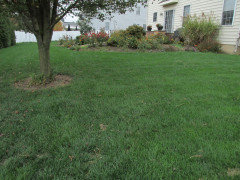
kendog2
Original Author5 years agoWow, it sounds like your artistic creations are very professional. I have absolutely no artistic talent and admire those who do.
Thank you for explaining the differences in drought-tolerance between KBG and TTTF. Not irrigating isn't an option here so I won't need to worry that the grass will die, except if the sprinkler coverage isn't perfectly adjusted.
Your lawn looks very beautiful and healthy. I like the dark green color and was beginning to regret my decision to go with TTTF due to the pale color. I'm happy to learn that it will darken with age. I will take your advise to grow some of the KBG in pots. The seed is five years old so it will be interesting to find out if it is still viable.
I looked up fungus infection in lawns. It sounds like fungus is a serious problem that isn't easy to get rid of. I realize that it was the result of keeping the soil too wet in my overzealous attempt to get the new seed to sprout. Is it likely that the fungus will permanently disappear now that I have stopped the excessive watering? I am watering by spraying with a hose and have not been using the automatic sprinklers. Should I avoid watering the part of the lawn that has the fungus? Would it be better to let that section die or just water it ever other day with the rest of the lawn?- 5 years ago
I've painted for ages. :-) I don't post here much because...well, OT...and frankly, there's some Nasty Nellies (with no art education or training) who just love to make horrible comments, so why bother? I do have an Artists thread over at another lawn place where I post sketches (rarely the finished stuff) that I do on canvas board.
Color's a combination of species, cultivar (inbred color), soil, and treatment of the grass. So your mileage can really vary here. My old lawn was much lighter, which was why I replaced it. Plus not as dense, healthy, or self-repairing. Time will tell and there may be another reno in your future. I did three before I got it right, so...
Fungi can be a major problem and can wipe the entire lawn...but also don't flourish when conditions aren't right. Colder temperatures, dry air, and frost aren't conducive to most fungi, which prefer warm and wet, so I don't think that's going to run rampant. I don't tend to panic much in November about fungi, even ones like this. Rust, red thread...even less. They're seasonal, don't tend to do damage, and will go away shortly.
Yours has a trim window in which to flourish and that window is rapidly closing if you cut back the water. Things may stay warm there, but they don't stay wet in desert southern California. kendog2
Original Author5 years agoWow, that's sad. It is our loss not to see your artwork. Those Nasty Nellies seem to pop up in a lot of places. Funny how people are so prone to being rude online. I doubt many of them communicate that way in person.
Thank you for another helpful reply. I apologize for the long delay in responding. I started to reply several times but was distracted as so much has been going on. Your suggestion that I might have more lawn reno's in my future is scary. I am a perfectionist but I sincerely hope you are wrong (so does my husband). We need to put this lawn project in the rear-view mirror. A large number of landscaping and major home improvement/remodeling projects are waiting to be completed. (Not sure if they will all get done in our lifetime.)
We have 81 California Junipers on our property, some of which appear to be over 100 years old. Due to years of drought, they have suffered the loss of many limbs. I've had to begin watering them and trimming off the dead growth. I could probably spend the next year or two focused on that task alone.
Meanwhile, nine months ago, my husband got a job in Arizona. He is renting a room there and comes home every couple of weeks. He’s hoping to find another job in California as Arizona real estate is very expensive. Sorry, way too long of an explanation of why I hope not to plant new grass again. Lol.
Some sections of the lawn are turning a lighter shade of green. Should I apply more milorganite or some other type of fertilizer? Temperatures are now in the low 50’s to low 60’s.- 5 years ago
There are certainly other forums where drama is not allowed. :-) Of late, I've been knocking out Art Bits (small canvases of 2-3" size that are meant to be placed in nooks and crannies, plus holiday-themed things and gifts that are for the holiday, but not themed. So I'm going through whites, reds, and greens like mad. 11 days left. 2 major canvases to go. I'm a little crazed. :-)
I was, perhaps, being a little extreme about the renos. You have to be a serious hobbyist before doing multiples; repairs and occasional overseeding will probably be fine! I do them because...well, new stuff comes out. Better stuff.
And you'd rather focus on the junipers anyway. Do that instead, then maybe come back to the lawn when you have time. Just give it normal maintenance and that'll seriously improve it beyond all belief.
And yes--if the shade of green is lightening and it looks like you're still in "fall" for you guys, a feed is just fine. Milo will still work in the (average) 55 range, if a bit slowly. Synthetics would also be just fine in that range if you'd rather.The normal "lower limit" for organics is around when soil temperatures start dropping under fifty or so, but even so, they still work. Milorganite is a bit more forgiving as it's a bit more active at lower temps (and has a lot more water-soluble nitrogen in faster forms). I'm more willing to give it a pass at cooler temperatures. Plus the iron will help darken the grass (assuming a good ion balance with Ca, Mg, and K, an unknown, but we'll make the assumption at this point if it's worked in the past).
kendog2
Original Author5 years agoThank you! A belated Happy New Year to you. I hope you survived your busy holiday painting season and that it was very successful. I always feel a bit relieved when the holidays are over as I convince myself that next year I will be more prepared. Haha.
I appreciate your encouragement very much. For now, I'm happy that the lawn isn't dead. I just need to focus on aggressive and regular application of the tabasco rabbit repellent that you suggested.
- 5 years ago
I lived. It went well. Right now, I'm relegated to watercolors done in the corner and occasional finger painting. :-)
There's nothing wrong with nailing First Principles and moving on later, just like the finger painting.
It may not be Great Art like you can produce with months and a paintbrush, but if you're willing to get your hands dirty and have some fun, you can definitely produce some show-worthy results. This is one I don't care if people criticize; the smallest paintbrush I used was my right pinky and I had a huge amount of fun getting absolutely filthy. I will never get the red paint out of that shirt and I think there's still some in my hair.

kendog2
Original Author5 years agolast modified: 5 years agoSo sorry, I just saw your reply. Thank you so much for sharing the photo of your artwork. It is absolutely beautiful! I love the vibrant colors of the flowers. The vase looks very real too. I can't imagine why anyone would criticize your work. It is amazing.
There are some artistic people on my husband's side of the family but I didn't inherit any such talent. For my son's birthday, I made him a guitar-shaped cake. I tried to draw the guitar body from a photo on my computer screen but wasn't even able to accomplish that simple task. I had to find an actual pattern to trace. Lol.
Our lawn is full of weeds which are thriving and multiplying. Some are even beginning to produce flowers. A small center section of the lawn is growing tall but the rest is only about a quarter of an inch in height. My son said that it is because the lawn is still dormant. Hope he is right.
I have been using a weed excavator tool to pull the weeds which works well but there are so many that I think I will need to use a chemical weed killer. Our local garden center carries Bayer Weed and Crabgrass Killer. Home Depot and Lowes have others such as Roundup for lawns and Ortho Weed B Gone. Does it matter which one I use? All of them seem to have good and bad reviews. Should I also be using a pre-emergent or is it late for that?
- 5 years ago
Thanks! I'm back in the game with Season Affective Disorder paintings now...lots of Prussian blues, indanthrene blues, Payne's grays... :-) It's done nothing but snow and sleet up here.
Any of the weed killers you named should be fine for fescue, but check the labels. I would tend toward Ortho Weed B Gone Clover, Chickweed, and Oxalis as a fairly wide-spectrum killer. Just spot-spray everything and watch it die in 14 days or so.
You can always apply a pre-emergent! No matter how many weeds have sprouted, there are plenty more to come. Just choose something like Dimension 0-0-7 that doesn't contain a nitrogen feeding. You don't want to force the grass right now; let it sleep if it wants to.
kendog2 thanked User - 5 years ago
I got a commission for the Appian Way, so that's on the easel right now. And a lot of cypress. :-) Mostly, my natural instinct is to follow the season itself, so snow when it snows...
The great thing about all this is when guests walk in, the wall paintings are always different. :-) If you don't like what you see, come back in three months.
So while we're due for yet another punch of a three inch storm tomorrow, I'm mixing bright and dark greens, sun-warmed grays and working with ruddy Titanate off-whites.
Overseeding would definitely be best done in fall, but if you have to in spring, you have to. Just be prepared to coddle that over summer. In that case, you can use Mesotrione as a pre-emergent, or Tenacity (they're the same thing). Sprayed Tenacity will take out a fair percentage of weeds, and keep weeds from sprouting in those locations for about thirty days. It's not easy on fescues, but they'll survive the experience and sprout through it, but they tend to whiten a bit. While a bit ghostly-looking, they'll recover.Starter fertilizer with Mesotrione, if used when overseeding, keeps the weeds down for 30 days during the overseed period. It's not perfect, but it does certainly help, and it's the only pre-emergent you can use with northern grass seed. I do wish they'd make it available without the fertilizer, which new grass doesn't really need, but the only other option is to spray with Tenacity (which would actually be just fine and I recommend that instead if the person has it).
kendog2
Original Author5 years agoI need to figure out how to get email notifications when there is a reply.
Oooh, congratulations on getting a commission of your artwork. I think it is a great idea to change the wall paintings every few months. I bet not many people do that.
Yeah, I probably should wait to overseed until the fall. I've never heard of Mesotrione or Tenacity. I will look into those.We burned some of our California juniper branches and Joshua trees and have lots of ash to dispose of. Would the ash be useful as fertilizer for the trees or is it best to throw it away? I read somewhere that ash is high in salt. Our soil already has too much salt (605). I don't know if it is acidic or alkaline. The old soil report doesn't seem to include that information.
- 5 years ago
Ash is alkaline, usually. You can use it up to 10 pounds per thousand in an unknown soil, but not really any more than that...I'd usually say limit it to that or less with no consequences expected, even in a saline soil or one that's alkaline. It won't twist things too much.
kendog2
Original Author5 years agoThank you again for the advice on overseeding and getting rid of weeds. I didn't end up overseeding. I did spray some weed killer which worked well. The lawn has taken off better than I could have every dreamed. It is dense, lush and and needs mowing every two to three days. I can hardly believe it. Our old lawn was nothing like this. It grew so poorly that we didn't need to mow it more than a couple of times all summer.
The success of this lawn is mostly due to your good advice. I truly appreciate it. Some areas seem to be slightly lighter green than the rest of the grass. Hopefully, it isn't too late to fertilize. Our temperatures are in the 70's and mid 80's now. What type of fertilizer should I use and at what rate? How often should I apply the fertilizer? Is it best to avoid fertilizing in the summer? Thank you.








kendog2Original Author