

(OT) Quince
Over the years, in the course of DH's casual planting of fruit trees we've acquired three quinces, and I've been admiring them this fall. They're very pretty small trees that grow and produce well in spite of the total neglect they enjoy in our garden. This year they've outdone themselves: two of our three trees are absolutely loaded with large, healthy acid-yellow fruits, as bright as suns. I saw some for sale at a local greengrocer's, and ours were twice the size and much handsomer. Anyway, what a tree: healthy, thrifty, good-looking, productive; and ours live without spraying or any other kind of care, either (I will have to prune back the shoots of at least one of ours this winter, though). The fruits need to be cooked: DD made a quince pie and it was fine, similar to apples.
This is a good area for temperate climate fruit trees in general--say I, who don't spray and who don't know how to prune orchard plants, but I need to learn--but the quinces are particularly rewarding. I was inspired to do something with them by my Albanian friend and garden helper, who has a healthy respect for food. She took home a crate of fruit the other day, and I need to collect more for her, so it doesn't go to waste.
Comments (27)
Related Professionals
Aberdeen Landscape Architects & Landscape Designers · Tulsa Landscape Architects & Landscape Designers · York Landscape Architects & Landscape Designers · Corpus Christi Landscape Architects & Landscape Designers · Nashua Landscape Architects & Landscape Designers · Queens Landscape Architects & Landscape Designers · Salina Landscape Contractors · Chambersburg Landscape Contractors · Yuba City Landscape Contractors · Lubbock Landscape Contractors · Niles Home Builders · New York City Home Builders · Garden City Home Builders · Santa Fe Home Builders · York Home Builders 11 years ago
I have japanese quince, and enormously envy you your full size quinces - I love love love quince jelly, but my little suburban garden does not really have room for a full size one. I've looked into different root stocks but haven't so far found one that will keep to a manageable size. Maybe when the giant ash dies.
- 11 years ago
In Virginia we had a quince that had a great tart fruit that my Grandmother made into a wonderful tart jelly. It also was the one shrub we could depend on for forcing blooms inside in the late winter. Nothing like vibrant red pink blooms inside with snow outside.
 11 years ago
Apart from using quince in dessert recipes, we cook quince with pork over here. Quince have to be protected from med fruit fly if grown within this horrible pest's range. I grow a small tree in between my citruses.
- 11 years ago
Oh yes, Nik - quince and pork would be wonderful - any chance of a recipe before I use up all the quinces? My neighbour's quinces had trouble with fruit fly last year but this year she used some type of trap which she hung in the quince trees - I'm not exactly sure of what she used but I do know that two of the ingredients were ammonia and fish trimmings - you can imagine the smell. Anyhow, it seems to have worked very well because I've only come across the odd quince this year that has evidence of the fruit fly (if that's what causes the problem with the cores).
Tricia
- 11 years ago
Ah Tuderte, I'm very bad in translating recipes into English... Maybe you can try googling the following and use google translate or Chrome to translate into English. I just tried it with a couple of recipes and it produces half decent results... Careful since the word for quince in Greek is the same as the word for one type of sea shells so if translation results in 'pork with clams' do not worry, it will be about quince..
- 11 years agolast modified: 11 years ago
Re med fruit fly, I have to use all of the following to get some (not complete) protection from the rampant med fruit fly over here:
1. Feromone traps with ammonia containing pyrethroid insecticide (extremely stinky)
2. Feromone bait spraying with mollases containing spinosad insecticide (less stinky more of a sickly sweet odour)
3. A couple of spinosad foliar sprays per season (also controls the odd thrip)
The first two are highly selective, the third is pretty selective if applied properly.
- 11 years ago
Many thanks Nik - after asking for the recipe, I googled 'Greek pork with quince recipes' and got quite a few hits. One, in particular, looks very appealing - just a bit strange to me because I'm used to cooking quinces for hours until they develop a deep red colour which doesn't seem to happen in any of these recipes. Most seem to use cinnamon which I've not used with quince before but if I use cassia bark it would be similar and not so perfumed.
Re: the med fruit fly -
You must really have a serious mff problem there! Do they target quinces in particular or are they indiscriminate?
Tricia
- 11 years agolast modified: 11 years ago
The flies are opportunistic and target most fruit with skins they can penetrate to lay their eggs in (but they are particularly attracted to yellow-orange coloured ones for some reason).
Nutmeg and allspice are also commonly used in such stews. I'm not very fond of cinnamon myself. I like quince mixed with prunes in stews.
 11 years ago
OK, you all have gone and done it! I LOVE Quince!!! I wanted to plant one tree/bush last year and instead planted a blood orange (which I also LOVE) instead. I have to get rid of my Meyer Lemon tree as it has reverted back to root stock. I was planning on getting an Sweet Lemon from Australia. I love growing unusual citrus--I have a Yuzu and an Australian Finger Lime, Mexican/key lime, variegated pink lemon, blood orange, and now you have me back thinking about quince again. I just love them. Even though they do so well here in my climate, they are hard to find. Will have to do an internet search again....Anyone have a favorite variety? I have cooked with the pineapple quince as well as the "regular" quince. The plant would need to be on the small side as it would be in a very large container.
- 11 years agolast modified: 11 years ago
fduk,
In the UK you can find quince tress suitable for the smaller garden or large containers and hardy enough for your conditions. Look for 'Serbian Gold' or 'Leskovac' (they refer to the same variety). They should usually be grafted on a dwarfing rootstock. I think they should be reasonably widely available over there.
mustbnuts,
Sorry no clue what may be available in the US, but the size of the tree should greatly depend on its rootstock. Also there are different varieties with different hardiness characteristics. Make sure what you get is not hardier than what you need since it will probably require more chill hours than you could provide for good blooming.
Good drainage is important for quince trees as they can suffer from crown blight. Treating them similarly to citrus with regards to watering and drainage works for me. I seldom fertilize my tree it just takes the runoff from fertilizing my citrus. I think it wouldn't need more than the occasional nitrogen in spring when young and potash in spring and fall when fruit bearing and I believe it could do without much fertilization in reasonably fertile soil.
I prune instinctively just to keep it wider and shorter because mine has a tendency to become tall and lean. It may need support to its branches and/or fruit thinning when younger to avoid branch breakage.
- 11 years ago
Thanks Nik. I will check this out. I know our local university participates in the local quince days (don't know if they are still doing that or not). I will check with them and see. I saw both of the varieties you mentioned on the internet, so I shall see what I end up with.
- 11 years agolast modified: 11 years ago
Quince may not be good for fresh eating, but the fruit has the most wonderful aroma... It kind of smells like the best apple you have ever tasted, but the fragrance is not quite like apple or pear. I will just say this: if there was an apple or pear with the fragrant aroma of quince it would be very popular. (There are ancient accounts of a variety of quince that could be eaten raw, but this variety has long been lost.) I would put quince in the kitchen fruit basket just to bring a little fragrance into the space.
 11 years ago
The ancient variety may be lost, but I do recall some modern cultivars producing fruit described as being fine eaten raw.
:-)
~ChristopherMelissa Northern Italy zone 8
Original Author11 years agoAbout the fragrance, a friend told me her grandmother used to hang quince in the closet in the winter for its odor,
- 11 years agolast modified: 11 years ago
Melissa and Tuderte in Italy, do you know the variety names of your trees? I have just one tree, which is a very old Balkan variety called 'Gigante di Vranja' in Italy. It produces very fine large pyriform fruit but is of an erect habit which quickly becomes too tall for easy collection.
I have also read that most of the modern commercial varieties are self sterile trees (not sure if that calls for cross polination from another variety or just from another tree of the same). I don't know if that is true but care should be exercised when obtaining a single tree to get a self fertile variety.
Also, as with most heavily producing fruit trees, plenty of potassium in some form should be provided every year (unless one doesn't pick up the fruit and just let's them fall and rot in place...). Quince in particular seems to be a heavy potassium user. If not enough potassium is present, fruit quantity and quality will suffer. Adequate potassium helps the fruit build up their sugar content.
Melissa Northern Italy zone 8
Original Author11 years agoI don't know the name(s) of ours; they were bought at different times but look like they're all the same kind. They could be the variety you describe: the fruit corresponds, but I haven't seen our trees getting big, though one will have to pruned lower this year. I don't know if they've just grown slowly (no water or fertilizer) or if they naturally stay the size of a large shrub. They seem to want to develop a shrubby habit. Ours fruited heavily this year. Up to this year we've left most of the fruit on the tree. On the other hand I've never had our soil tested for its mineral content. The clay, once adequately amended with organic matter, seems to be good for a lot of plants. I take note of your comments about potassium. N.B. we had just the first tree for a while and it did fruit, so I take it it's not a self-sterile kind.
By the way, you mentioned in another thread that the during the process of decomposition organic matter in the soil will consume nitrogen, making it desirable to add nitrogen for the plants growing there. Does it make a difference if the organic matter was collected while still alive (hay, pruned live twigs and canes) or had died (dead leaves and organic detritus)? Seems I read something about this once.
- 11 years ago
Green fresh matter has a larger percentage of nitrogen by itself.. If fertilizing by embedding uncomposted organic matter it's good practice to mix green stuff (e.g fresh cut grass, leaves, the best being fresh cut fabaceae) with dry brown..That's what's required in composting. In a sense what you're doing is composting directly in the soil.
Look there is this famous carbon to nitrogen ratio (C/N) which determines all about decomposition. The higher the carbon mass which needs to be decomposed (e.g. woody matter, brown stuff) the more nitrogen the soil bacteria will require to decompose it, thus more nitrogen needs to be provided otherwise soil available nitrogen will be 'drawn down' (only to be released again when decomposition is complete). In soils very nitrogen poor decomposition will slow down or even stop.
I would try to freely sow fabaceae if I were you (e.g. alfalfa, legumes, trifolium) cut the grass when green and use that as green manure in combination with dry hay.
Melissa Northern Italy zone 8
Original Author11 years agoThanks for the refresher course! I had read this years ago, then forgotten it. All the organic matter we use is hay, cut of course from green grass. Is it green stuff or brown stuff? About your last recommendation, in fact for the last few years we've been sowing clover and alfalfa in all the grassed areas where the growth is thin or poor. It's been working fine for greening up the garden, improving the soil and discouraging erosion; and, our shoes don't get as clay-caked as before. We have alfalfa here and there, remnants of ancient plantings (from before we bought the property) and I do cut that and mulch with it.
- 11 years ago
When you cut some green stuff and let it dry much of the nitrogen escapes literally into thin air.. Manure fresh out of the stable which has a lot of urine is a nice, though smelly, alternative to green stuff. It often contains hay which simplifies things. Or DH and his mates can help for that matter, after having a few pints... But you can't plant immediately in these... I make my life simple and use urea fertiliser in the compost.
Melissa Northern Italy zone 8
Original Author11 years agoAha: got it. I was thinking of supplementary nitrogen; sounds like I had better acquire some and begin using it.
- 11 years ago
Hi Nik, sorry I've been away for a couple of days so I've not been able to check my computer. I've just been going through my bag of labels (because I can't bear them on the trees so, for years, I've been putting all the labels of my plants into a plastic bag so that 'soon' I'll start a spreadsheet and know what I have in my garden ....
In the meantime, I've found the two quince labels and they say -
'Cotogno maliforne Tewnkara' - (apple shaped quince 'Tewnkara') - self-fertile - ripens September - suitable for jam. Round yellow fruit.
The other label reads -
'Cotogno Piriforme De Beretzky' - (pear-shaped quince 'De Beretzky') - - self-fertile - vigorous - perfumed fruit suitable for jam. Large, elongated yellow fruit.
However, I think that the 'pear-shaped' quince was mis-labelled because both seem identical to me. I've picked the fruit from the one that was meant to be 'pear-shaped' (they were definitely round) and poached them because they were quite small. The flavour was just like every other quince I've ever cooked.
The quince that still has fruit on it looks like this -
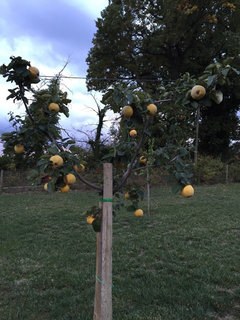
So, it's definitely a round, or 'apple' form quince, too.
Hope this helps ...
- 11 years agolast modified: 11 years ago
Hi Tuderte, mine is this one. I've seen it called 'Gigante' (giant) or 'Monstrueux' (monstrous)... Monstrueux de Vranje
Melissa Northern Italy zone 8
Original Author11 years agoThat looks like it could be our variety (I notice they say it's self-fertile). Ours is the only quince I've ever seen, so I don't know how variable they are.
- 11 years ago
Btw, quince trees do have a tendency to get mildew on their leaves, it is not the exact same fungus as the rose one, but it does grow under the same conditions, so when it does get it I know that PM pressure is high. It doesn't get it every year and it does not seem to affect the fruit although I suppose if a tree is badly affected season after season it might affect its overall health.
- 11 years ago
I think your 'Monstrueux de Vranje' may be one of the varieties that my neighbour, Anna Paola, has. The fruit are certainly enormous - they seem to weigh around 400g each. BTW, they make excellent jelly and cotognata - as well as the poached quince that I love.
I'll have to hope that my round quinces develop larger fruit over time but I'm pretty sure that one of my trees must have been mis-labelled at the nursery (grrr) and I have two of the 'Tewnkara' variety. Oh well ...


tuderte