Software
Houzz Logo Print
ashdep

Need more leaves!

11 years ago

I've had my fiddle leaf fig for about 2 years. It was very shell shocked when I first purchased it so I did not immediately repot. I had a lot of leaf drop at first. Then the watering schedule was hard to pin down- leaves browning, then I think I may have had a fungus that improved with a good couple of flushings/showerings of the roots.

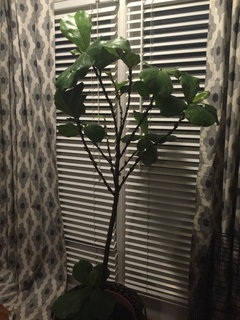
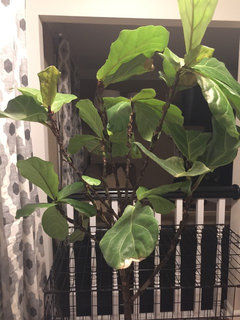
I've nailed down a good watering schedule and have now repotted the tree in organic potting soil and in a 16" pot. The tree is about 5' and is, in fact, a tree and not bush. It has one long trunk with 3-5 branches at the top. I have leaves that have grown since repotting but they are focused on the ends of the branches. I also have a sprout at the base of the trunk.

How and when can I improve the foliage? Will this happen now that I have repotted, or is there a special way to prune so that more leaves grow on the entire branch as opposed to just the ends?

Thank you for the help!

Ashley

Comments (16)

  • 11 years ago
    last modified: 11 years ago

    That pompon/poodle look is very often due to either a mobile nutrient deficiency (usually N) or root congestion in the original root mass. There are ways to force back-budding by pruning, but the tree's response is going to be very lethargic at this time of year, especially if the plant is highly stressed by cultural problems. If you haven't repotted yet, you'll get the most from your efforts if we work together to formulate a plan that includes a full repot (which includes root pruning and a change of soil) in the part of the growth cycle that's most advantageous to the plant, but not knowing where you live or wanting to tell you something you can't rely on, I'll wait to find out where you call home. Essentially, the plan centers on working with the plant's natural rhythm to get it to a point where it's healthy and has a lot of reserve energy, then cutting it back during the part of the growth cycle when you can depend on very robust growth, which is when the tree will respond to your ministrations with the most enthusiasm.

    Al

  • 11 years ago
    Thank you!

    I live in the Southeast US.

    I did, in fact, just repot it as I felt it needed a new (bigger) pot (it was still in the one I bought it in... I know, I know...) and soil and that that benefit was better than waiting until the spring. Hopefully the re-potting and changing of soil will provide more nutrients?

    Any other thoughts? Much appreciated!
  • 11 years ago

    A repot includes reducing the volume of the roots, correcting problem roots, and changing soil, so USUALLY the plant would go in a smaller pot. Did you root prune and bare-root the plant? REPOT time for you would be early to mid-June. Potting up is just moving the plant to a larger pot and filling in around the old root mass with fresh soil. Potting up can only partially/ temporarily ease the impact of root congestion, while repotting can eliminate the limitations entirely.

    Al

  • 11 years ago
    Good to know. I was advised by an employee at big-box-retail-that-shall-remain-nameless to repot and remove as much excess dirt from the root ball as possible, which I did. The roots did not appear to be bound at all and actually looked pretty healthy, per my very amateur eye. The retailer also advised me to place it in a much larger pot (20") which I didn't due simply because it would not fit into my basket that I keep the tree in.

    I will try root pruning in June, then.

    When should I fertilize?

    And keeping with the original question, all of this will lead to more leaf growth, correct?

    Thank you!
    -Ashley
  • 11 years ago
    Also, I will send a picture when I arrive home
  • 11 years ago
    Also, I will send a picture when I arrive home
  • 11 years ago

    The questions, "When/how should I fertilize" seem simple and straight forward, but how you should fertilize is primarily determined by soil choice and watering habits. Because I use a soil that allows me to flush the soil at every watering, I fertilize weekly in the summer and every time I water (at a very low rate) in the winter. This approach can work very well for open (highly aerated and fast draining) soils. When using soils that don't allow you to flush the soil with each watering, there are issues that need to be considered, Since you CAN'T flush the soil with each watering, mineral salts from fertilizer solutions and tap water build in the soil, quickly increasing the EC/TDS (roughly - the salt level) of the soil solution. Fertilizer RATIOS (different than NPK %s) are a very important consideration when it comes to managing fertility, and nutrient ratios can very quickly become badly skewed, especially when the fertilizer's ratio is not even close to the ratio in which the plant actually USES the nutrients. Imagine what would happen in an automobile factory id we bought tires, steering wheels, and headlights in a 1:1:1 ratio. We would very quickly run out of tires sand have piles of steering wheels in every corner of the factory, So it is with nutrients in the soil solution when we provide fertilizers, the ratios of which don't closely correspond with how the plant actually uses the nutrients. In the soils we can flush, it's like pressing the fertilizer reset button every time we flush the soil of excesses. When using soils that can't be flushed w/o consequential impact of root health function, we're left to suffer the limiting effects of the badly skewed nutrient rations in the soil solution.

    There are just too many benefits associated with using soils you can water correctly w/o penalty in terms of your plants' vitality to not work toward ensuring your plants have at least the opportunity to realize the greater measure of their genetic potential these soils offer.

    Tell me more about your soil and watering habits and I'll help you decide how to fertilize, but the most significant improvement in your ability to maintain your plants in fine fettle is going to come from your ability to ensure a healthy root system and adequate light.

    Al

  • 11 years ago
    The potting soil I've used is supposed to be one that drains well and seems to be very aerating. I typically check the soil 2-3x a week and only water when the first inch is dry. This seems to be about once a week/week and a half. This might change during the colder months. I've given the tree a couple of "showers" outside and allowed the soil to drain really well, but I don't do this regularly and I probably won't do it now that temperatures are cooling off outside.

    Should I be using filtered water to water it or would a more regular flushing as you describe be more beneficial?

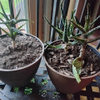
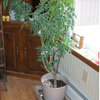
    I've attached two pictures that can better show the lack of leaves on the stems. I will say, though, that the leaves are looking healthier with the new soil.
  • 11 years ago

    If you're watering when only the first inch is dry, you're over-watering. Best would be to use a smooth, sharp wooden stick pushed deep into the soil - all the way to the bottom would be ideal - as a 'tell'. If the stick comes out dark or moist, hold off on watering until it comes out almost completely dry. Before long, you'll be able to get into an appropriate rhythm, but that rhythm will change with the seasons, so don't forget the stick entirely. HOW you water is a very important part of what sort of opportunity your plant has to realize as much of its genetic potential as possible.

    Water filtering systems based on reverse osmosis provide excellent water for plants, but water from ionic exchange systems leads very quickly to extreme toxicities of Na and or K, depending on the salts being used during the exchange, so don't use that type of water.

    If you're not watering so you're flushing the soil each time you water, you should thoroughly flush the soil on a regular basis. About every 4-6 weeks would be good. Once I know how you're watering, what you're watering with, and how often you'll flush the soil, I can help you with nutritional supplementation.

    Even though your tree isn't in the best of health, its branch pattern seems to offer a lot of potential. Key points to concentrate on:

    A well-aerated and fast-draining soil

    Keeping your watering under control

    Plenty of warmth and very bright light, with some air movement if possible

    Regular fertilizing with an appropriate fertilizer and taking steps to keep the level of salts in the soil as low as possible w/o the tree suffering nutritional deficiencies

    Repot and root-prune around the summer solstice, using an appropriate soil

    When normal growth resumes after repotting, cut the top back. We'll revisit how to best do that based on what the plant looks like next Jun or Jul.

    Sound like a plan?

    Al

  • 11 years ago
    This is fantastic information. Thank you!
  • 11 years ago

    I'm glad you think it sounds reasonable, Ashley. Sometimes small changes and application of a little science yields big dividends. I'm quite comfortable thinking the watering issue will make a big difference in helping the plant hold its own over the winter (as opposed to back-sliding), and once you get the repotting and pruning tended to, your plant should really start to reward you for your efforts.

    It's always exciting for me too, when I come across growers who feel like they're finally onto something that makes sense to them. It's fun to be around people who exhibit that "I'm ready to get right after it" attitude. I count myself lucky when I come across those whose attitudes allow them to move forward very quickly.

    Best luck. Let me know if there are other things you're inclined to think I might be able to help with.

    Al

  • 11 years ago

    How far South? I live in Florida and grow mine in a pot on my patio. It gets a lot of sun. Full morning until about 2pm.

    I would try to increase the light. I notice you have it in the house. Unless your area gets cold, I would keep it outside until the nights get too cold.

    What zone are you in?

    Jane

  • 11 years ago

    Thanks for reinforcing the suggestion the plant could do with more light, Jane. I appreciate that.

    Ashley - your plant's response to cultural conditions is determined by genetics, not geography, so where you live, even your zone, isn't important. In some conversations about plants it can be quite relevant, but not to this one.

    If, by chance, you were contemplating moving it outdoors, geography still wouldn't be important, but temps (mainly night lows) and how much sun it should get would be a significant consideration.

    Al

  • 10 years ago
    Re-visiting this post as I believe it is almost time to consider re potting. The tree has been kept inside during the winter, next to a window with lots of light for at least 4-6hrs/day. Now that temperatures are warming up (upper 60s and some low 70s during the day) should I be moving the tree outside for some more direct light? I hesitate to do this as I would still need to bring it back inside I believe at night (still getting down to the 40s)

    Also, is there a specific brand or key words I should look for when choosing a soil?

    And finally, any root pruning tips or YouTube video suggestions?

    Thanks!!!
  • 10 years ago

    Move it out permanently when nights are reliably above 55*, and in and out during the day as temps allow. If you live in the deep south, consider repotting around Memorial Day. If not so deep south, think second week of June. That gives you plenty of time to read up on soils and decide how you want to approach that part of repotting.

    I'll link you to a thread about maintaining trees in containers - long term. It has lots of information about root pruning and other strategies to help you keep trees healthy enough, long enough, that there's no reason you couldn't pass them down from generation to generation.


    Al

Sponsored
The Steele Group
Average rating: 5 out of 5 stars1 Review
Industry Leading General Contractors in Franklin County, Ohio