Software
Houzz Logo Print
txred0810

St Augustine problems

11 years ago
last modified: 11 years ago

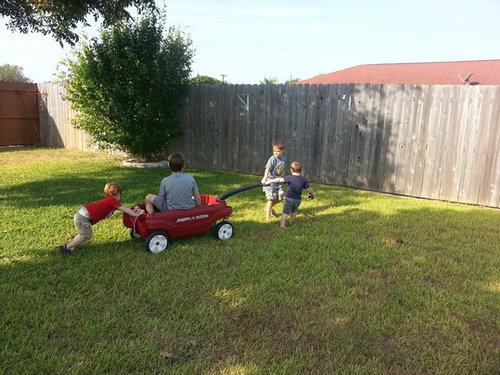
I just moved into a new house and I am a complete beginner when it comes to lawn care. The front yard is about 4000 sq ft and has irrigation. The back yard is about 10,000 square ft with no irrigation. I am currently watering the front yard about 3 times per week for 60 minutes. I have just recently set up a makeshift watering system in the back yard and have watered it about 60 minutes per week but can only manage to do this from about 7:30 to 8:30PM since I do not have timers yet. I also put down Gardenville 7-2 2 about a week ago (40pounds for half of back yard and 40 pounds for front). The grass is cut to about 2.5 inches. If my pictures upload below, you should be able to see the problems. My septic system drain fields have zero grass and the back yard is turning completely brown except under the areas of shade. The front yard is hanging on due to more shade, but has some brown areas where I think the sprinkler system isn't saturating as well. I have a ton of questions, but the first would be, why is my back yard grass dying and what is going on with the septic system drain fields? I am located just north of San Antonio in Seguin TX.


Comments (7)

  • 11 years ago

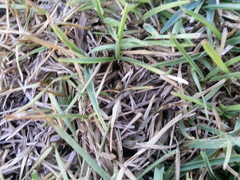
    I'm going to ask for another picture taken from 3 inches above a spot that shows both brown grass and green grass. Please take it in the shade like the area between you and the wagon in the second picture above.

    Generally with watering we talk about deep and infrequent. Deep means 1 inch all at one time. You can time how long it takes your sprinklers to deliver 1 inch by placing some cat food or tuna cans around the yard. Put them in the green spots and the brown spots. The time it takes to fill them is your watering time. My oscillator sprinklers, with my hoses and water pressure, take 8 hours to fill the cans. High flow in-ground systems can fill the cans in 20 minutes. Your time will be different. Infrequent, the other part of the watering mantra, means you wait until the soil dries out from the previous watering. There are many factors in determining when to water but they all simplify down to air temperature. Now that the temps are in the 80s, you can water once every 2 weeks. With temps in the 90s water once a week. With temps in the 70s, water once every 3 weeks. When it's cooler, water once a month. This is the single most important key to success with St Augustine.

    Mowing height is the second important factor. Always mow at your mower's highest setting. Hopefully that is 4 inches rather than 2.5. My neighbor's riding mower only goes up to about 2.5, so I quit using it. I'll mow weeds at that height but I steer around my actual grass (I've moved to a weedy lawn in Bandera). Tall St Augustine grows much deeper and more drought tolerant roots. These two factors account for at least 90% of success with St Aug.

    Fertilizer is much less important. It counts, but if you're trying to improve your current lawn, watering and mowing are the most important. Nice to see you're using organics. I can save you some money on that if you like. Rather than paying $20 for 40 pounds I buy the raw materials at the feed store for more like $10 for 50 pounds. The ingredients in the Gardenville product are unequaled; however, not always needed. If you used that once every year or two, along with 3 total applications per year, you'd be fine. I fertilize with either corn meal ($8) or alfalfa pellets (rabbit chow, not horse cubes ($12)). The application rate is 15-20 pounds per 1,000 square feet or about the same as the Gardenville fert. You can use these organic products any day of the year, or every day of the year, without any fear of hurting anything. They don't need to be washed in like chemical fertilizers.

    There is no reason I can think of that the grass over the septic fields would not be growing. The grass over top of the concrete tank might need more water, but the rest should be fine. I would suspect lack of water (or too much water). If you get your water and mowing height adjusted, you should see it turning around.

    Please post another close up picture so I can look for signs of disease. Rather than writing an essay on disease when you don't need one, I'll wait for the pic.

  • 11 years ago

    My back yard system will currently only put out about 1/8th of an inch an hour. That must be the main issue currently. I believe my front system will do about the same but I haven't measured it yet. I'll bump my mower up to 4 inches. I do have one capable of that height. Here are a couple of more pictures.

  • 11 years ago

    Are you watering off a well or city water? I ask because wells usually give lower pressure than city water, but not always. Water flow is linearly related to pressure, so the more pressure, the more flow you can get. Since almost all irrigation pipes are rated for 200psi or more, you may want to consider installing a booster pump. For myself, I have about 50-60psi normal water pressure. After my pipes branch off to my house I installed a 220v booster pump, tied a 24v relay to control the pump. My irrigation controller has an option for a booster pump and which zones need the booster pump. My in-ground pipes are 1" and found that the standard 1" valve only has a 30gpm flow, this dampened the benefit of the booster pump, so I swapped the valves out for 1 1/2" valves that have a 120gpm flow rate. The pressure in the pipe after the booster pump is 80-90psi and my controller kicks the pump on 10s after the valve opens. I notice that I get about 5 more feet in the radius of what each sprinkler covers and can push seven sprinklers in one zone.

    I built the sprinkler system, added the booster pump, and added 2 more sprinklers in each zone, and then bought an open source controller that can control unlimited zones, the booster, and has a web interface to program it. In hind sight, I would have changed my design and maxed out each zone with 4-5 sprinklers so that I could deliver an inch of water in 30 min for each zone.

    I know this is a different topic that could be in a different form but I thought it might help you with some options.

    On the same token, I have been known for over doing things, but I have fun.

  • 11 years ago

    Yeah I was thinking the back yard was more than just lack of water since it has some different colors than just that dry brown grass gets when stressed. I have rigged up the same type of pop up sprinklers used in my irrigation system in the front yard to help water the back. I have about three of them running in a series and will end up with about 4 different zones for the back yard.

    If I get my watering and mowing straightened out, will the St Augustine I have start to spread or will I need to re-sod some areas, specifically the drain fields that are mainly dirt and weeds?

    I will stop by the feed store tonight and try to get started before all of this rain hits. Thanks for your help!

  • 11 years ago

    St Augustine spreads fairly quickly once the air temp falls below 85 degrees. That means you have two growth spurts during a normal year - one in spring and one in the fall. Each time I would expect to get 5 feet of growth out of the runners that shoot out. It also spreads much MUCH faster in the shade, so be sure you keep that in mind. I gained about 3,000 square feet in 1 1/2 seasons under some live oak trees in George West a couple years ago. But as soon as it hit the sunlight out from under the tree, it slowed down. So keep that in mind, too. You have a lot of sunlight.

    Did I mention mowing every other week except in the spring? Tall St Aug is much healthier and drought resistant than short grass. It also seems to spread better. I let mine in George West get up to 32 inches high (max height). No only did I not have to mow, it didn't need water or fertilizer. It was amazing. Here's a picture of my chow chow wandering through the grass. If you look carefully you can see her ears and the top of her tail.

  • 11 years ago

    I am contemplating planting some more trees for shade but I am a little concerned about the roots interfering with septic system pipes down the road. They would definitely need to be strategically placed. That is some beautiful grass you had. Hopefully I can get mine turned around before it goes dormant.