Software
Houzz Logo Print
mojomom

Hydronic Radiant vs Forced Air

11 years ago
last modified: 11 years ago

We're planning on whole house hydronic radiant and I have been shocked to see a poster opine repeatedly that hydronic radiant "is cheaper" because pex is easy to install. That is in direct contradiction with what we have been hearing from both architects and builders we have talked to that whole house hydronic radiant is significantly more expensive to install and I'm wondering whether they are selling us a bill of goods and what the relative advantages and disadvantages are.

Here are a few comparisons I've found surfing:

Hydronic Radiant vs Forced Air, comfort, costs, etc.

Radiant vs. Forced Air

From these reviews and talking to folks with radiant, that's probably the way we will go (even if more expensive) but I'd love to hear what the experts on this forum have to say on the subject.

Comments (14)

  • 11 years ago
    last modified: 11 years ago

    Hydronic isn't suitable for all areas. It has a great deal of lag time if you have the proper thermal mass necessary to make it efficient. In areas where you have rapid temperature change from day to night or not much winter, it's a waste. Or, if you need AC, it's not very cost effective since you still have to install air handling equipment and ducts for the AC. Might as well do forced air for everything if you need air.

    We put in hydrionic PEX in our shop when we built it. Cost us an extra 2K for the materials. DIY. That would have been 10K if we needed to pay labor. And we still needed the ducting and blower for the AC. We only did it because we could and the costs weren't much different than doing gas fired air without labor.

  • 11 years ago
    last modified: 11 years ago

    Thanks live wire. Will be building in a ski area at 7200' in the Rockies so lots of winter! Talking to builders out there gas fired radiant hydronic apparently is the standard in 1M+ homes these days with forced air dominating in the lower price point homes. I was wondering why that is so if if it is actually cheaper.

    We have gas fired forced air in our 15 yr old spec and while it is efficient, we won't do it again. DD has allergies and at least according to the literature, the radiant will be much superior for that. I do agree lag time is the an issue of concern.


  • 11 years ago

    cheaper is relative lol. My quotes for radiant heat, materials only, ranged from $8k to 11K for 3000 square feet including garage. Labor was coming in around $5k. We nixed the idea because of the absolute need for AC.

  • 11 years ago

    " if you need AC, it's not very cost effective since you still have to install air handling equipment and ducts for the AC."


    A local couple have hydronic heating AND cooling. They circulate cool water in the summer, using a humidifier to remove some of the humidity for more comfort.

    They use solar heaters for the hot water, and I forgot to ask how they get chilled water. Maybe a ground loop.

  • 11 years ago
    last modified: 11 years ago

    We needed to boost heat in two north-facing rooms that the HVAC installer failed to furnish with enough forced air supply. The materials were cheap. The little boiler was cheap. Our contractor paid for the drudge labor to tack up the tubing.

    I love the warmth in those rooms, but would not want to live without the moisturized air throughout the house that is supplied via the forced air furnaces. (We have flow-through humidifiers to prevent mold circulating.) We also need the forced air blowers to circulate cool air in summer. (I also appreciate that we have two sets of air returns -- high on the walls for summer; low on the walls for winter.)

    I never called this 'hydronic' until corrected by someone on the forums. I'd thought 'hydronic' involved underground piping and pumps. I was told it just means using circulated water. ???

  • PRO
    11 years ago
    last modified: 11 years ago

    Sounds like you live in one of those rare climates where radiant floor heating makes sense financially. It is one of the most efficient ways to heat but as live wire points out, if you are including any type of AC or heat pump for cooling, then the upgrade to radiant is probably more of a luxury add-on whose cost effectiveness is very much in question.

    Sounds like forced-air is still cheaper overall than radiant in your area. Radiant floor heating is less comfortable than forced-air for homes that meet international code levels of thermal performance. If you can feel the heat of a radiant floor by touch, it suggests the building envelope was not proven airtight with a blower door test and probably does not have adequate levels of insulation and fenestration performance.

    Thermostat response delay or lag time is the reason forced-air is arguably more comfortable than radiant. Outdoor temperature, mood, state-of-rest and other occupant dynamics benefit from quick thermostat response. Radiant floors respond slowly to changes in thermostat.

    Don't base your experiences of forced-air heating on older, inefficient homes. A home built to international code minimum performance has very low CFM (airflow) requirements. A professionally designed and installed forced-air system results in operation that is barely noticeable. Hire a third party certifier, like energystar to verify your home is designed to meet international code minimums and upgrade to have a Manual J calculation by this third party certifier. The nice thing about energystar is that an outside party will be verifying your home is built to minimum standards and that the HVAC system is installed appropriately. It's also important to choose a builder who is comfortable with this process of checks and balance.

    It sounds like healthy Indoor Air Quality IAQ is important to your goals as it should be. I would argue that forced-air can be better for dust control because it offers the opportunity to use filters to capture dust in your indoor-air, dust that is present whether you have radiant or not. Most people's problems result from poor construction protection and not having filters at return grills. Filters can reduce dust but should not be the primary strategy for IAQ.

    Outdoor-air ventilation is the best way of ensuring healthy indoor-air and most systems rely on some amount of ductwork. Using a third party certifier is a great way to ensure these systems are installed and commissioned in an appropriate manner, as most programs are following ASHRAE 62.2 minimum ventilation rates. Eliminating attached garages, vented crawlspaces and indoor combustion appliances are more important for indoor-air quality than any concerns of radiant vs forced-air.

    mojomom thanked Springtime Builders
  • 11 years ago
    last modified: 11 years ago

    I spent two years working for an architect in Aspen where radiant hydronic systems were not considered feasible because they could not respond fast enough to the the sudden need for heat when the sun dropped below the mountain ridge.

    I would think a hydro-air system would be best because it combines the efficiency of a condensing boiler with the rapid delivery response of forced air. It also allows radiant hydronic heat in the areas where it matters most.

  • 11 years ago

    Our last house had forced air, and our new owner built one has radiant so my opinion is based solely on those two properties. Radiant is a better choice if you live in a climate that you tend to put the heat on and leave it on - not if you only want heat at night. Radiant is a more comfortable even heat if you have large rooms or open spaces. I used to get cold everytime the furnace came on because of the air movement being like a fan coming on which is not an issue with radiant. It doesn't blow dust around every time the furnace comes on either. Having an open floor plan also works out to use a wall or window a/c for cooling. We were warned away from cooling in the floor causing condensation problems. Radiant is quieter so placing the heater in the center of the house for efficiency is not an issue. I used to wear slippers all winter because the floor was cold, and now I am comfortable in socks. Like Lori_inthenw_gw mentioned the floor is not hot to the touch, just warmer than if not heated. the layout and material choices for your house will also make a difference on which heating system is best. House size, which way the joist bays run, zone sizes, carpeting vs concrete, etc that I am sure you are learning in your research. As far as the cost being more It is because just a single pex fitting can be $2-$18. That adds up quick. Also add in insulation under slab and between joists. Then add labor to work over head putting all the tubing in and the hourly wage of professional with boiler knowledge to hook it up. You can also cost compare boilers to a traditional furnace. The only drawback we have found from radiant is not having a furnace mounted whole house humidifier.

    mojomom thanked neonweb US 5b
  • 11 years ago

    I would love to have the under-floor heating throughout my home! This is a 2001 brick and stucco build. It's not a 'leaky' house -- I can't even hear a car approaching on our gravel driveway if the windows are closed.

    Radiant heat is more comfortable to me. I notice the difference between rooms with it and without it. However, I would not want to give up the humidity furnished by the forced air system, nor the Aprilaire filters on that system. I credit the filters and my central vacuum for decreased dust. We also have all hardwood and tile flooring and wool area rugs that go out to be washed. (No dirt-magnet carpeting with soap residue.)

    In a way, we benefited by the HVAC mistake. It let us enjoy the radiant comfort, and we can sometimes use just the radiant before it's cold enough to add the forced air heat.

    I remember visiting a "modern" home in the 1950's that had radiant heating in the concrete on both first and second floors. The warmth was lovely, but...it took days for the house to either heat up or cool down. We don't have that problem.

    mojomom thanked chisue
  • 11 years ago

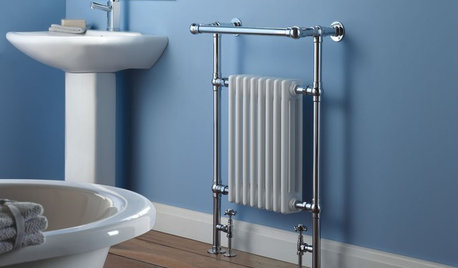
    If you live in a cold climate radiant is the way to go - with either cast iron radiators or cast iron baseboard. There are lots of 'designer' radiators:


    Hudson Reed


    Runtal

    I would have insulated duct work installed in the ceiling (where it belongs) for A/C.


  • 11 years ago
    last modified: 11 years ago

    My in-laws recently built a home in western Colorado (similar elevation) and went with in-floor hydronic heat. They like it pretty well. Here are a few things they mentioned to us:

    - It does have quite a bit of lag so they keep it set at a low temperature and use a wood stove for "comfort" heating as needed.

    - Some floors transfer heat better than others -- they went with tile throughout their main floor.

    - They have been struggling to find a way to add humidity to their home since they don't have duct-work. Between the in-floor heat and the wood stove, the air is extra dry in winter. So far, they've been running small individual humidifiers in the rooms they spend the most time in.


    For what it's worth, we're designing a custom home for 8000 ft elevation on the eastern slope right now and architects/builders are all telling us that gas forced air heat will be much cheaper than in-floor heat.

    mojomom thanked redfoxco
  • 11 years ago

    IMO. needing a wood stove and room humidifiers are evidence of a poorly designed HVAC design.

  • 11 years ago

    @JDS - wood stove is no design. I'm not a 'green', but wood burning is very polluting.