Software
Houzz Logo Print
bettegh

Need HELP sourcing ductless island range hood components

10 years ago
last modified: 10 years ago

I'm building a house to sell in the Caribbean. The main living space is open plan. There is no a/c or heat. About 2/3 of the wall space is windows- jalousies, for airflow.

It's a cook's kitchen- the LP range (pro- not 'pro style') is in the kitchen island. 2 realtors have told me that a range hood is not necessary here, but I need to get the heat away from the cooking/eating area on the island. I can't exactly put a ceiling fan over the cooker, so a 'range hood' is my only choice. I'm not going to vent it- It would cost me a few thousand dollars to cut a hole through a poured concrete wall for the venting and with 10' ceilings, all those windows and courtyards with water fountains/evaporative cooling (to produce more airflow), the heat and fumes will go sailing out over our heads once I get it up to 8+ feet.

I have the manpower and brainpower (oh, not just mine) to make what I want- but I simply cannot source the parts.

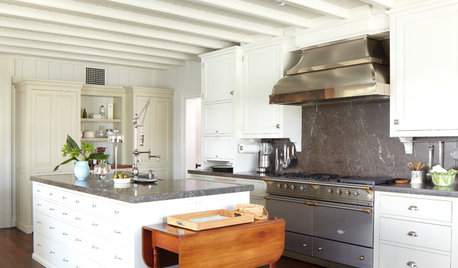
This is what I want to make: (well, sorta)

The problem: I've searched on & off for months and all I can find are giant 18 - 21 ' high cone shaped insert units. I can manage 10- even 12 inch high inserts, but rectangular. There's an excellent metals fabricator on island, but I need to find a US company that sells (manufactures) the components needed.

Recommendations would be greatly appreciated.

Comments (4)

  • 10 years ago

    I seriously doubt that injecting greasy fumes into the air aimed toward the direction of even the nearest open wall space will do anything but dump effluent into the room. The effluent should be passed via ducting through the ceiling and ejected outside without contact with the interior air. Because of the open plan, the preferred blower would be up-blast type, mounted on the roof. (Professional equipment for your professional stove.) Suitable equipment is available from commercial kitchen ventilation companies, such as Greenheck.

    Bettina Hooper thanked kaseki
  • 10 years ago

    What you want would be a fire hazard. You need to duct the effluent away, and have a design that can be regularly cleaned instead of accumulating grease above an open flame.

    Bettina Hooper thanked User
  • 10 years ago

    Thanks. I appreciate the time you've taken to pen your concerns.

  • 10 years ago

    Assuming a cooktop with a cooking area (contour around the union of hot pan base areas) of some dimensions L x D, a hood entrance aperture of dimension L + 6 x D + 6 (inches) would (in still air) provide sufficient capture up to about 36 inches of height over the cooktop. If there are strong cross drafts, then a larger aperture is recommended. Blower airflow (actual) capability should be of the order of 90 CFM/sq. ft. of hood aperture.

    If roof penetration and wall penetration are both out of the question, then adapting the methods of apartment type recirculating hoods may work, if not prohibited by the safety statement associated with the range. Such hoods need adequate layers of grease capture filters, and charcoal filters. Vent-a-hood and Broan/Best/NuTone may have units suitable for modest air flow requirements; for higher power cooking requirements, their approach would have to be adapted into a larger, more powerful unit. Perhaps custom hood fabricators such as ModernAire could rise to the occasion.

    A simple web search for a commercial counterpart led to this as one example of perhaps others: captiveaire.com

    This particular unit is too low in CFM for a cooktop. And because it is made of 430 stainless steel, in salt air it may need a dilute phosphoric acid wash now and then to brighten it up.

    See also http://ul.com/wp-content/uploads/2014/04/ul_RecirculatingHoodSystems.pdf

    and

    http://restaurantexhaustfans.com/how-effective-are-ductless-commercial-hoods/

    And here is a snarky, albeit imperfect tract, part of which addresses this subject. The comments about cooking effluent constituents is pertinent:

    http://www.treehugger.com/kitchen-design/most-screwed-badly-designed-inappropriately-used-appliance-your-home-kitchen-exhaust.html

    (Please note that a hood cannot "suck" more than it "blows.")

    Anyway, the important point that I didn't elaborate upon in my first message is that when the hood exhaust air is directed to go "sailing out" along the ceiling, its velocity rapidly drops as the moving exhaust effluent's momentum interacts with the friction induced by the room air inertia. To succeed in the original plan without ducting would require a very powerful and loud "screaming-mimi" fan to accelerate the effluent such that much of it made it to whatever door was open. There would still be significant undesirable mixing with the room air. Some improvement might be achieved by also accelerating a cylinder of the same velocity clean air surrounding the effluent. I believe that achieving even partial success this way is much less practical than any duct scheme, including one that has to penetrate concrete.

    kas

    Bettina Hooper thanked kaseki