Software
Houzz Logo Print
ruth_mi

Soil Test Results

11 years ago
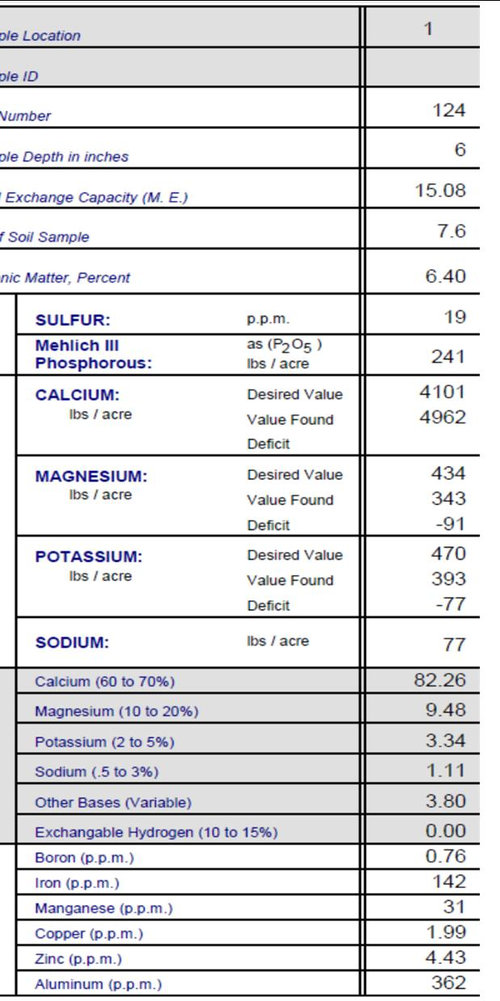
Before I dug for the test, I thought my OM would be really bad, but this was based on some digging I'd done in a corner bed that had rock "mulch." When I actually took the sample, I realized it wasn't as bad as I thought. But 6.2% surprised me. (Have "always" mulch-mowed though. Have been adding a fair amount of OM the past month and a half, but was careful to scrape off the top layer when taking my sample.)

Morph, when you can find time, I'd really appreciate your input on this. You've already been a huge help. My lawn looks better than it has in years, and I'm looking forward to taking it to the next level. I really can't thank you enough.


Comments (6)

  • 11 years ago

    Did you truck this soil in from my front yard or something? It's nearly perfect out of the starting gate, with very few resource corrections...and most of those are marked "optional."

    If you correct the optional ones? It'll nudge out a little extra performance, but I doubt a casual observer will see much. If you ignore it? No real harm done. This soil is excellent right out of the starting gate.

    Depth 6": The standard is 4". I'll correct the numbers (where necessary) below.

    EC 15.1: This seems a little overinflated by the calcium in the soil, and I suspect you have some free calcitic lime in there. I'm turning it down to about 12, which is still a great place to be. Off the cuff, my bet is your soil is relatively silty with some sand and perhaps a whisper of clay.

    pH 7.6: It's a little high due to the calcium kicking around, but this isn't a problem. We'll simply compensate, and the lawn doesn't particularly care.

    OM 6.4%: At the lower end of Excellent. Certainly mulch mow, mow your fall leaves, and so on, but you don't need to make any special effort in this department.

    Sulfur 19: Normal, and right where it should be.

    Phosphorus 241 (161 adjusted): Somewhat low. Of all the adjustments, this is the most important....which is to say, of midrange importance. Still, I'd work on correcting this due to your pH and the fact that it'll bind phosphorus pretty heavily. My target here is 280 (420 on the 6" test). We use starter fertilizer, the cheapest you can find, to adjust this.

    Calcium 82.3%: High, but there's nothing we can do about it and it isn't a problem. Calcium isn't toxic even when grass grows in limestone chips, so it's of no concern, we simply adjust the other resources to compensate.

    Magnesium 9.5%: Kind of marginally sort of a wee little bit low by the numbers, but really not a problem. This adjustment is completely optional and can be safely ignored. We use Epsom salt to adjust this, available at any local drugstore (scented is just fine) in the First Aid or bath sections.

    Potassium 3.3%: Just the faintest whisper low, but I'm a fan of slightly high potassium levels. This is utterly, completely optional and not an important adjustment in the slightest due to your locale and already sufficient potassium. We use potassium sulfate (AKA sulfate of potash) to adjust this, which you can sometimes get at local garden or landscape stores, or they'll order it for you.

    Sodium 1.1%: Completely normal, but with your higher pH I mention this only because it also raises pH. Applying the optional resources (magnesium and potassium) would help reduce this a teeny bit, but nothing important.

    Minor Elements; Every. Single. One. Is. Perfect. I did mention Iron below, but...

    Iron 142: A completely good answer and not deficient in the slightest, but probably not going to produce the best color at your pH. Whenever you like, you can apply Milorganite at bag rate to very slowly raise your iron numbers and improve the color of the lawn. If you choose not to, there are no consequences as your iron levels are just fine.

    Recommendations (for 2016):

    April 15: (Optional) Apply 1 pound of Epsom salt per thousand square feet.

    May 1: (Optional) Apply 2 pounds per thousand square feet of potassium sulfate.

    Memorial Day: Apply starter fertilizer at bag rate.

    August 15: Apply starter fertilizer at bag rate.

    September 15: Apply starter fertilizer at bag rate.

    October 2016: Retest the soil; we'll probably need more starter as my window for application is limited.

  • 11 years ago

    Starter and any organic fertilizer are going to play extremely well together, so corn, soy, alfalfa, or anything else you can think of are all great. The soy is complete overkill but certainly won't be a problem.

    For the organics, the normal schedule is May 1, August 1, September 1, and October 1 (that last one might be a bit touchy in your locale depending on how warm it's staying, but it's fine if you miss it). You can keep it there if you want, or apply at the same time as the starter if that's more convenient for you.

  • 11 years ago

    Thanks. Saving this for next year!

  • 11 years ago

    Hi,

    Did you take your soil sample from the recommended 6" depth?

    Thanks

  • 11 years ago

    Yes, I didn't realize that I should have only used 4" for a lawn soil test.

Sponsored
Custom Home Works
Average rating: 4.6 out of 5 stars10 Reviews
Franklin County's Award-Winning Design, Build and Remodeling Expert