Software
Houzz Logo Print
ellyn_murphy10

Walnut Dining Table Provenance help

11 years ago

I would like to try to date an oval, walnut drop-leaf dining
room table that has been in my family since around 1960. My guess is that it
was built sometime between 1880’s and 1930 based on the information collected
so far, but it would be nice to narrow this down a little – maybe to within a decade or two.
The table was old when my
mother bought and refinished it circa 1960. Underneath it was signed “Clinton,
Iowa” and “Janssen ***”. The last part may be “Sons” or “Bros”, but it is not
very legible.

From a Face Book posting I learned the following. In the 1887 Directory of Clinton, Lyons
and Chancy, it lists JANSSEN & STRUVE (Wm. Janssen and F. Struve) Furniture
and Undertaking, 305 2nd St. Clinton, Iowa.

William Janssen was born in Germany in 1830. As a young man,
he came to the US at age 22, lived in Australia and Chile and then back to
Germany, until he moved to Clinton in 1864. His furniture business was well
known in Clinton. Two of their sons, August and Carl Janssen, were carpenters.
In the 1929 City Directory, August lived at 239 North 6th St and
Carl at 410 2nd Ave South.

Ernest Struve was born in
Holstein, Germany in 1826. He came to the US in 1848, to Texas, and then like
so many others from Schleswig-Holstein, moved to the Clinton, Iowa area. Struve
started a sawmill – the Elk River Mill on 320 acres he owned near Hauntown.
Ernest had eight children. Son Ferdinand Struve was born in 1862 and ran a mill
near Miles. The Struve saw­mill is the sawmill on display at the Sawmill Museum
in Lyons.

As you can see from the picture above, I used a golden pecan
stain to give the walnut a warmer color than the traditional dark brown. I
replaced a few items on the table during the recent refinishing process. The old iron
casters (pictures below) would always scratch my wood floor, so these were
replaced with round, hard rubber casters that have an antique brass cover. I
also replaced the slotted head screws with similar thickness (#12) Phillips
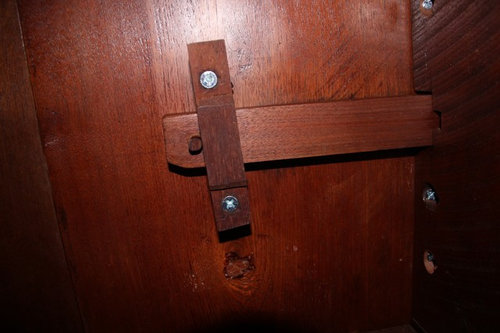
head screws on the underside. Finally, I attached brass-plated table locks on
the underside.

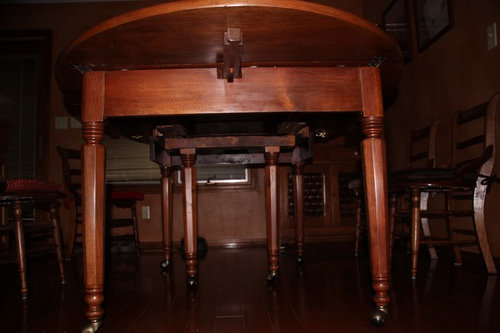
Additional pictures that may help date this table. Pictures
below show the drop leaf table support (angled side view and view from underneath the
table). Wooden pegs in the support board keep it from overshooting the wooden “collar” on the underside of the table (2nd picture). The Phillips head screws on the wooden collar are new.


Pictures below show the old iron casters on the table. The wheels have 4
small holes. The stem is a little over 1.5 inches long with a ridge pattern
that looks like it was pounded into the top of the stem, which is somewhat flattened compared to the round stem.

The next photo shows the underside view of one of the two expansion
mechanisms. The table expands to support up to three extra leaves. The leaves
have breadboards on the ends.

Photo below show the six legs of the table. Note that the leg in the far left back
has a slightly different design at the bottom than the other five legs. I do
not know if this was intentional or a replacement leg that was added before we
purchased the table circa 1960.

Can anyone narrow my guess at the timeframe between 1880 and 1930?

Comments (11)

  • 11 years ago

    Wonderful table....really very very nice!!
    I would put it at much closer to 1880 than 1930.

  • 11 years ago

    You have found quite a bit of time line information on Jannsen. He arrived to Clinton, Iowa in 1864, therefore, the date of the table most likely is after 1864 or maybe 1865. Presumably, he needed some time to establish his shop after arriving. This is an interesting date for an immigrant to arrive in the mid-west. The Civil War (1860 - 1865) was in its final days in 1864 and the country was torn apart. The infrastructure of Iowa was not as affected as southern Missouri.

  • 11 years ago

    Thanks to both lindac92 and jemdandy for your comments. I was hoping that the style of the table might nail down the time it was built. Your comments have forced me to think more about the timeline. Janssen would have been 34 years old when he arrived in Clinton in 1864, so his "prime" furniture making was probably over the next 20-30 years. Maybe this is as close as I can get, assuming his sons did not build the table at a later date. My goal is to place a brass plate on the underside of the table with the key information on the history. This walnut is so heavy and dense, that it will likely last another 100 years with care. One of my kids will surely want it!

  • 11 years ago

    Another 100 years??...Another 300 years! Look at the size of those boards in the top! Iowa was noted for it's walnut trees and walnut lumber. I have a couple of piece with those huge wide boards from a giant tree!
    Assuming that when Janssen came to Clinton he didn't buy a stock of already dry walnut, that wood had to be cut at his sawmill from the trees on his property. Since walnut wood need to be VERY dry before using, it would be a good estimate that that table was made about 1880....give or take7 or 8 years. Also, that style was very typical for that time.
    BUT...it could have been made from lumber from the site that had been stored at a much later time....not likely....but possible.

    Again....it's a wonderful table!!!


  • 11 years ago

    Thanks again! Yes, I probably low-balled it at another 100 years. I like you reasoning on the time line. I had not considered the milling and drying of the walnut.

  • 11 years ago

    I agree......don't let the original casters escape....even if they do scratch your floor.

    Ellyn Murphy thanked lindac92
  • PRO
    11 years ago

    The similar one I restored last year really needed the casters to get to a comfortable height, the apron/frame is so deep it hits your knees.

    The one I had in the shop was clearly factory-made with obvious low regard for quality control, and had a patent cast iron mechanism for the drop leaves; it would not surprise me if yours was sort of a local copy made in a rural shop where they did not have that hardware available.

    It seems 1880's to me.

    Oval drop-leaf extension tables are really neat, until I saw the one I restored I did not know they existed. Mine had five leaves, opened to over 10 ft, but with the drops lowered, was about 34" long. Crazy cool design.

    Casey

    Ellyn Murphy thanked Sombreuil
  • 11 years ago

    The patented table support thingies were a later innovation....like after 1900. The older tables had wither a wooden turn around in the apron to support the leaf, or a pull out like the OP's. Most of the ones with the iron leaf support that I have seen were oak....telling me they date to the "oak period">
    I have a love affair with walnut drop leaf tables...I used one as my diningroom table for about 25 years. It had 5 leaves and opened out to seat a bunch, but with the leaves stored and the sides down it was 32 by 29 and worked well for a small space. I gave it to my daughter when my mother died and I inherited her diningroom table. And I bought another oval walnut drop leaf that opened for leaves for my son when he married, and I bought a 36 inch square walnut drop leaf for my kitchen, and another larger one rectangular, about 40 by 52 or so, and another smaller end table with 2 drawers and leaves that flip up, and another square walnut one that I sold to a friend for a song....because I didn't need it. All have had the wooden turn around leaf support but for one that had a pull out like the OP's table.
    I love walnut drop leaf tables!!!
    If you sit at the short sides, you really need the casters....but if you sit where the leaves are or at the ends, there is more room. interesting, the rectangular tables never had casters, the oval ones did.

  • 11 years ago

    Is OP "original poster"? With the drop leaves up, but no addition leaves, the oval table is 44" wide and 52" long. With all 3 leaves inserted it is 94" long. Agree on the apron/frame hitting your knees on the side. The new ball casters that I installed raise the table another inch, which really helps. I will find a place to store the original casters with the table.

    I also love these walnut oval drop leaf tables. I refinished another one that was my grandma's a few years ago and gave it to my daughter. It is a few inches narrower and only has 2 leaves. The drop leaves have an iron piece that "clicks" in place when you raise the drop leaf. To lower, you reach under and pull the iron rod down to release. Definitely an old mechanism.

  • 11 years ago

    When I said the caster raise the table "another inch," I meant over the previous height with the original casters.

Sponsored
More Discussions