Software
Houzz Logo Print
edmonrivers

Fiddle Leaf Fig (much needed help and advice)

10 years ago

Hello,
I brought home a fiddle leaf fig from a floral shop about two months ago. It appeared to be a reputable distributor, and the staff seemed highly knowledgeable. I presume the state that my FLF is currently in is due to my misunderstanding of the care it requires, and more than anything would like to better understand the needs of this tree. I have done ample research, own a multitude of other house plants, and hydroponically garden in the summer- yet caring for my FLF constantly perplexes me.

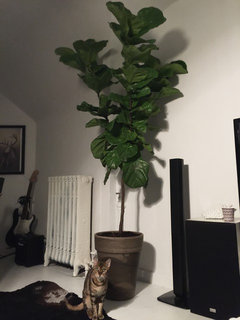
It is a seven foot tall tree, in an unglazed terracotta pot. The tree was given to me in a shipping pot which was filled with a mix of peat moss and soil. Upon planting the tree, I kept the soil housing the roots and added it to a quality light soil that does not get soggy. The pot that it is in was recommended by the staff at the floral shop. It is near a North-facing window, wherein it receives ample indirect sunlight for at least eight hours a day. There are not buildings obstructing the sun across the street. I think I am watering it right by letting the first inch-or-so dry out before flushing it with water? The pot it is in has excellent drainage, which I wipe up to ensure the FLF does not sit in. I have not yet considered fertilizer.

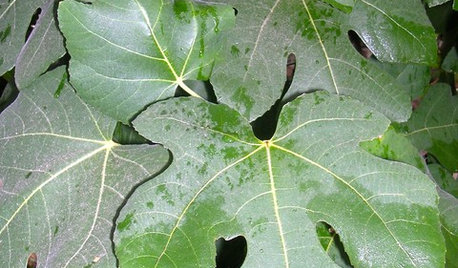
The tree is continually dropping leaves, they first brown near the edges, dry out, split then fall off. I don't know what to do, I'm entirely at a loss of ideas. Another thing to note is that we live in an attic apartment, it is heated by hot water with a temperature preset by the landlords to 75F, could the air possibly be too arid? Am I watering it wrong? Should it be moved closer to a window? Possibly a East, or West facing window? Thanks guys, I really appreciate your help. I am deeply concerned about losing this magnificent tree.
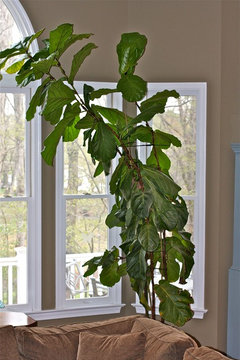
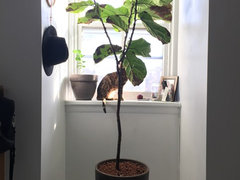
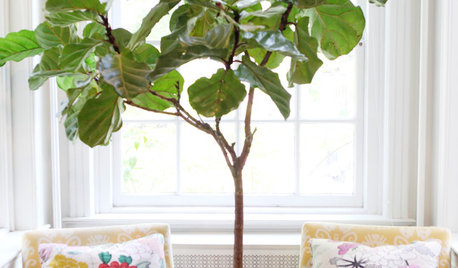
I have attached a few photos showing the leaves, pot and location of the FLF. Thanks again!

http://imgur.com/lsh6KVM

http://imgur.com/J1pNqib

http://imgur.com/IXBKZRU

http://imgur.com/yhW9wzK

Comments (19)

  • 10 years ago
    last modified: 10 years ago

    These figs can be very traumatized by a change in location. Between the amount of water they get, to the amount of sun to the relative humidity, they can go into shock.

    My fig did this when I brought it into my home from a nursery. I found I needed to water more frequently, and also use an all-purpose houseplant food.

    The fig really flourished and I put it outdoors for the summer, but when I brought it in from the deck this Fall, it's in shock once again.

    I found that lots of ambient sunshine makes this plant thrive, so it sounds like you've got that covered.

    Water more frequently would be my advice and know that the plant can bounce back.

  • 10 years ago

    Thank you, mimipadv. That's really refreshing to hear, I will look into an all-purpose houseplant food as well. Thanks again!

  • 10 years ago
    last modified: 10 years ago

    You and I can update each other on our fig recovery!

    This was before I put it out for the summer. It's lost most of the lower leaves ;-(

  • 10 years ago

    What a nice looking tree! It looks very tall from the picture you shared. How many feet tall is it?

    This was mine the evening I brought it home (I couldn't convince the cat to stay out of the picture), it used to have so many leaves :(

  • 10 years ago

    Hi, M - What I see: You're over-watering, little doubt about that. If the soil is only dry for an inch near the top, it's very likely the bottom 4-8" of soil are 100% saturated. The leaves exhibit classic symptoms of over-watering as well. Forgive me for doubting that your soil doesn't get soggy. If you didn't make it yourself, odds favor that it does get very soggy after watering by better than 100:1. I would invest in a 1/4-5/16" wooden dowel rod, cut it in half, and sharpen all 4 ends in a pencil sharpener. Use the rod as a 'tell' by pushing it deep into the pot - all the way to the bottom; and don't water until the rod comes out clean and dry. My guess, knowing you recently potted up, that your plant could likely go 2-3 weeks between waterings, but that remains to be seen - you'll know better if you test regularly until you establish a rhythm, which is going to vary with time of year and size of foliage mass.

    About the planting arrangement: Is the clay pot what your plant is planted in, or does it serve as a cache pot? Is the plant allowed to sit in a drainage saucer full or partially full of water at any time?

    A west window would be a better choice because the plant does love light. It's hard to guess what effect humidity might have on the plant w/o knowing where you live and how cold it gets.

    There's plenty to discuss about the plant regarding it's cultural preferences. If you're serious about wanting to get to the point where you can be confident in your ability to eliminate the most serious limitations now affecting the plant (identifying and eliminating limitations is what growing is all about) I think these two threads will help a lot. The thread about Ficus in containers mentions Ficus benjamina (weeping fig), but the cultural wants of lyrata are nearly indistinguishable from those of benjamina, so it will apply to your plant.

    A basic overview that should help you avoid all the most common pitfalls we all face at one time or another.

    This one is about maintaining Ficus in containers for the long term.

    Your thoughts?

    Al

  • 10 years ago

    My fig was about 12 ft. tall before I trimmed it.

  • 10 years ago

    Oh! I didn't answer one of your questions. No, the plant is not allowed to sit in any water at anytime. After watering I ensure to wipe up the water that drains from the pot.

    Thanks again!

  • 10 years ago

    I made a mistake, I do have a West facing window which is not drafty!

  • 10 years ago

    If I'd known you were new I'd have offered a welcome - will a belated one work?

    A cache (cash) pot is a pot larger than the one the plant is actually potted in. They are usually more decorative than the actual pot the plant is in and usually don't have a hole. I was concerned that (if it was a cache pot) the plant might be immersed in water at the bottom of the pot, but I see by your reply that's not the case. Good.

    The south window would be best.

    The plant wants light as bright as you can provide w/o it being in direct sun. If you acclimate the plant to full sun and keep a fan in the room on a timer from around 10-3 it will work well. It's not the direct sun that causes a problem, it's the heat buildup that causes the leaf to overheat. The fan disrupts what's called the boundary layer (of air) surrounding the leaf so the heat can escape.

    Have a good weekend. We're waiting on a snow storm that starts tonight & blesses us through tomo night.

    Al

  • 10 years ago

    Here is the new set up (let me know if you see anything that could prove to be detrimental to it's recovery):

    The South facing window has been covered in clear plastic to ensure there is no draft durning the colder months, I went to a hardware store as well and purchased a fan and a wooden dowel. I am going to be more cautious with the watering, and keep my fan on from 10-3 like you suggested. I also purchased a tray on wheels, to ensure that the move wasn't too stressful.

    It has been a busy weekend preparing the new home for the FLF, I really hope I can pinpoint the environmental problem before it's too late.

    Thanks again Al. I hope the snowstorm wasn't too bad. We're expecting our first snow this week.

  • 10 years ago

    Snow wasn't bad - only 3". Cold now, though - 16* last night.

    Looks pretty good. Be sure to rotate the plant 90* weekly. If you're at all like me, you might need to note whether you're rotation clockwise or counter clockwise.

    It would be a good idea, if you haven't in a while, to flush the soil at the next watering, then get right back on the testing with the dowel right after. If you do flush the soil, fertilizing at that time or next time you water would be appropriate.

    You CAN water in small sips if you can score water from someone with a reverse osmosis water system, or you water with snow melt. This will keep the salt level from tap water & fertilizers from accumulating in the soil.

    Al

  • 10 years ago

    Hi there, sorry again for the long response time. It's hard to get on the net as often as I like at such a busy time of year.

    That is cold. Lots of snow here as well, can't take the bicycle to work anymore.

    The tree is not due for it's watering just yet. I have been testing it with the dowel, and am looking into distilled water from the grocery store for when the time comes. I have placed a small sticker on the pot to keep track of it's rotation too. Still dropping leaves almost daily though, will it recover it's leaves? If pin-pointing the environment issues doesn't work, what should be the next step? Patience and hope for now.

    Thanks,

  • 10 years ago

    Once leaf loss is underway, it's not unusual for the symptom to get worse, even while the cause of the symptom becomes less limiting as you're get watering under control. The reason is, once the shedding process reaches a critical point, it can't be reversed, so any leaves that already have/had abscission layers forming where the leaf is attached to the stem are destined to be shed. That sort of makes your job out to be getting the plant through the winter and into a state of vitality that will allow the plant to be repotted and subsequently pruned back. Once you do that and get the plant into a soil you can water correctly, you'll have a much different scenario. I various ways, I often point out that when using a water-retentive soil, you end up battling the medium for control of the plant's vitality. That's frustrating and no where near as rewarding as growing CAN be.

    Keep in mind that the 6-7 months you should wait to do the work is little more than a blink of an eye to a tree. This might sound corny or new agey, but if you settle yourself into the same rhythm the plants go through in their annual growth cycle so you can take advantage of their strengths and allow for their weaker times, you'll feel a much greater sense of unity with your plants. More knowledge, a better understanding of how plants work, and the confidence that comes from knowing you are acting with the best interest of the plant in mind (which can only increase your own gratification), all act to elevate the plane on which you interact with your plants. If you pare the reason you're here down to its bare bones, isn't it because you want more from the growing experience?

    Al

  • 10 years ago

    Just to make sure I understand... we don't leave the dowels in, right? We just poke one in when we begin to wonder whether to water?

    I ask because it worries me that I am hurting the roots, putting a sharp stick in there. But of course overwatering kills the plant. Sorry if this is a dumb question.

  • 10 years ago

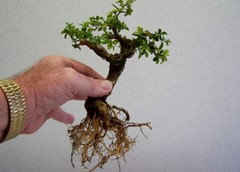
    Leave the dowel close at hand, but not in the soil ...... and it wasn't a dumb question at all, especially because most growers have the same concerns about the possibility of damaging roots. First, you'll probably be using the same test hole over and over, so root damage will be minimal. Second, even if a few small roots are damaged, the plant won't notably miss them and will quickly replace them. What might seem like root abuse the plant could never recover from is a regular part of the work people who manage the root systems of their plants regularly perform. To illustrate what a plant will tolerate in terms of root reduction, look at this 90%+ removal of roots, yet the plant lives on.


    Al

  • 10 years ago

    Hello Al,

    It was time watering today, I flushed it with distilled water and noticed the soil was not retaining any water. Rather within seconds water was gushing from the bottom of the pot. Should I repot to a more suitable soil? I am very worried about the roots.

    Thank again for all your help,

  • 10 years ago

    You might need to find a bucket just slightly larger than the pot the plant is in. Put the pot in the bucket & add enough water to the bucket so the water in the bucket is even with the soil line in the pot. Wait about 10-15 minutes. The water level should have gone down in the bucket, which means it's getting absorbed into the soil. If after 15 minutes the top of the soil isn't moist, add more water to the bucket until it IS moist. If your plant is too large to do that, use a spritzer to wet the top of the soil, then start pouring more water on top of the soil - slowly - like a cup at a time - so the water you're applying soaks into the soil instead of flowing over the top of the soil and then down the side of the pot.

    If you know how long it's been since the last time you watered, try reducing the interval by a couple of days so there is still some moisture in the soil when you water. The drier the peat-based soils get, the more difficult they are to rewet.

    Al

  • 10 years ago

    As always Al, I appreciate your help. It is very kind of you. I will be doing this. Thanks again.