Software
Houzz Logo Print
mattp321

Shrub for under Leland cypress

10 years ago

Can anyone suggest any shrub (or anything really) that can grow underneath a leelandi (within the drip line)

so, basically a pretty dry area. Part sun (6-8 hrs). Would like something 4 feet tall or so.

no additional water available...

Comments (32)

  • 10 years ago

    can we see a pic of the situation ... how big at the Ls ????


    even coming out a foot or two from under old trees.. at least gives the plant rain ...


    and as noted ... even drought resistant plants... need water until fully established ...


    ken

  • 10 years ago
    last modified: 10 years ago

    Agree with Gal here-these sites are apt to be truly sucked-out dry, forbidding to most lifeforms! Such plants really colonize their sites, leaving little in the way of moisture, nutrients..even light itself, to live on.

    I've got a roughly analogous situation at my home, where I'm attempting to garden under some very old, very well-established Thuja o's. These trees really limit what can be grown in their shadows. I've limbed them up just a bit over the years, for various reasons and so there is at least a decent amount of light. But the dryness is exacerbating. Very few species really remain viable for long. For example-I'm way over hostas-but that common shade-tolerant landscape plant is utterly useless here. Wild geraniums-a forest floor species with considerable drought tolerance-just marks time. One plant that has come through with aplomb is Lamium maculatum. this common groundcover-I've got the 'aurea' type, is proving itself to be far more capable in such a site than almost everything else I've ever tried. so you might look that one up. It has one of the worst common names in all of horticulture-spotted deadnettle! Lamium works for me!

    This plant is obviously not a shrub, but to my thinking, requiring a shrub is even more limiting.

    +om

  • 10 years ago

    I have Aucuba, Skimmia, Fargesia, Viburnum tinus and various others under Leyland cypress that have been in place for some time in Island County, WA. Look for lists of plants for dry shade to find candidates.

  • 10 years ago

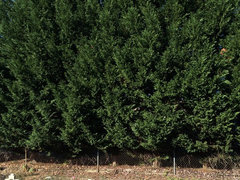
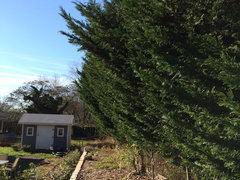
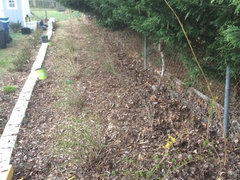
    I'll take some photos tomorrow of the situation. Basically the deal is my neighbor planted them ~18 inches from the chain link fence, so they hang over like 8 feet into my yard. Plus their yard is above mine, so from my perspective the limbs don't come all the way to the ground. I want to cover up the fence from my view and also "fill the gaps" between the bases of the conifers...

  • 10 years ago

    I have first hand experience with Aucuba japonica and Ilex aquifolium growing under and very close to Chamaecyparis lawsoniana and Thuja plicata. Once established, they do just fine here in that situation.

    The Viburnum tinus I have growing under a Cunninghamia lanceolata 'glauca' is thinner and blooms less than if it were in more light, but it is growing well with no additional water during our dry summers.

    My one and only bush form of Sarcococca is only waist high, but doing fine in dry shade.

    Matt, with 6-8 hours of sun, I assume your planting area has a southern exposure?

    Mike

  • 10 years ago

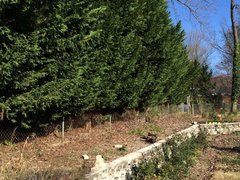
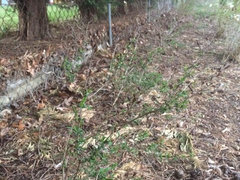
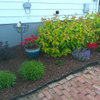
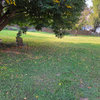
    Here's some photos of the area. Chain link fence is 40" tall. Distance from my retaining wall to that fence is 8' and the trees as you will notice pretty much hang over it all. Because of the retaining wall, when I'm in my yard I'm pretty much staring at fence and tree trunks. I want to plant something on that ledge to hide the fence and the "bare" area at base of trees from my view.

    fenceline runs pretty much north/south, and my yard is on the east side, so the area gets sun from sunrise thru 1:30 or 2 pm in the summer. But, unless it's raining heavily, the ground doesn't even get wet.

    this year I put some mulch down and it did stop most weeds- previous years I'd get mostly pokeweed, rose of Sharon, and mimosa tree weeds growing.

    thanks for any advice on dealing with this spot!


    Concept is grass, then knockout roses, then retaining wall hidden from view, then some sort of blocking bush, then chain link then leeland background...

  • 10 years ago

    Matt, maybe Diervilla lonicera would do it. Certainly hardy enough for your location, and a pretty carefree plant overall. nice color contrast with the Leelands.

    +oM

  • 10 years ago

    Interesting suggestion... Seems easy to grow but did I read that it's very slow growing? As in it will take 10 years to reach 36" height?

  • 10 years ago

    Also, any thoughts about comptonia peregrina (sweetfern) growing there? thanks

  • 10 years ago

    What about, dare I say, some Junipers? A spreading gold one like J. chinensis 'Pfitzeriana Aurea' or 'Gold Coast'. Sometimes if you buy in quantity they can be had at a reasonable price. They're not too expensive anyway.

    Mike

  • 10 years ago

    Diervilla isn't particularly slow growing IME, spreading both by suckering and tip rooting, and there are cultivars with both variegated and reddish leaves as well as plain growing.

    Sweet fern will be a bit slow in starting, but once started, it will spread via suckering fairly vigorously. IME it doesn't grow super densely, so will continue to need some mulch to keep down weeds.

    Here both those get to something like 3' - 3 1/2' and are tolerant of varying light conditions from 3/4 day shade to full sun and will grow in average to very dry soil once established and are tolerant of poor fertility. I don't know how they would do in your zone.

  • 10 years ago
    last modified: 10 years ago

    erm - sympathies. One of the rare situations where convallaria has a place - yes, not remotely shrub like but green at least. I hate, hate and loathe these abominations with every fibre of my being - when that awful hybrid was birthed, it was a horticultural tragedy (no holding back)...although I realise the US has a whole lot more space than urban UK gardens and their selfish owners, (shrieking 'privacy' above all else)..

  • 10 years ago
    last modified: 10 years ago

    How formal do you want this hedge to look? How much maintenance in the way of trimming are you willing to do? Are deer an issue at all?

    Other suggestions, if deer are not issue, are euonymus (japonicus [perhaps a variegated version like Silver King], or kiautschovicus “Manhattan”), hollies such as Dwarf Burford or Gold Coast, variegated Eleagnus 'Giltedge' or solid green E. x ebbingei, Viburnum 'Conoy' or 'pragense'. Of course I'm thinking in terms of evergreens.

  • 10 years ago

    I also like the Comptonia idea. As far as Diervilla, I too do not consider it slow-growing. And yes, Mike's thought of junipers has merit in this case, especially, as he says, with some of the colorful foliage available in that genus. Too bad junipers are under such assault by voles nowadays. Used to not be that way, my memory stretching back to the late 1970s, when nothing seemed to consider junipers as food. For general landscape utility, I think the various chinensis offerings to be best, again, as Mike has suggested.

    +oM

  • 10 years ago

    Okay, all great suggestions. Let me add my thoughts/questions:

    1. Diervilla - for my location near Washington, D.C., which is better, diervilla lonciera (northern bush honeysuckle) or diervilla sessifolia (southern)? Or is there another bush honeysuckle option?

    2. Comptonia (sweet fern) - is anyone successfully growing it as far south as northern Virginia? Seems like it grows further to the north...

    3. I want more of a natural rough look than a formal hedge. It also can be mixed species down the line. There are deer around here but nothing too bad. Doesn't need to be evergreen but it certainly can be.

    4. Dave, can the euonymous, eleganus, and viburnums grow in a very dry soil?

    thanks!!!

  • 10 years ago

    "4. Dave, can the euonymous, eleganus, and viburnums grow in a very dry soil?"

    Yes, they can all tolerate very dry conditions once established. But growth and appearance may be enhanced or improved if irrigation is provided during periods of extended heat or dryness.

  • 10 years ago

    Matt, not expert in the case of your area-which Diervilla would be best. Good question. Maybe a more locally-aware member here will chime in. Comptonia is sure drought-tolerant but there too, I don't know the answer to your question regarding that species' suitability that far S.

    +oM

  • 10 years ago

    Just to follow up with some further information I've obtained:

    According to the "BONAP" maps, diervilla lonciera (northern honeysuckle) is the appropriate species to grow in the DC area.

    The national botanical garden has comptonia (sweet fern) growing outdoors in their mid Atlantic native garden, so I suppose it can indeed grow here. Even if nobody sells it.

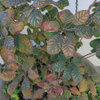
    as an additional point of interest, they also have diervilla rivularis (mountain honeysuckle) growing outside, so one might surmise that's also possible here. Pic attached:


  • 10 years ago

    It might just be the photo, but that's one sorry-looking Diervilla, compared to the thrifty and happy-looking plants that are routine here. Of course, I'm talking D. lonicera and that is rivularis, so maybe a difference there-I've never seen the latter-but really, not a very nice-looking specimen.

    Sounds like you'd be good to go with D. lonicera, and at least here in WI-usually a much better-looking plant. I like them.

    +oM

  • 10 years ago

    Can nandina grow in this spot?

  • 10 years ago

    yes

  • 10 years ago

    American beautyberry? Some internet sources say it can grow in partially shaded dry soils under and around trees. Size and shape pretty much perfect for the spot, and I do like the messy look for a background screening plant...

    Anyone think it's a possibility? Thanks

  • 10 years ago

    See thread above^

  • 10 years ago

    American beautyberry should be fine and is very nice in late summer/early fall. We also have one of the dwarf oakleaf hydrangeas (hydrangea quercinfolia) in a similar site that provides incredible spring/summer flowers and fall color that are just out of synch with the beautyberry peak apperance. A mix of these might be really nice there.

    Rhus aromatica grows well under trees and is tough as nails once established. Nice, but slower growing than other options. 'Gro-Low' is a cultivar that stays in the 2-3 ft height range.

    Virginia sweetspire (Itea virginica) is another that might do well there if soil is not too alkaline. 'Little Henry' is a dwarf cultivar that should stay in the 3-4 ft range. Does not sucker much in our heavy clay, but might be an issue in looser soils.

  • 9 years ago

    Has anyone ever tried Heucheras??

  • 9 years ago
    last modified: 9 years ago

    Heucheras are unlikely to be happy in that situation. They prefer an organically rich and evenly moist soil, not something one is likely to find within the root spread of a Leyland. And not exactly a shrub, either :-)

  • 9 years ago

    Our native Heuchera likes a little shade too, but can handle full sun with enough water. Our sun, that is. Next to those Leylands the soil would be too dry.

  • 9 years ago

    I'll update on the status. Just took a photo although it's getting dark out:

    Right now somewhat of a proof of concept test I have 3 rows planted. Row 1 is about a foot behind the top of the wall, Row 2 is in the center of the bed, and Row 3 is all the way in the back. Things are just leafing out now so it's kinda hard to see.

    I'll start with Row 2 in center. I have 5 diervilla sessifolia "butterfly" plants spaced about 4' OC on the right side (foreground in this pic), and I have 5 callicarpa americana on the left side of wall spaced the same. In Row 1 in front of these, I have 3 butterfly bush (milkweed), 3 bushy St. John's wort, and 3 New Jersey tea plants, spaced basically splitting the plants in Row 2.

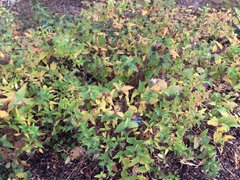
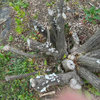
    along the rear right in front of the fence, I have a line of bushy St. John's wort (hypericum prolificum). This was planted bare root in oct 2014 and has basically been ignored. It is not dead, and they are bigger than when planted... but they are definitely not big and thick enough to block any view. Here's one of those for example:

    I'll have to wait and see what they do over the next couple months as everything leafs out. They did flower last year, so maybe there is hope?

    Everything is leaning towards the sun- towards the wall. However from the yard this isn't really noticeable.

    Thoughts? Again my only goal is to block the view of the chain link fence.

  • 9 years ago

    "butterfly bush (milkweed)" - hopefully butterfly weed? (butterfly bush is Buddleia, which is a medium to large shrub.) :>)

  • 9 years ago

    Yeah exactly nice catch... the a. Tuberosa I believe. The Orange one

  • 9 years ago
    last modified: 9 years ago

    I would spray paint the chain link fence black to make it visually disappear as a first and immediate measure.

    The retaining wall looks nice to me, I would try to make it a feature as a raised bed, e.g. grow a variety of trailing plants in the first row. Mix that up with the knock out roses and other plantings in curved-edged garden bed(s) below to soften the straight lines.

    In the same vein (softening straight lines) I would try not to plant the raised bed in rows, but stagger the plantings and space them out in irregular ways, 8' should be sufficient width (maybe you encounter big roots that practically forces the plantings to be like that anyway :-))

    There are quite a few gorgeous 2 or 3 level landscape designs on Google Images for further inspiration, the above is just a start to try and make it a deliberate multi-level landscape design. In particular, use the existing raised level as a feature and the trees in the back as a borrowed background view.

Sponsored
Hope Restoration & General Contracting
Average rating: 4.7 out of 5 stars35 Reviews
Columbus Design-Build, Kitchen & Bath Remodeling, Historic Renovations