Software
Houzz Logo Print
sylvia_dacosta

Vine recommendation

10 years ago

Hi all, though it is almost winter - I've been planning on what to add to the garden next spring. I'm wanting a vine to grow up a trellis along the east side of my house. Since its facing east, it gets morning sun until about noon. At first I wanted a climbing rose but I think it's just not sunny enough. Now I'm thinking maybe morning glory or a jasmine? I live in nw Indiana outstide Chicago so jasmine would have to be treated as an annual I think. Any thoughts? I'm looking for something that blooms

Comments (9)

  • 10 years ago

    Trumpet vine? Wisteria?

    Sylvia Da Costa thanked User
  • 10 years ago

    tibbrix, I'm a little scared of how vigorous those vines are - even though they are beautiful. I have vinyl siding - I'm planning on putting up a trellis a few inches off the siding - would the vines damage the siding?

  • 10 years ago

    Tom, how large does climbing hydrangea get - would it work on a large trellis? I'm hesitant to let anything climb directly on the house since I have vinyl siding

  • 10 years ago

    I'd ask a pro, but the issue is with vines getting in under siding, not on the siding itself. Can't see how they could hurt vinyl siding. It's "one piece", isn't it/

    They definitely, though, need to be maintained to keep from getting out of control, which isn't a big deal, IMO.

    Sylvia Da Costa thanked User
  • 10 years ago

    Climbing hydrangea does eventually attain size, but it's not quick about it. I should mention, it's not a good choice for hot sun and dry soil. It will take full sun if soil is constantly moist.

    Another option might be sweet autumn clematis or the somewhat similar and native virgin's bower, another clematis.

    +oM

    Sylvia Da Costa thanked wisconsitom
  • 10 years ago

    Climbing Hydrangea is a great vine if you are patient. As Tom said they are slow to start but once they take off they are large. It will take about 5 years to flower. I really enjoy mine.

    Clematis will give quicker results just make sure you choose one that can handle the eastern exposure such as Clematis 'Henryi' or 'Jackmanii'. They will present no danger to your siding.

    Actinidia kolomitka is another option. I grow the selection 'Arctic Beauty'. You need a male and a female if you wish to have fruit.

    You should have your trellis set a minimum of 6" out from the wall for good air circulation for the vine and your home. The plant itself whatever you choose should be planted at least 18" from your foundation.

    Sylvia Da Costa thanked peren.all Zone 5a Ontario Canada
  • 10 years ago

    Climbing hydrangea gets way too large for a trellis and needs a wider surface to attach to - a tree trunk, fence, chimney or masonry wall - somewhere that the rootlets can attach to. The plant does not vine but attaches by adventitious roots that grow along the stems..

    Both wisteria and campsis (trumpet vine) are very aggressive, BIG vines and can indeed grow under siding. And through cracked concrete. And send up copious root shoots at a considerable distance from the mother plant. Not climbers I'd recommend for planting against a house, trellis or not

    Pretty much any type of clematis would work well for this situation - few need all day sun and an easterly location is ideal. And most tend to be very well behaved, non-aggressive vines - the exception is SAC which grows rapidly and large and has become an invasive issue in parts of the country.

    Sylvia Da Costa thanked gardengal48 (PNW Z8/9)
  • 10 years ago

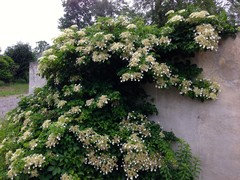
    What GG48 said. While I grow and love climbing Hydrangea, I am not a believer in trying to keep a plant that wants to be 40' tall and climbing on a flat surface (attaches with sucker-like adventitious roots) pruned to a size that would work with your situation and trellis. One of mine is on a large (8' x 12' approximately) concrete retaining wall, and the other is intended to grow up the trunk of a large tree, though it is still young. The pictured one is limited in height by the mower along the top of the wall and is about 10 years old. This far north it hasn't had any issues with being on a SW exposure, and it gets no water, mulching or any other attention. Great plant, just not for your situation.

    Either wisteria or campsis would take constant vigilance to not damage siding and could send out shoots on the other side of a drive, into another yard, etc., so I really wouldn't recommend either in your setting, though mowing can chop off shoots if surrounded by grass.

    Clematis is one of my favorite vines and you can choose bloom season, pruning style, and size. You probably can fit in more than one, but maintenance is easiest if they all have the same pruning type, which the nursery should be able to tell you. IME the type 3 prune (each winter take the vines down to a couple sets of buds) are easy, healthy, and reliable bloomers. Your trellis should either have parts that are 3/8" diameter or less, or plan to drape it with wires or netting since clematis climb by twining their leaf stems (petioles) around the support, so they have difficulty with wide supports such as lattice. Sweet autumn clematis isn't invasive in the north, but I am not sure if you are far enough north for the seeds to not ripen, so I would check that out before adding it to the garden.

    If you are close enough to the lake to be in zone 6, Carolina jessamine (Gelsemium sempervirens "Margarita") is a great plant, flowering in early spring or during warm spells in winter. Here in the cold end of zone 5, it survives, but hasn't ever bloomed. I may try to make it a potted plant when I have a sun porch for it.

    Morning glories are annuals, and so they take a bit longer each year to reach a reasonable size. Here, they didn't start blooming until late summer, and in warmer areas they can be a self-seeding pest, though your area may not have time for seeds to ripen. Another few annual and tender perennial vines to look at, all of which provide more flower power than morning glories in my garden, though I've never tried growing any of them in morning only sun. (see note about roses at the bottom - the same applies to these.)

    Scarlet runner beans have bright red flowers the humming birds love, beans that are edible as green beans when new and as dried beans when mature. Blooms more profusely if deadheaded or beans are kept picked. A favorite of mine.

    Black-eyed Susan vines (Thunbergia alata) have lots of bright yellow, orange or cream-colored flowers all summer. They need regular water in my garden.

    Climbing snapdragon (Asarina scandens) has delicate looking vines and foliage that bloom up a storm in shades of red through purple. Mine reseed some.

    Mandevilla - Glossy leafed tropical with large trumpets in a range of red, pink, and white. Be sure to get one intended to be a large vine, not one of the shorter selections intended for growing in a hanging basket.

    I'd also ask on the rose forum about part-shade-tolerant climbing roses. Particularly if you or a close neighbor have a light-colored house and no overhanging plants, the bright shade you get in the afternoon may be enough to keep a rose happy.

    Regardless of what you plant, you will want to look up to see if where you place the plant will be under an overhang that creates a rain shadow or where rain will drip directly down onto the plant (if you don't have gutters and it isn't a gable end) and adjust placement or watering to compensate.

Sponsored
Bella Casa LLC
Average rating: 5 out of 5 stars17 Reviews
The Leading Interior Design Studio in Franklin County