Software
Houzz Logo Print
joseph_corlett

The Debate Is Over

10 years ago
last modified: 10 years ago
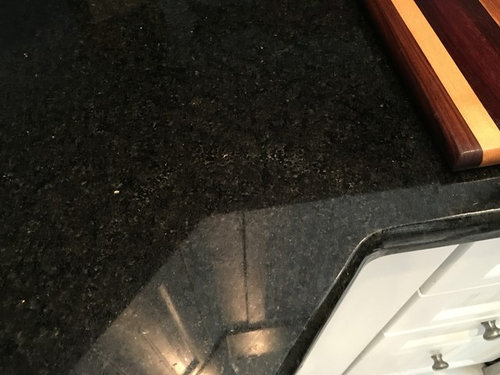
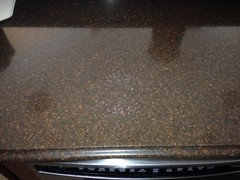
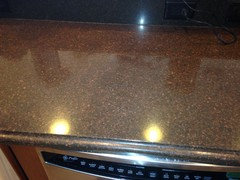
And I'm not talking Republican presidential candidates, I'm talking about whether or not you can set hot pots on granite. Let's let the pictures speak for themselves:

While the homeowner was still angry at herself for setting a hot pot on her granite and creating the ring similar to those created on overheated engineered stone or those made by toilet bowl cleaner, I pointed out a heat crack she hadn't noticed (between the top and middle reflections):

I was able to disguise the crack, but like toilet bowl cleaner marks, the heat has sucked the color out of the granite particulates and there's no way to get the color back in. Maybe some black magic marker maintenance. There is nothing wrong with the finish; polishing is a waste of time. Replacement is the only option.

Her undermount sink is leaking and her top is rodded too. I bore bad news today. Maybe she'll fix it after Christmas.

Before all the stoner apologists get started, let me concede that granite is more heat resistant than estone or solid surface and that this failure is rare. Granite makes a fine countertop, but it is not "bulletproof".

The Marble Institute of America is right. You must use trivets for hot items on natural stone. The debate is over. Don't make me link to the heat lamps that destroyed the local pizza place tops, please.

Comments (30)

  • 10 years ago

    One of the reasons we have a 48" cook top. Yes, we will rarely have 6 burners and the charbroiler going at once. But 4-5 isn't unusual. The extra real estate is mostly for hot skillet, pot, and pan management.

  • 10 years ago

    The poor homeowner, indeed. I'd be kicking myself for months. Is quartz similarly susceptible for cracks and burn marks?

  • 10 years ago

    Which pizza place?

  • PRO
    10 years ago
    last modified: 10 years ago
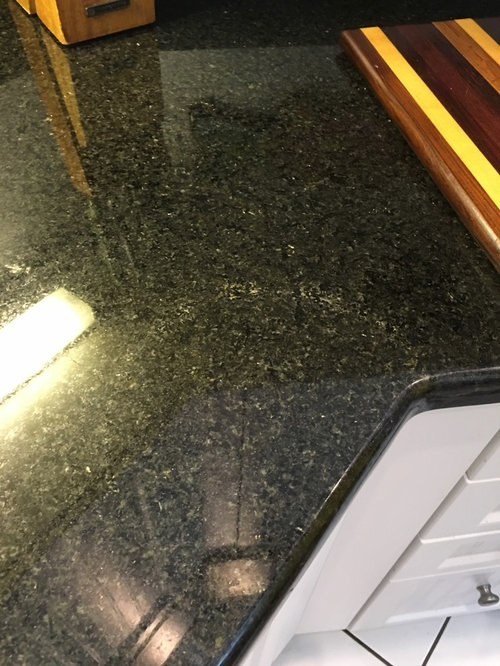
    "Which pizza place?"

    It was the Hungry Howies in Ellenton, FL, but they've subsequently replaced it all.

  • PRO
    10 years ago
    last modified: 10 years ago
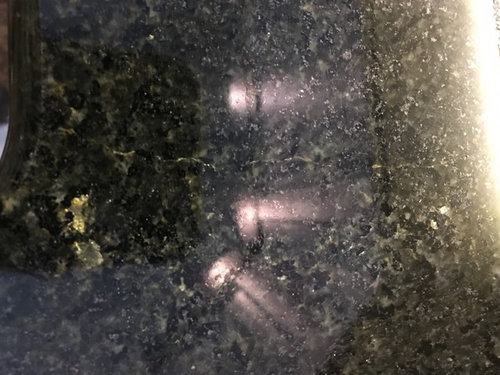
    " Is quartz similarly susceptible for cracks and burn marks?"

    Even more so for burn marks anyway. At least with the quartz, like solid surface, you've got a chance to fix it:

  • 10 years ago

    Yikes!!! So glad I grew up with cheapo laminate tops, I would never even THINK to put something that hot directly on a counter!!

    It either goes on the stove or on pot holders on the counter.


    Though I have been making my yearly toffee and pour it directly into a cookie sheet coated with wax paper. Always did the same with laminate and never had any problems, though the counter remains warm for a bit afterwards.


  • 10 years ago

    "stoner apologists" lol joseph!

  • 10 years ago

    Heat hasn't been an issue with our soapstone countertops. We serve casserole dishes from the oven to the island countertop with no trivets much to the shock of our guests.

  • 10 years ago

    I've had granite for years and always use a trivet. I won't take the chance

  • 10 years ago

    My plumber had canning jars set up on his granite, poured in the hot tomato sauce, and cracked his granite. His was a black granite too.


  • 10 years ago

    Hopefully my soapstone will hold up. I've been putting everything that comes out of the oven and the stovetop on it. Soapstone is OK right? They use it in fireplaces.

  • 10 years ago

    Loving my dekton and being able to place hot things directly on it! With granite I wouldn't either...

  • 10 years ago

    Scrappy- out of habit I use a trivet on my new soapstone. But I am very paranoid about taking out a glass or ceramic baking dish from a 400 degree oven and putting it directly on a counter that feels so cold to the touch. I know the ss has a high tolerance but casserole dishes shatter fairly easily with an extreme change. A thin silicone pad gives me piece of mind.

  • 10 years ago

    I had absolutely no issues with putting hot items on my soapstone. In fact, I had to be careful as to what exactly it was because things would cool down far too fast being on the ss. Plop an ice cube on soapstone and watch how quickly it melts!

  • 10 years ago

    I don't know what is going on with that granite, but I don't think heat is "sucking out" color from the minerals. Unless the color is applied artificially?

  • PRO
    10 years ago

    "Unless the color is applied artificially?"


    Many stones, and especially blacks, are dyed.

  • PRO
    10 years ago

    If I were a soapstoner, I wouldn't get too cocky. Soapstone used to fabricate a fireplace or stove heats evenly and completely. Trouble comes from one specific area being heated and the other area not, like a hot pot. The MIA makes no soapstone exceptions.


    Dekton and Neolith are sintered and in a different league when it comes to heat. I doubt you could heat a pan hot enough to damage them.

  • 10 years ago

    My fabricator who works exclusively with soapstone says no worries about hot casserole dishes or pots on the soapstone he supplies.

  • 10 years ago

    "Many stones, and especially blacks, are dyed."

    Well, that explains it. Of course, actual granite doesn't come in black, so I wonder what those are. I had just assumed they were an actual black rock, not a dyed rock. As a geologist, the stoneyard nomenclature drives me batty. It just doesn't communicate well.

  • PRO
    10 years ago

    The problem comes when a dyed stone owner has a scratch they want removed. I'm supposed to bet 5K or so, the cost of a new countertop, that I can get the scratch out without grinding through the dye and creating a gray spot where the scratch used to be all for the opportunity to earn $300.00 or so. No thanks. Yeah, I can dye it again. Might work, might not. Nogondoit.

  • 10 years ago

    @brdrl -- I have the same concern about soapstone and glass/ceramic dishes. I don't want the thermal shock to break the dish, even if the counter can handle the heat! If we get soapstone, I do plan to put hot metal trays/pots/pans directly onto the counter, but we'll continue to use trivets for glass/ceramic.

  • PRO
    10 years ago

    You'd save a lot of soapstone scratches with an "all trivets, all the time" policy.

  • 10 years ago
    last modified: 10 years ago

    True soapies embrace all the scratches, that's one beauty of a living surface, the patina. I set my right out of the 500* oven pizza stone on mine, as well as a searing hot cast iron skillet just off the burner, no issues in three years. In fact, I've seen trivets made of soapstone to use on other counter materials...

    And remember Joseph, all soapies may be stoners, but not all stoners are soapies ;)

  • PRO
    10 years ago

    "...a searing hot cast iron skillet just off the burner, no issues in three years."


    This is the same argument the granite people make. How lucky do you feel?

  • 10 years ago

    I'd be very upset if I did this to my granite counter tops, especially because since they'd still be perfectly serviceable, I'd end up living with it instead of replacing an expensive counter top.

  • PRO
    10 years ago

    For the last customer in the same situation we recommended either replacing the counters or install a dimmer switch.

  • 10 years ago

    I could never imagine me placing a hot pan directly on my counters or even cutting anything on my counters (quartzite) maybe because I had Formica for so long prior to stone. Even if I was told it was perfectly fine to do so, it takes all of 2 seconds to pull out a trivet. Why would anyone take a chance at destroying their counters? 2 seconds for a trivet or stare at a ruined area for a lifetime or the hassle of finding someone to repair it if possible. Better safe than sorry when it is so easily avoidable.

  • 10 years ago

    No matter the counter, you should take care of putting casserole dishes on a cold counter. The counter may survive, but the dish might not. Of course, new soda lime glass is the worst, but the porcelains and older borosilicates are not fully immune, either.

  • 10 years ago

    While my technie side is fascinated by discussions of how various surfaces interact with heat, I'm with Jancy and those who wouldn't risk it. Even if a surface is very forgiving, protecting it is easy to do. If I succeed 99 percent of the time in grabbing a pot holder or trivet, I can always test my expensive countertop the 1 percent of the time there's a true emergency and I have drop something or put it down in a hurry.

    Or there's always that pesky relation. Winter is ... err, Christmas is .... coming. :)

    "The counter may survive, but the dish might not."

    Ah, yes. Don't ask me how I know this. (File under: Pyrex; see also: Historian Takes Shortcuts)