Software
Houzz Logo Print
rober49

blue spruce browning

10 years ago
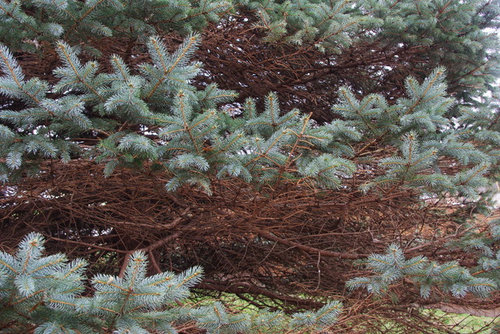
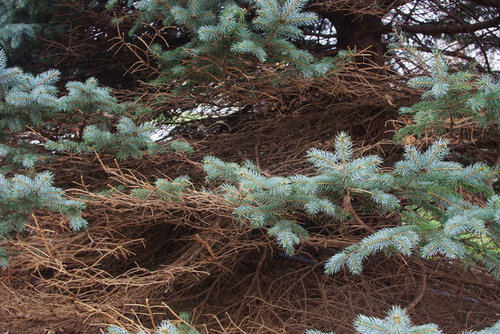
I have a blue spruce that came with my house so i'm not sure of it's age. it's between 20' & 25' tall. the last couple of years some of the lower branches have turned brown & lost some of their needles. now it is moving up thru the rest of the tree. we had some periods of drought the last few summers but I did give several good soaks during those periods. 5 years ago I treated for & rid the tree of bag worms. any opinions? is it going into death throes?


Comments (16)

  • 10 years ago

    pic of the whole ... plz


    yes.. it looks like an overly mature tree .... this type of plant does not have dormant buds.... so it isnt go to fill back in from the interior ...


    you either spend a lot of time.. pruning out all the dead stuff.... to find out if you will like it.. after all that work ...


    or you just get rid of it ... and start over ...


    personally .... i would not spend time or money.. trying to renew a suffering tree ... spend the money for removal and replacement ...


    i doubt drought had anything to do with a tree that age ... simply shouldnt need it ....


    ken


    ps: mature pungens are subject to some disease .. of which i dont recall the name... begins with rh ... or something.. lol ... a call to your county extension office.. might get an answer if it is rife in your area ...


  • 10 years ago

    Out here this would be spruce aphids or maybe mites. If there is a fungus back there that produces the same effect the outcome is the same - you have to look closely at the right time of year, determine which particular causal agent is involved and then undertake appropriate control measures in order to see improvement.

  • 10 years ago
    last modified: 10 years ago

    That would be Rhizosphaera needle cast and it is just as common here in the PNW as elsewhere in the country and while it is considered a "spruce" needle cast, it seems to plague Picea pungens more than any other species. But spruce aphids and white pine weevils are just as common, especially in our mild climate. All will produce similar symptoms. Drought is unlikely to be much of an issue as spring and summer droughts are pretty common for this tree in its native environment and it tolerates them easily. Excessive rain, on the other hand, could well be a problem.

    In any case, I'd tend to agree with ken that a tree that heavily infested with either the insect issues or a fungal needle cast is never going to regain its former glory - it will always have the bare branches on display and generally look stressed or in ill health. Replacing with something less problematic is probably your best bet.

  • 10 years ago

    happy new year gal ... and the rest ...


    had a neighbor waste a lot of money having his sprayed ... could have just flushed it down the toilet.. for what benefit he got ...


    lets see the whole ... but probably ... be done with it


    ken

  • 10 years ago

    here are some full views. the opposite side looks the same.


  • 10 years ago

    nothing you can do.. but limb it up... and then decide if its worth keeping...


    ken

  • 10 years ago
    last modified: 10 years ago

    Rhizosphaera can be treated via fungicides. Bordeaux mixture-that venerable old preparation-is still a viable alternative. Thing is, there is almost certainly more going on here than just that needlecast disease. A fatal condition-cyospora canker-is likely working this tree over as well. And as if that's not enough already, a variant of phomopsis canker is now officially cited as yet another cause of the demise of Rocky Mountain (dry air) conifers when planted in the east. It didn't used to seem so bad with these various agents, but today, they seem to rule.

    If I had to have a spruce-and hey, I do-I'd plant Norway spruce only, if east of the Mississippi River. It has a greater tolerance to high atmospheric moisture as compared to these western species. The one other one, depending on where you're at, would be the native white spruce. That too is well-adapted to more humid areas. Just don't let anybody talk you into the western variant of white spruce-black hills spruce. That one's a dog too in the east, and not a great tree regardless.

  • 10 years ago

    I guess it's time to decide on a replacement. the birds will miss this tree. it has literally become a feathered condo. last year there were 7 active nests in it. i'll look into the Norway spruce. is there any danger of this site infecting future trees?

  • 10 years ago
    last modified: 10 years ago

    Yes and no. Debris from an infected tree-old cones, needles, etc. can serve as inoculum for a while, for similar species nearby. But in time, that fades, and any practice which will cause rapid decay of such debris will remove that threat.

    I would say, may as well get what you can out of your existing tree for a time yet. No, I don't advocate the fungicide treatments I mentioned above, simply because it's a losing battle in the long run. But the tree will still have some life in it for a while to come. In the meantime, yes, by all means do plan for a replacement. Oh, and if you do happen to prune off lower, dying limbs from that tree, the best thing to do with them is to burn them. If that's not an option, try to get them off your property-into your community's brush/yardwaste collection system or some such. Once chipped and blown into a pile, most such pathogens are rapidly destroyed by the much more active decay fungi in such a pile, not to mention the high temperatures often developed in such piles.

  • 10 years ago

    i'm not firing up the chainsaw just yet. i'll let it run it's course for awhile. does pruning infected branches slow the spread of the disease?

  • 10 years ago

    not really ... just might make it look less messy ..


    i am guessing.. it serves a purpose to hide whats behind ...


    if so ... i would be planting two replacements.. say 6 to 8 feet left and right of the plant in the second pic ... and they would not be picea pungens .... blue spruce ...


    birds are rather resilient ... they will find new homes ...


    it is best to do it.. while they are out of town.. and not laying eggs .... so either soon ... before spring.. or after they leave in fall ... but even then.. they will renest .... and relay ... if the urge strikes in summer ...


    ken


  • 10 years ago

    you are looking at the view from the front porch so yes the tree lends a bit of privacy. the windmill is the wife's thing but since I just finished a sun room in the back I think it will move to the back yard. there is a row of bottle brush buckeyes along the street to the left of the spruce that makes a nice screen as well. I think this tree will stay the summer. between a bathroom remodel, expanding my apiary to 30 hives, & a few other things my plate is pretty full this spring & summer.

  • 10 years ago

    Yes, if cytospora canker-and I'm almost certain that's in play here-the removal of affected branches is indeed a part of "sanitation", the overall tactic of removing infected materials from the zone of a plant you are trying to keep around a bit longer. Just saw them off right at the trunk. It would probably be a good idea to sterilize your saw blade in between cuts, using bleach, rubbing alcohol, or some similar material. At the very least, if going from obviously infected branches to those you're not sure about, do the blade sterilization thing.

    Remember too to either get this material out of your yard or burn it. Each pathogen behaves somewhat differently but it is a commonality that old, infected plant parts can be a source of new inoculum.

  • 10 years ago

    Typical damage.

  • 10 years ago

    can this attack other species or only conifers

  • 10 years ago

    The pathogens I've listed in this thread are attackers of primarily pine-family members. There're many, many more forms of say, phomopsis out there. I'm not on that level of detail here, but the phomopsis I'm referencing here is active on spruce. There's a more well-known phomopsis tip blight of junipers, and I'll be honest, I don't know exactly what the relationship between the two types is. But suffice to say, these are pathogens of spruce we're talking about here. So final answer-these particular pathogens don't even necessarily attack all conifers. But they are virulent on spruce, particularly those spruce species having the drier parts of the American west as their home base. BTW, it's not soil moisture at play. Even in the Rocky Mountains, something like Colorado spruce is going to grow where there's sufficient moisture in the soil. No...it's our high atmospheric moisture that gets them in the east, or here in the upper Great Lakes region. Our air is too humid. Two different things. Just like many gardeners think moisture is the cause of powdery mildew on their lawns and garden plants, when in fact, the plants' being stressed out by drought or just a too-dry soil, are then predisposed to attacks by these leaf-inhabiting fungi, which do take advantage of dew and fog in the late summer period to spread. But they weren't started by this moisture. If anything, they were predisposed to this problem by dryness. But I digress (like I always do!).