Software
Houzz Logo Print
thatlife

hiding under cabinet light wire

10 years ago
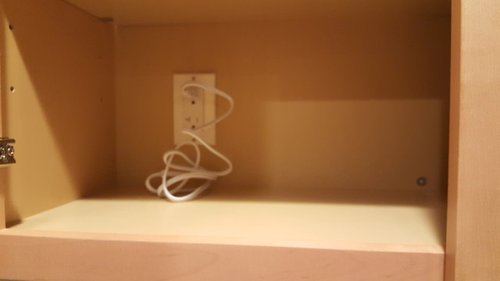
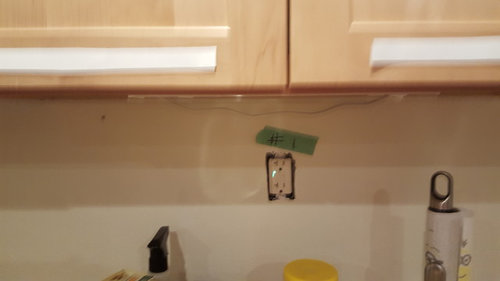
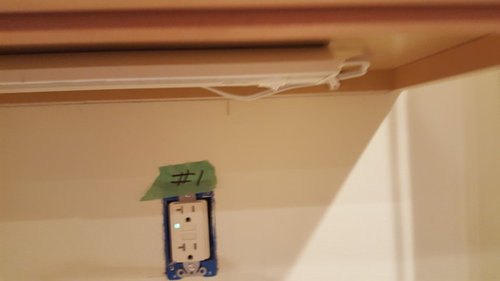
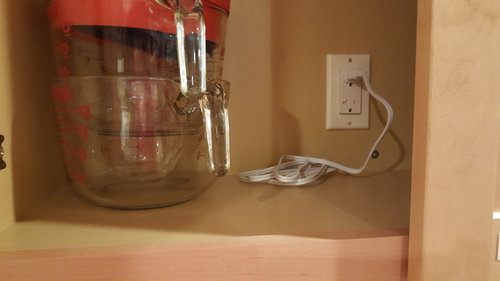
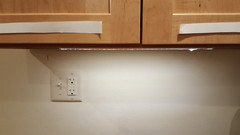
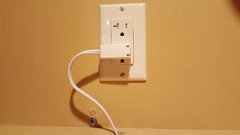
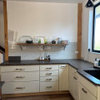
Our contractor has installed under cabinet lights and they work great. The question is about how to manage the power cord. He has an outlet inside each cabinet and is running the power cord up through a hole in the underside of the cabinet. This results in seeing the cord under the cabinet as well as the plug and remaining cord taking up space in the cabinet. Is there a way to make this work and be more visually appealing? I apologize for the duplicate pictures - having issues with the picture uploading.


Thanks!


Comments (14)

  • 10 years ago
    The type of installation you have been given seems inappropriate for new construction..it may not even be the right type of fixture...the finished product should be wired in directly..no hanging cords and plug-ins installed inside cabinets an also no visible fixtures under the cabinets..you may have to ask your contractor to go back to the drawing board on this...
  • 10 years ago
    last modified: 10 years ago

    Cords are found in 400.8, and the usual arguments are as follows;

    400.8 Uses Not Permitted.

    Unless specifically permitted in 400.7, flexible cords and cables shall not be used for the following:

    (1) As a substitute for the fixed wiring of a structure

    [This is not fixed wiring since it plugs in.]

    (2) Where run through holes in walls, structural ceilings, suspended ceilings, dropped ceilings, or floors

    [A cabinet is not one of these. A cord is allowed to extend through a cabinet for a DW in Article 422, as is the cord for an over the range microwave. Cords are even allowed to rum through gromets in desk tops. This is a similar application.]

    (4) Where attached to building surfaces

    [This is actually the reason the job looks sloppy. It has to by code]

    (5) Where concealed by walls, floors, or ceilings or located above suspended or dropped ceilings

    [A cabinet is not one of these]

    (7) Where subject to physical damage.

    [ A cord for a floor lamp is just as, or more susceptible to damage with something heavy like a chair leg when somebody is sitting on it.]

  • 10 years ago

    The contractor can not make a silk purse out of a sow's ear, as they say. If the customer wants to pay for a more expensive lighting system, then it can be installed in a way that has a more custom look, but those custom light fixtures will cost a custom price.

  • 10 years ago
    Wow Fred ....that was a lot of information..since you obviously have a lot of knowledge on the subject ...do you know of a solution somewhere between this kind of hardware store equipment and a high end custom installation? It looks like new construction ...so wouldn't this be the time to get this done a little better?
    thatlife thanked btydrvn
  • 10 years ago
    last modified: 10 years ago

    Usually not much stuff will fall in between high and low. You might think it would look better if you cut the cord shorter and just hardwired it, but that would violate the luminare's UL listing and be a code violation. There were some products that were UL approved that could be cut to lenght and customized easily, but UL put a halt to that when the products became cheap enough and 'consumer friendly' enough that every home owner was putting them in instead of an electrician. So, now it is either cheap and consumer friendly with a rediculously long cord that plugs in, OR complicated and expensive enough that most consumers won't do it themselves, costing even more in electrician labor $$. Hopefully, you caught the Catch22 in there that UL has purposely built into the product standards for the most part.

  • 10 years ago

    The biggest problem is not knowing what fixtures the homeowner is going to pick when the electrical rough-in is done, not to mention what products will still be available once those need replacing. Except for plug in models, not much else is that interchangeable. There is a way to make the rough wiring more readily "universal", but it is too late and too many words to type for this dilemma.

    http://www.inspiredled.com/

    Seems to have as good of system as any for the next step up.


    thatlife thanked User
  • 10 years ago

    With these kinds of under cabinet lights, there doesn't seem much you can do. You can tape the chord to the bottom of the cabinet (under side) and tape the cord to the back of the cabinet to be less in the way. If that's not going to make you happy, consider LED strip lights under your cabinet. They are brighter, much smaller and hardwired in.

    thatlife thanked Barbara Almandarz
  • 10 years ago

    Thanks for all the great feedback! When I got home from work today, I saw that the cords were changed to have flat plugs and the cords are now adhered to the underside of the cabinets. It looks better - not sure if that meets code based on the previous comments though


    .

  • 10 years ago
    last modified: 10 years ago

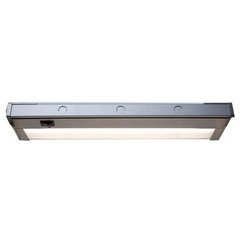
    Now that I see the fixture, it appears that the power cord is detachable from the fixture. I believe you have a linkable fixture where that "port" can be used to link several fixtures together. It appears that the manufacturers are finding better ways to get UL approval for making these more universal now. The ones I am seeing on the internet right now have a way to hardwire them in the back, through the little round knockouts, and the cord can be removed entirely.

    By doing this, you could run a piece of "Romex" straight out the back and straight into the wall. It is very easy to fish the wire into the back/bottom of the junction box at that short of a distance. This gives you a lot less cord on the bottom of the cabinet. It could even be encased in a short piece of tan wire mold if preferred. At that point, the receptacle can be removed, and a blank cover put on the junction box. The advantage (other than having less inside the cabinet) is that if that receptacle is controlled by a light switch somewhere else in the room, you would not be allowed to use a dimmer at that light switch. It is against code to dim a receptacle because you might fry any other appliances that someone might unknowingly plug into it. It is also against code to hack a UL listed cord assembly like that. However, that doesn't necessarily make it unsafe if the polarity was double checked after they did that, but I'd bet that it isn't even a polarized plug. It might be good to know if the original one was polarized.

    404.14

    (E) Dimmer Switches. General-use dimmer switches shall be used only to control permanently installed incandescent luminaires unless listed for the control of other loads and installed accordingly.

    406.15

    Receptacles supplying lighting loads must not be connected to a dimmer switch unless the plug/receptacle combination is a nonstandard configuration type specifically listed and identified for each such unique combination.

  • 10 years ago

    second photos much better -- he made some of the changes suggested here. still, should have given you a heads-up about having a plug inside a cabinet (I hope only one) and discussed options.

  • PRO
    10 years ago

    Go Fred ! Knows what he's talking about.

  • 10 years ago
    last modified: 10 years ago

    A 3" wide horizontal board affixed beneath the cabinets could prevent you from seeing the cords and light fixtures unless and until you bend down to look below it.

    Is cord inside cabinet intended for: a clock radio? plugging in a small computer/laptop/tablet used in the kitchen? a phone and/or phone recharger and/or answering machine?

    If you put a toaster oven there you could set fire to your kitchen -- do not use a heat producing appliance there. Even a small microwave needs room for air to flow around it.


  • 9 years ago
    last modified: 9 years ago

    I just installed a new kitchen and I planned my under cabinet wiring the same way as you - I have outlets in three different cabinets that all run back to a wall switch so I can turn all of my cabinet lighting on with the same dimmer switch. I don't think this is a "hack" way to do this job at all. There are so many products out there and most of them (from what I've seen) terminate with wall plugs. I can't imagine planning what type of fixture and wiring I would want before closing my walls. The outlets in the cabinets allow me a lot more flexibility in fixtures now. I plan to shorten my wires and replace the plugs with flat, low profile plugs so they are minimally intrusive.