

Dia De San Juan
This is a follow up on our Aztec corn crop. We have made cornbread with a few different recipes now. Last evening I reheated a large cake pan of southern cornbread (no wheat flour) and ate the whole thing by myself. Actually, there was only half a pan left from the previous evening. The reheated cornbread was better than the first day. I applied liberal amounts of sweet cream butter.
We planted 2/3 acre and lost half to flooding. The remaining 1/3 acre produced 60 to 80 pounds of dried white dent corn (shelled). It took four pounds of seed to plant 2/3 acre.
We will be serving white cornbread all Winter at our free Saturday brunch (Brunch On Noble). That was the main reason for growing it.
It has an interesting survival technique. I noticed that when it fails to rain, its leaves curl up a little and it just stops growing and waits for rain. Also, it makes corn even when planted in marginal soil.
I might make a hobby of looking for the perfect cornbread recipe.
2 cups Dia De San Juan corn, ground fine
2 tsp Rumford baking powder
1/2 tsp Baking soda
1/2 tsp Salt
2 Eggs
1/4 cup extra virgin olive oil
Enough milk to obtain a consistency like pancake batter
Mix the dry ingredients well before adding wet ingredients. Bake immediately at 425 degrees for 15 minutes. Use a well greased, large cake pan so the cornbread is only 3/4 inch thick when done.
Yes, it is THAT good.
Comments (69)

johnnycoleman
Original Author10 years agoGeorge,
Have you seen any variety of corn that needs less nutrients to make corn? Said another way, have you seen corn that grows well and makes corn in poor soil?
Johnny
 10 years ago
I calculated an 8' x 5' plot with corn 8" apart and in staggered 18" rows would be 33 plants. (This was per "block" planting instructions I found). I figure at best I would have room for 2 of these blocks. Which doesn't come close to 200 plants. When you save seed, how much do you save in relation to what you use for food and what kind of yield would you expect (in an average year...I know, there are no average yeilds in OK).
Related Professionals
Cape Coral Landscape Architects & Landscape Designers · Pittsfield Landscape Architects & Landscape Designers · Forrest City Landscape Contractors · Mountain Home Landscape Contractors · San Marcos Landscape Contractors · Auburn Landscape Contractors · Waterbury Landscape Contractors · Springfield Landscape Contractors · Duluth Landscape Contractors · Sioux Falls Landscape Contractors · Rutland Landscape Contractors · Tallahassee Accessory Dwelling Units · Raleigh Accessory Dwelling Units · North Adams Accessory Dwelling Units · Provo Accessory Dwelling Units- 10 years ago
It is my understanding that about 90 percent of commercially grown corn in the US is GMO, but not popcorn. I frequently make cornbread using ground popcorn, but the taste is a little different. It is still good, but maybe I could say a little "corn-y-er" taste. However, that may be just my cornbread because I use only corn and don't add flour or sugar which are common ingredients in recipes.
I wish that I had enough space to grow dent or flint corn, but I really don't. I have some seed on hand so I'm thinking I might grow a small amount in clusters and let pole beans climb the stalks.
My husband has kidney disease so I have to be really careful with food. I use coconut oil, olive oil, and butter, 99 percent of the time. I have never used canola oil because I think it is dangerous, but I fell for the hype of other vegetable oils and used them for many years until I started to study how they were made and what chemicals were used in the process. In addition to the processing, many of the crops used to make oils start out as a GMO plant. I can't control what we get when we eat out, but I try to be really careful with the foods we prepare at home. Summers are easier because our garden produces much of what we eat. I like where I live, but have considered moving to a larger property simply to be able to grow more of our food.
- 10 years ago
Autheray, Regarding your friend who has trouble with foods containing gluten....you didn't say if he is a diagnosed celiac or just a person for whom certain proteins in grains cause a strong reaction, but the answer would be the same regardless. (It is just a more important issue for a diagnosed celiac versus a person who isn't diagnosed with celiac disease but who still has an adverse reaction to certain grain proteins.)
Anyhow, it is known that folks sensitive to the gliadin proteins found in wheat, rye and barlety also tend to also have a similar reaction to the zein protein found in corn. The reaction to the zein protein found in corn may be somewhat milder than their response to the gliadin in grains that contain gluten, but it still means they likely need to avoid corn in any form.
Many recipes exist for a cornbread-like muffin or bread made without using any wheat, rye, or barley flour and without actually using corn meal, largely because people following several popular types of grain-free living (Paleo, Primal, Wheat Belly, etc.) have developed those recipes. I'll link the best one I've found below for you. It is easy, tastes great and if you don't tell someone it is not cornbread, they tend to think it is cornbread, if you know what I mean. This recipe might work for your friend. My son, who is not following a grain-free diet of any kind still likes "cornbread" made with coconut flour (and no corn) more than he likes cornbread itself, and he is a lifelong cornbread eater.
Dinner Muffin Substitute for Cornbread
Hope this helps,Dawn
- 10 years ago
Johnny Coleman,
Now a days it is hard to find cornmeal with out some wheat flower in it and most all recipes call for flower and sugar to be added to the cornmeal to make cornbread. I don't get corn dodgers very often, but I am not computer savvy and don't know how to post pictures. Corn dodgers and Hoe cakes are basically the same thing except that generally hoecake batter is poured out in a skillet like a very small pancake most of the time. Corn Dodgers can be made the same way, they are both just fried cornmeal. It boils down to if a person likes fried cornmeal. Until I was grown I never tasted cornbread baked in the oven as my Mother cooked cornbread in a skillet with a lid on it up on a top burner, more or less kind of fried. This way seems to be more moist than baked in the oven to me. My wife bakes cornbread most of the time in the oven and we have gone around and around about which is the best, I usually loose and have to give in.
The way that I've always heard it was that about all corn used to be like the Hickory Cane type corn for grinding into meal, which I guess would be kind of like flint corn or Indian Corn. Yellow Dent corn was an improved type of corn that was flat and indented on top and the grains were wide as a mans finger nail. I don't know if it was really any better or not but it may have been better livestock feed and more productive. I know back years ago my Dad hoped to make 100 bushels to the acre which was hard to do and it needed to be real good ground and fertilized, the poorer the ground the less you make. We grew Yellow Dent until I was nearly grown before there started to be better more productive types of corn on the market. Before the new kinds of corn came about my Grandpa and me would shell out corn seed from the corn crib in the barn to be planted, after the newer hybrid types came we bought corn seed. We left corn on the stalks in the field until after frost and it was dry before picking it and putting it in the barn for the winter.
The type of cornmeal is determined by how it is ground, either coarse or fine. I have heard that stone ground taste better than meal ground in a modern mill, but I am no judge of that. The courser the grind can be made into grits where the finer is more for cornbread. Also they used to make Hominy by boiling corn in a cast iron pot and adding hardwood ash or lye to the water to puff up the corn into hominy and then washing it off a couple of times before cooking it.
You can use most any old kind of corn just like sweet corn, that is where the term Roasting Ears comes from. Any corn can be picked early when it is in what is called the milk stage and boiled or roasted and sprinkled with salt and butter and eaten. About the only thing that I know sweet corn that has gotten dry and hard is good for is to feed the chickens or ground up and cooked into Moonshine.
Also used to be people cooked with home made lard and butter and didn't have to worry about any GMO cooking oils.
Well, I guess I have spread enough rumors for now.
johnnycoleman
Original Author10 years agoIf I were in your shoes, I'd ask some local farmers to share crop 1/2 acre just for growing dent corn.
Johnny
johnnycoleman
Original Author10 years agoAmyinOwasso/zone 6b(6b),
We averaged about 1/3 pound of dried corn per ear. It took about four pounds of corn to plant 2/3 acre. However, I planted the rows 48" apart to reduce water stress. I planted the seed about one every 4 to 6 inches. We lost about half of our corn to flood and wound up harvesting 1/3 acre.
So, 200 ears of corn could produce about 60 pounds of dried corn. That is about two 5 gallon buckets. That would make A LOT of corn meal!
NOTE All of the above numbers are approximations.
Johnny
PS We shucked and dried the corn the way the Native Americans usually did it. We picked the corn when ripe (husks started turning brown) skinned back the husks, tied them together over heavy cord or wire to dry. We used a hand crank corn sheller after the corn dried for about a month.
It was quite an interesting process.
Johnny
- 10 years ago
Johnny Coleman,
If the ears of corn are not allowed to dry out completely they get a black mold on them like a smut.
johnnycoleman
Original Author10 years agoWhen we harvested our corn, we found two ears of orange corn (almost the color of candy corn). I have asked a friend who does not usually grow corn to see if she could get a crop of orange corn from one of those ears. The rest of the corn was white but the cobs were either white or red. Again, I asked a friend to see if she could get a crop of each.
Sooo interesting.
Johnny
 10 years ago
This thread is turning out to be a really good one! Carol, I've heard that popcorn isn't yet GMO. Some years back I read that white corn hadn't yet been invaded. But by now, I suspect it has.
Ami, if I were growing fewer than 200 plants, I think I'd try to save at least a half a handful of kernels from each plant which produces. I'd mix that all together and draw from that for my next planting. If one uses a lot of organic fertilizer, corn can be squeezed together. It's a pain to hoe, and might be impossible to hill. But it can be done. Years ago I did it as an experiment and it worked pretty well. Here's a picture.
This was in 2007, and the corn was Mesquakie Indian.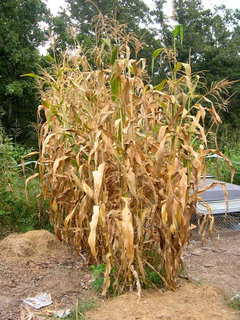
Come to think of it, if I see you before spring, I'd be happy to share some Mesquakie Indian seed. You could grow it and then we could trade some seed to widen the gene pool. I think I feel an idea coming on. Perhaps I should offer this to a number of people. It would just be extremely important to avoid crossing.
 10 years ago
great thread
I like the Dia De San Juan corn. Makes good cornbread.
I can also vouch for:
the worthiness of Deppe's book
close planting of corn plants in well amended soil- 10 years ago
If the corn is dried well, can it be shelled easy enough just twisting with your hands? Maybe with some rough palmed gloves?
johnnycoleman
Original Author10 years agoYes it can be shelled by hand. However, you wouldn't want to shell 200 ears by hand.
There are antique corn shellers available. Here is the one we own. I doubt we will ever wear it out.
- 10 years ago
We have an old fashioned sheller. But we have also shelled corn by hand. It's slower. One way to better do it by hand is to use a cob for rubbing on the ear that is being shelled. Another help is ... to be watching an interesting video while you do it.
Some corns are harder than others to shell. Cherokee Squaw is much easier than Mesquakie Indian. Most large kernel varieties are easier than the small kernal varieties. Flour corn tends to be easier. - 10 years ago
I am not ready to commit to corn this season. We are still building beds. Where I want to put corn is just grass now. It can't be tilled because there are wires buried there. A lasagna plot there is possible, and some soil building crops first. Good to know I could space closer. While the next door neighbor grew a few things last year, I don't think he grows corn. I haven't seen any other gardens in the neighborhood.
George, what did you think of the idea of surrounding the corn with sorghum? How tall does your corn get?
Johnny, I had to laugh when I watched the video of the corn sheller. Kernals going every where! Then I saw it was over a box. We bought a manual grain grinder recently and it did the same thing, only I don't think it was supposed to. We had to wrap a plastic bag around it to catch the flour. johnnycoleman
Original Author10 years agolast modified: 10 years agoAmyinOwasso/zone 6b(6b),
A number of kids shelled corn for us this year with our hand cranked sheller. They had so much fun, they wouldn't let any adults have a turn.
Mission accomplished!
Our sheller is mounted to a "bottomless box." We have a pan that fits in the box. Otherwise, you can put the box in a large tub that will catch the corn.
Johnny
johnnycoleman
Original Author10 years agoWe hung the corn to dry on long runs of steel wire. We tied the husks around the wire. The corn was allowed to dry for three to six weeks indoors.
We did it that way to prevent mold. After shelling, we are keeping it in the deep freeze. That is supposed to kill any insects in the corn.
Johnny
- 10 years ago
I think that the sorghum barrier is a good idea. It wouldn't be fool proof, meaning, if there is foreign pollen in the air, it can still get through. But it would cut down on cross pollination.
Both my corns grow 9-12' depending on moisture and fertility. Both have superior root systems and strong stalks. My impression is that, though both are dents, Mesquakie Indian leans more toward flint corn, in characteristics and Cherokee Squaw leans more toward flour corn. Mesquakie Indian corn, if heated in an oven will actually have some kernels make popcorn.
 10 years ago
Holy COW! What the heck have I been missing and DANG! THIS IS AN AWESOME THREAD!! Scottcalv - I will help shell (shuck?) that corn for a small percentage of the grain!!! I'll even supply my own gloves! (along with arthritis meds and cream! LOL!) And I have a KitchenAid - surely there's an "attachment for that"!
This info strikes a big cord with me. After years of undiagnosed illness - both my daughters have auto-immune disorders and they both are rooted in gluten problems. One simply can NOT tolerate it at all and both of her daughters have varying degrees of sensitivity. The other has varying degrees along with a sensitivity to soy and egg whites. This last holiday was a challenge - how does one do a traditional holiday meal that is gluten, sugar, soy, sodium and egg-white free? Message me - I did it.
I'll be following this closely. I'm also planning a large amaranth planting to use as a gluten free flour substitute. If anyone is interested, I'll share those results also.
Who needs a "master gardener" class? (hehe- Bon! You got that one right!)
johnnycoleman
Original Author10 years agolast modified: 10 years agop_mac(7),
We have just received our allotment of crookneck milo seed. Sandhill would only sell us eight ounces. Next year, we will have enough seed to plant all crookneck. It is a variety of milo particularly well suited to small holders who harvest by hand. I understand it is gluten free. A chef I know wants to develop a bread recipe so he can sell it at the local farmers market. I expect it to be little affected by persistent herbicide, another benefit.
Johnny
johnnycoleman
Original Author10 years agolast modified: 10 years ago- 10 years ago
Paula-I thought about the kitchen aid. We have a great stand mixer. But that's all I need...Something else cluttering up cabinet space. Quick story for you. About a mile or so from your house to the east is a tornado siren on 108th. A couple weeks ago I was heading down hill by it going south towards the stop sign. The very moment that I touched my brake pedal to slow down that siren went off. I mean the exact instant I touched the brakes. I thought they were falling off the truck! So I let off the brakes, the siren kept going, and I thought "What in the world??" Then of course I figured it out, but nearly drove through the intersection because I could not stop in time.
- 10 years ago
Johnny Coleman,
Corn hilled like you did is a good way because if you wait until it is bigger you can hurt the feeder roots and it will wilt your corn stalks. Hilling corn use to be something that everyone did but has fell out of use with modern farming methods. As you saw it helps against wind and water damage.
- 10 years ago
Yes, I always try to hill my corn, at about 12" as mentioned. It adds stability. When I planted corn real close together, that was practically impossible. And, it worked. Hilling is also a opportunity to knock down the weeds, one last time, just as the corn hits a point that it will shade them out.
- 10 years ago
I have a Nutrimill and just read the following in my book.
"POPCORN - Contains less starch than other types of corn and makes
the best cornbread. Use also in pancakes, waffles, breads, and as
dusting flour." johnnycoleman
Original Author10 years ago
I use corn meal under my rustic bread and oven fries. It keeps them from sticking to the cookie sheet.Johnny
- 10 years agolast modified: 10 years ago
Kitchen Aid does have a grain mill attachment for their stand mixers. I've linked it below. I'm considering buying one so I can make my own corn meal from home-grown corn.
johnnycoleman
Original Author10 years agoDawn,
I think it will make steel cut oats too. I might experiment with naked oats next year.
I soak them over night, in water, in the fridge. In the morning I put fresh water on them and cook for about 10 minutes. Sooo much better than rolled oats. However, oat groats are kinda hard to find.
Johnny
 10 years ago
What I want to know is why oh why couldn't all this fun knowledge have been available when I could eat grains.
That being said I hope to reintroduce corn for cornbread at some point, so I will grow it every year I guess till I am ready. I grow Mandan bride flour corn.
johnnycoleman
Original Author10 years agoEven if you can't have grains, others can. You can share these great "whole" foods with others.
We served thirty people yesterday at our free brunch. I made pancakes with organic hard red winter wheat from John's Farm.
Now THAT is whole wheat flour. I made it the previous day with my grain mill.
It felt good to serve better food than can be bought in stores. Just for fun, I bought some real maple syrup and 100% honey (MIO) for the pancakes. Also, I introduced them all to cultured butter. It is made in a similar fashion to how they make it in Europe. It is like double butter! (;-)
Johnny
- 10 years ago
Talking About Oat's,
It is none of my business but I like the Old Fashion Oats but I don't cook them. I pour them out of the box into a bowl and add milk and a TLBs. of honey and a 1/2 Tsp. of cinnamon with a few raisons scattered on top. I like this better than cooked. Cooked oat meal makes me gag.
johnnycoleman
Original Author10 years agoI too buy the old fashioned oats. I bring the water to a rolling boil and add just enough for one serving. Let the water come back to a rolling boil, turn off the fire. Let them sit for about three minutes. Then they are ready to eat. They are very much like steamed oats.
I hope you get the opportunity to try fresh steel cut oats. They are much better.
Johnny
- 10 years ago
Johnny Coleman,
I am sure you are right. But I'm afraid I would still have to eat them raw as I am just not a fan of cooked oats. I think it is something to do with the texture. But I do like corn meal poured into boiling water and cooked into grits or mush.
- 10 years ago
Kim, I've voluntarily cut way back on the grains I consume, but my other family members still eat oats and some corn and a small amount of wheat. I'd rather grow our own flour corn and make corn meal than buy pricey organic corn meal, and that includes making our own tortillas and tortilla chips insead of buying them. There's no way we're eating anything made with GMO-corn, which is most of what is found in stores now as most of the corn grown in this country is GMO. I've been reading and researching the effects of eating Bt-corn (and other Bt-modified crops) and Round-up Ready crops, and now am trying to eliminate everything from our food supply that might have any Bt- or RR- crops in it.
Johnny, I see oat groats in some of the stores that carry a lot of organic and healthier type foods like Central Market and Whole Foods, for example. Bob's Red Mill also has oats groats and lots of other grocery stores carry at least some of the Bob's Red Mill products. I wonder if oat groats might be available through the OK food co-op?
Dawn
johnnycoleman
Original Author10 years agolast modified: 10 years agoDawn,
If you find a local source for organic oat groats, please let me know. I love the (crunchy?) texture of steel cut oats.
I recently read about naked oats. Back in the day, they were very popular. I'd like to try them. Might even grow some.
Johnny
- 10 years ago
Johnny, I use both hard red wheat and white wheat, but I frequently hear people say that they use orange juice as part of the liquid when they use whole wheat flour so that it doesn't taste bitter. Since mine had never tasted bitter, I finally realized that it was because I grind it fresh. I think what they are tasting is just old bran. Even if they keep it in the freezer, they don't know how old it was when they bought it. I am now on my third grain mill so it is just a normal part of cooking for me.
- 10 years ago
You are right Johnny. I do grow some sweet corn for my son and my flour corn oh and popcorn. Mostly though I giveaway lots of greens and turnips. They are what people here love.
johnnycoleman
Original Author10 years agoWe served pancakes to thirty people last Saturday (Brunch on Noble). I ground the flour the day before and kept it in the freezer over night. There were no pancakes thrown away. (;-)
Johnny
https://www.facebook.com/brunchonnoble
johnnycoleman
Original Author10 years agoGood for you! We gave away some purple top turnips that were half as big as my head.
We are not sure which cool season crops to plant in Feb. We have had very little interest in any of our leafy greens. We'll see.
Johnny
- 10 years ago
The pancake brunch sounds awesome. I love to feed people.
And real maple syrup.....my downfall right now. I have been making tortillas with cassava flour and then I fry in tallow and sprinkle cinnamon and a drizzle of maple syrup
johnnycoleman
Original Author10 years agoI am more than 40 pounds over weight. I did not eat any of the pancakes or maple syrup. However, I was very tempted.(;-)
I like the idea of giving away food that is better than is available in the stores.
Johnny
- 10 years ago
Johnny,
Because I am so far south that Texas sits to my west, east and south, I suspect my "local" is not the same as yours. : )
We do almost all our grocery shopping in Texas, generally in the D-FW metro area, which is geographically closer to us than the OKC metro area. I'll be down there this weekend and will look for oat groats in both Central Market and Whole Foods. We buy Bob's Red Mill steel-cut oats at CostCo. Because CostCo carries a huge selection of organic and non-GMO foods, it gets a lot of our grocery dollars every month, even though we have to drive 80 miles one way to shop at CostCo. The Central Market where we shop has the full Bob's Red Mill line.
In our never-ending quest to eat healthy foods, we are trying to avoid all products made from GMO crops like Bt-engineered foods and Roundup Ready crops. When you cut all those from your diet, you're either buying only organic foods or you're buying raw ingredients and making everything (and I mean everything) from scratch. That is why we'll be growing our own flour corn this year so we can make our own corn meal and then cook with it.
Our desire to eat as organically as possible also explains why I lose my constant battle to make my garden smaller (gardening organically by hand is so very labor-intensive and I can only do so much in one day). Despite my efforts every year to cut back and grow less, it seems like every year I grow more and more. I might not like it when I am out sweating all day long in the hot summer sun (or sweating inside in a hot, steamy kitchen while canning), but I like it when everything I can, dehydrate, freeze or root cellar is 100% organic. As hard as I try, I still cannot buy 100% organic at the grocery store, but every year we're getting more and more that is organic and less and less that is not.
Oh, and to clarify, I love gardening and I love my garden. However, the work to raise as high of a percentage of our own food as possible does get exhausting at peak times in the growing/preserving season.
Dawn
johnnycoleman
Original Author10 years agolast modified: 10 years agoDawn,
I saw a video about canning that showed a fellow canning in his steel building. He had the big doors open. I thought that was a very good idea.
I'm not very worried about my own health when it comes to adulterated food (GMOs and toxic chemicals). I'm more concerned for our descendants welfare. Our grandchildren deserve better than that.One of my concerns is sustainable farming. We (humans) have squandered enough resources already. I am still trying to learn how to apply no-till to veggie gardening.
On a side note, we sure have enjoyed our frozen Kennebec potatoes this winter. I cleaned them with a veggie brush outside, quartered them, blanched them, and froze them in gallon bags. That technique allows me to go get a hand full for supper and re-close the bag.
I have linked to a pic of our corn growing last year. I like to look at it.
Johnny
- 7 years ago
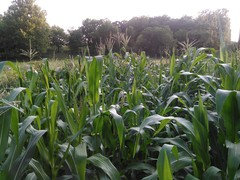
I have harvested this year's Mesquakie Indian corn and need to shuck and shell, etc. Here's a picture of it back in August. I got it in real late and had to water like crazy for a while. But then, in spite of the drought, we had good rains at strategic times. Next year I hope to grow a WHOLE LOT MORE. Since this thread was active, I've decided to only grow Mesquakie Indian Corn, simply to make the work of preservation easier.
- 7 years ago
George, Your corn looks great.
I can relate to having to water a lot. It was a really rough summer here. We got a nice, low water bill in the mail yesterday and Tim and I both marveled at how low it was, after all the sticker shock we had each time a summertime water bill arrived. We decided it was about the lowest water bill we've ever had in our 20 years here in OK. Of course, with record-setting rainfall over the last two months, nothing has needed to be watered at all and that is why the water bill was such a small amount. Even plants in containers haven't needed any extra water.
Shucking and shelling the corn is going to take up a lot of your spare time, not that you ever have any spare time to begin with.
Dawn
- 7 years ago
Indeed. I still haven't finished shelling some beans from 2017 and now I have from 2017 and 2018 to do. Last night we slowed down for the evening and watched a video together. While I watched I shelled beans, catching up on two varieties. It was enjoyable. Corn will be around Thanksgiving. I think I'll work on that while I'm visiting with family, "Here, want to help?..."
This year I had a really good corn harvest. Some ears were larger than I've ever before observed for this variety. The rains must have it at the absolute most strategic times.








Macmex