Software
Houzz Logo Print
splinter1804

Why is it so?

10 years ago
Hi everyone.

This is the side of bromeliad growing no one wants to experience however let me tell you what happened to me.

Toward the end of November 2015 I had an open garden day for the members of our local Bromeliad Society; my garden was finally looking reasonable and the temperatures were between 17 – 20 degrees C. with nice mild sunny days, ideal for a garden visit.

Two days before the visit the weather forecaster said there was an unexpected extra hot day on the way so just to be on the safe side I rigged up some temporary shade cloth over the front garden which is otherwise unprotected.

The day before the visit it happened; the temperature jumped from below 20 degrees C. to 39-41 degrees C. accompanied by a hot dry westerly wind just as previously forecast, and it wasn't until about midnight that a cold southerly change came through and the temperature finally dropped back to the low twenties.

I was up early the next day to survey the damage and remove the shade cloth and to my surprise everything in the garden looked fine with no visible damage. The Bromeliad Society members came and spent an enjoyable 3-4 hours viewing my plants of which I was very proud and a good morning was had by all.

Unfortunately a few days later, a bit of burn damage started to appear on a few of the Neoregelias which was surprising, as they had been protected by the temporary shade cloth covering. A week later it was a much different story with lots of plants showing severe burning even including some Ae. blanchetianas, which really did surprise me as I know they grow in the open in tropical North Queensland and tolerate the northern heat OK and it puzzled me why they had burnt here in Shellharbour.

Anyway after a lot of thinking, I’ve come to the conclusion that it’s not so much the heat that does the damage but the sudden severe change in temperature and accompanying hot westerly wind which sucks the humidity out of the air, and because it’s so sudden, the plants don’t have time to adapt to the change.

It’s also interesting to see what some plants do when they are severely stressed in these situations, and the “trigger mechanism” that’s activated to reproduce themselves. e.g. I’ve had a Vriesea in that garden that rarely flowers but after that hot day it has produced six or seven flower spikes and some of the larger growing Aechmeas which I had grown from seed were also putting up flower spikes as well; again probably in an attempt to reproduce themselves just in case they died.

Mother Nature can sometimes be very cruel and cause a lot of damage, but then she also has a wonderful way of repairing it, and hopefully the burnt plants will eventually produce a pup or two to restart the growing cycle all over again.

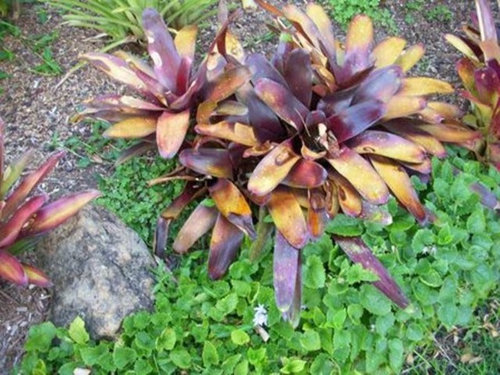
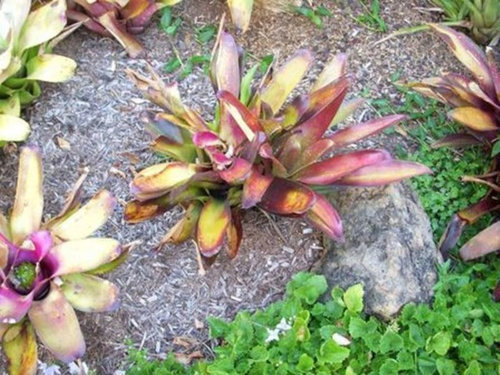
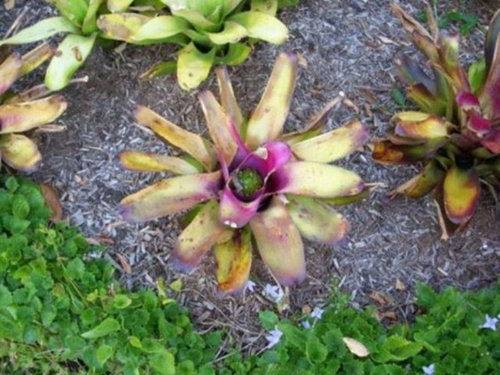
What did puzzle me somewhat is that there is a soft leaved small border plant along the front of the garden which you can see in pictures 3, 4 and 5, and not a single leaf of that was burnt and it wasn't even beneath the protection of the shade cloth. As a well known Professor Julius Sumner Miller often asked on his TV show many years ago...........Why is it so?

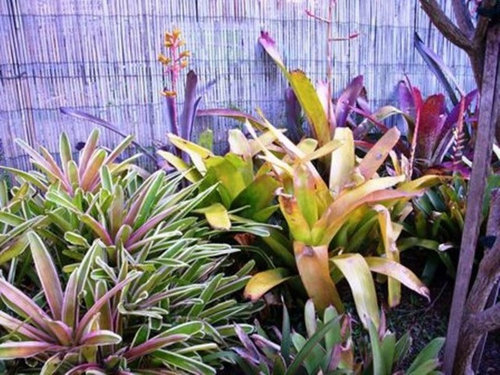
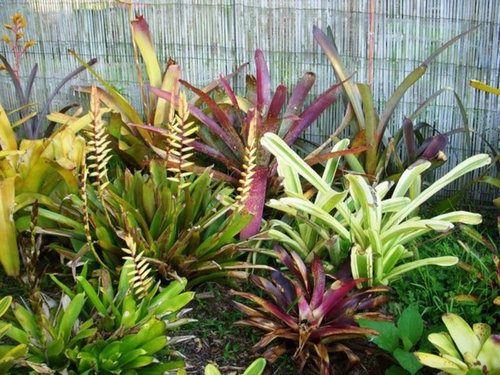
I’ll finish with a few pictures, and if you look past the weeds that I haven't got around to pulling out yet, you can see the heartbreak Mother Nature caused me with the burnt Neoregelias.

This it the multi-spiked Vriesea which previously rarely ever flowered


Even the Ae. blanchetianas took a roasting

But not quite as much as this (what was once) a beautiful clump of burgundy coloured Neoregelia.

The puzzle is though, why didn't the leaves on the small green border plant get burned as well?


All the best, Nev.


Comments (9)

  • 10 years ago

    ..

  • 10 years ago

    Nev, that's not a pretty sight.

  • 10 years ago

    Hi Everyone.

    I guess you win some and you lose some but "Mother Nature" has the final say.

    All the best, Nev.

  • 10 years ago

    The only vague and flimsy explanation I can offer for the low growing plants survival is that cool air sinks and perhaps low to the ground was ever so slightly cooler than above. And yes, stress will definitely trigger a survival response.

    tj

  • 10 years ago

    Well at least your tour was a success. Sorry about the shape of your plants now.

    I'm not familiar with whatever that ground cover is, but likely it's able to take more heat than broms.

    What I don't understand is : do you normally have all these broms in the same location year-round? Are these hot spells unusual? Wish I was better at translating Celcius to F.

    What is your air quality like on a normal warm-season day? Clear blue sky? Or sort of milky, humid and hazy?

  • 10 years ago

    Hi everyone.

    Dave - I agree with you about the ground cover; it does
    seem to be "bullet proof" which is surprising because it has very
    thin leaves and I thought it would have been the first to suffer.

    To answer your second comment, yes these plants are in
    the same location all the time and have been for some years now.

    Fortunately these abnormally hot spells are unusual,
    we'll just get one every three years or so but this time I thought I was
    prepared and rigged a temporary shade cloth covering about three feet above the
    plants. What puzzled me was it didn't seem to make any difference and the
    damage was the same as it had been on previous similar occasions when the
    plants were uncovered.

    That's why I suspect it was the hot dry wind which put
    the nail in the coffin by dehydrating the plants and adding to the already
    sudden temperature variation going from 19 degrees C (66.2F) in the mid-morning
    to 41 degrees C (105.8F) early afternoon and back to 20 degrees C (68F) the
    following mid-morning. That's a temperature variation of 22 degrees C in a
    twenty four hour period.

    Normally summer days are moderate to hot here with clear
    sky and average temps. around 18 - 28 with moderate humidity as I live just one
    street back from the ocean, but this year the temperatures have been all over
    the place.

    All the best, Nev.

  • 10 years ago

    Hello Everyone!

    Nev that's the first time I have seen these pictures, that change in weather was very nasty and I hope they have all produced some nice offsets for you to replace your damaged plants. If there are any that you do not have replacements plants for please let me know and I will see if I have any spares I can send you.

    This summer has been super dry for us with hardly any rain when we truly need it and we have had to put a lot of time and effort to make sure everything gets water when it needs it and move our bromeliads and orchids around to protect them when and if needed; so the gardens a bit all over the show at the moment but once things cool down a little I will be able to put things back in there usual spots to get the best out of our plants.

    Take Care & Happy Gardening!

    Trish

  • 10 years ago
    last modified: 10 years ago

    Hi Everyone.

    Trish - At last you've managed to join our friendly forum and I'm sure you'll enjoy being here and contributing to our knowledge sharing. Those pictures above are the ones I tried and tried (without success) to post on the other forum.

    The weather here is still very unsettled with rain almost every day which is almost unheard of for this time of the year, this of course is bumping up the humidity and the next thing we'll experience will be problems with rot, so it's important to make sure there's good air circulation and adequate space between all plants.

    When I grew orchids many years ago, it was usually mid February that these conditions prevailed in our area and everyone could expect to lose at the very least a few plants to rot no matter what preventative measure they had in place and it was so common the problem came to be commonly known as "February Rot" .

    I only mention this here because I know that many of us still grow orchids and the following link is an interesting read for these people (Joe) for instance. It points out that the start of this rot was in December (not February) and by the time February came around, treatments often didn't work because the disease by then was too firmly established and a preventative treatment should have been started in December.

    http://www.bribieislandorchidsociety.com/wp-content/uploads/file/orchidgrowing/Pests-and-Diseases.pdf 

    All the best, Nev.

  • 10 years ago

    Hello Everyone!

    Yes Nev he he I finally was able to get on and join this forum; I experienced some registering issues at the beginner.

    The weather is just so unpredictable at the moment and I hope things are on the improve for you. Just imagine all the pups those damaged plants are going to produce and you will probably find they will astound you with the intensity of their colour because of the harsh conditions they have endured.

    Thanks heaps for providing above link; Joe and I will sit together over the weekend and check it out for sure. Joe is still heavy into growing/collecting orchids and although they have been through one tough summer they are still doing well but he has lost a good 5% of the seedlings he had that were still rather small and that would have been from rot because of the relentless hot/humid weather.

    Take Care & Happy Gardening!

    Trish

Sponsored
Schlabach Woodworks
Average rating: 5 out of 5 stars21 Reviews
Franklin County's Reclaimed Wood Professionals