Software
Houzz Logo Print
stevesdigits

They're All Hybrids!

So, have you ever tried "de-hybridizing?"


Ya know, they gotcha if you like a hybrid. The seed companies own the parent lines and if they decide to discontinue the variety ... yer sunk! Burpee did that with Honey Girl charentais melon. I still haven't found a replacement for that melon!


I've been growing Gary O Sena tomatoes for several years. That's no "de-hybrid." Gary O Sena is a stabilized cross. The story on cross-pollinating tomatoes seemed straight forward to me ... until I tried messing with the tiny flowers with my big, fumbling digitS! My 2013 efforts at hybridization are recorded on RMG, somewhere.


Stabilizing a cross requires another step. Several other steps! Here is a one page pdf article fromThe American Gardener Magazine. It's called The Dwarf Tomato Project, by Craig LeHoullier and you click that title to download the file.


I had a nice little tomato I talked about last year and earlier that must have been an accidental cross. It had red fruit and, seemed stable one generation after another, until 2014. I suspected each generation was "hiding" a recessive orange gene. It finally showed up. I think the other characteristics are stable enough and the orange one can't hide the dominant red gene. Viola! A new variety!


I didn't happen right away but it's kinda like finding gold ت.

I'm playing around growing out some varieties from a Montana gardener. He crossed a couple of varieties and the first generation in my garden was great. That was true with the first time I grew his de-hybridization of a Lemon Boy. The next season and another generation, it didn't do so well. I think I need to go back to the original seeds and try again.


Are you growing out saved seed from a hybrid? Is there one that you would like to try? Are there two you'd like to cross?


Steve

Comments (8)

  • 10 years ago

    Some of that effort looks almost like surgery to me. It gets quite a ways from just happening on things. Ha!


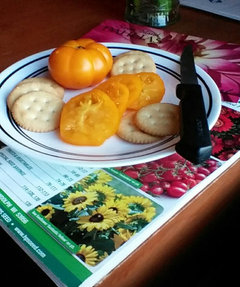
    Here is what was a happy little red variety for 4 generations. It might have been several more than that but I sure didn't begrudge it space in my garden while it was red. Then, the recessive orange color showed up.

    Steve

  • 10 years ago

    Hi, Digit! How fun to get one to throw a sport or mutation!

    Glad you found the Dwarf project tomatoes. Lots of good people involved in that. I'm trying a few this year. Under Keith's direction, I did manage a cross, but then the cross-country move and all, I finally ran out of seeds to grow it out. I may try again, but I may not. It is hard on aging eyes to get the blossoms pulled apart to do it.

    About time to start really thinking about what to grow. Onions are off to the races, but nothing else yet. Happy growing all!

  • 10 years ago
    last modified: 10 years ago

    That orange tomato is a beauty! Does it taste as good as it looks? Does it grow well in Idaho climate? I must admit that i know almost nothing about tomatoes as I've always had a hard time finding varieties that grow well in my climate. Any chance i could get some seeds?

  • 10 years ago
    last modified: 10 years ago

    Thanks Keen. I'll have to check but I believe there are a few extra seeds. The plants and fruit didn't change much from several years ago when the dominant red gene was in control. That may not have been the case with the de-hybrid Lemon Boy. Or, I might say that the plants of the second generation in my garden were not as acceptable as the first.

    It was a little difficult for me to understand how a plant that usually self-pollinates is not producing seeds that are clones of itself. Of course, it isn't! If the plant is a mix of genes, each seed will be a part of the mix. Those people seriously trying to sort them out, must commit to growing quite a few individual plants over several years to do so.

    Someone with an average size garden and an interest might best be involved in a team effort with other gardeners. The Dwarf Project is an example. Somehow, they built a common direction with people on two continents.

    Steve

    Edit: I followed you Keen. I believe that you just need to follow me back to send me a private message ...

  • 10 years ago
    last modified: 10 years ago

    "If the plant is a mix of genes, each seed will be a part of the mix."

    That works if the parent plant is heterozygous. However, what if the self pollinating plant is homozygous, or only carrying the dominate or recessive gene? I assume this is the case with most "open pollinated" varieties. But even the oldest strain of "herilooms" are unlikely to be completely homozygous, probably only at the loci that influence the traits we care about. But what about the hypothetical, total homozygote? Does it create a clone? Is it even self-compatible?

    Certaintly if such a case existed mutation surely would play a part in preventing clones, but what, if any, other variables are involved? I have scanned my bookshelf looking for answers over the years, but even my big botany textbook only gives examples of heterozygous selfing, and my general biology book doesn't delve into the subject at all.

    Keen, you seem pretty involved with plant breeding and genetics, do you have any thoughts?

  • 10 years ago

    hmm... hard to say. For plants that are normally self pollinating and self compatible such as peas and tomatoes i would think at some point they would become homozygous for most genes. That's not to say every gene is homozygous. Certainly even in these cases many generations later a recessive gene can segregate out. For example this last season my sugar magnolia peas threw out a random "parsley pea" type. Alan Kapuler bred this pea originally from a parsley pea type, but in the strain I've had i had never seen one show up until this summer. Who knows how many generations that has been, but i'm willing to say probably many.

    Of course there is always the fact that when genes separate out they do what is called "crossing over". where part of each gene gets snipped out and swapped between the "father genes" and the "mother genes", this can help to increase genetic diversity.

    and going even further, in some crops such as corn there are transposons. These are basically where genes are copied or moved to new areas in the plant genome where they were not before. This is one way a plant can adapt to new conditions by reusing old genetics in new ways. From the outside this might appear to be random mutation, but i think it's probably different. Who knows if this occurs in plants other than corn.

    Just my thoughts. Some plants are known to be self-incompatible. So it probably all depends on what type of crop or plant.

  • 10 years ago

    Thanks Digit! I will try to follow you and send a message