Software
Houzz Logo Print
bassamtabbara

Lowering Wolf Pro Wall Hood

10 years ago
last modified: 10 years ago

Hi,

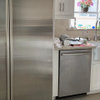
We have a 48" Wolf Range with 4 burners, charbroiler and griddle (link), 27" deep and 48" wide Pro Wall Hood (link), and 1200 CFM internal blower. The hood exhausts out of the wall its mounted on -- roughly a 2' run and a 90deg elbow out. The hood is mounted 39.5" above the cooktop. No makeup air damper. A few pictures attached.

We have two complaints about this setup 1) its does not effectively trap smoke and grease (the alarm goes off a lot, and you can smell the smoke everywhere) and 2) its loud.

I'm considering lowering the hood about 6" to about 33.5". I chose 6" because I can use the 24" height hood cover instead of the 18" hood cover that is on right now. I'm trying to avoid custom hood cover work.

I'm hoping that the 6" will improve containment and maybe reduce the noise a bit due to a slightly longer run. I'm willing to live with the noise, but we can not live with the smoke everywhere. I'm handy and could do the lowering myself.

I'd like to get your opinion on a few items:

1) Will lowering it 6" make a substantial difference? Or should get a custom hood cover (and live with a seam) by lowering it to 30" height? I'm OK with the clearance at that height.

2) Are there other things that I can do that are more effective?

Any thoughts/guidance would be most appreciated.

Comments (13)

  • PRO
    10 years ago

    Kas always gives the most technically proficient responses I have ever read. I almost always learn something new from reading his posts.

    The long and short is, yes it will improve your hoods performance. Unfortunately I don't know that it will be a dramatic improvement. In a perfect world you should have a 54" wide hood at the correct height (normally recommended at 30") to work most effectively.

    A few things to help. Turn your hood on first on lower speed. Before you start cooking or at least before heavy cooking. Let it run consistently so you get positive air flow through the hood. This will help. As Kas mentioned you may have a Make up air issue as well. Try cracking the windows in the room when cooking when you turn on the hood to allow some air in. That may alleviate the pressure differential that might be reducing performance.

  • 10 years ago

    Kas and Joe, thank you for the valuable information. As you point out there might be multiple factors impacting the poor performance of my setup.

    WRT to MUA, I did try to open a few doors during smoke generation but didn't notice an increase in capture or containment. I looked up the local code (Seattle) and they recommend MUA damper for 400cfm and above -- not sure how the builder got away with it. I'm going to look into adding one although I'm unsure about placement.

    WRT to the degree between pan and side of the hood, its almost 0 deg regardless of height of the hood. The degrees between pan and front of the hood is improved when the hood is lowered. I think lowering is going to be more about capture than containment.

    I would like to experiment with this some more, what is a good way of generating smoke?

    I would also like to try the side skirts or side panels, but I'm unable to find anything on this on the web. Do you have any pointers to something that would work with my hood? Or are these all custom made?


  • 10 years ago

    Most ways of generating smoke are not "good" in the overall sense. For example, hot enough peanut oil makes nice smoke, but you won't want it on everything. Titanium tetra-chloride open to the air makes smoke, but it is pretty acrid and not recommended for breathing. Sulfur bombs for woodchuck harassment are another unpleasant option.

    The professional approach is to use schlieren photography of the rising heated air turbulence cells, but I would have to investigate the standard techniques used before I would suggest anyone try to set up a home recording scheme.

    Dry ice may be an option for observing air flow some purposes, particularly if the air is humid at the time of the experiment. The ice may need to be broken up to generate enough cold CO2 to cloud the air at the flow rate the hood should be able to achieve. Maybe just boiling water in a cool room will be sufficient to see the directions of flow. This technique, however, fails to measure the conditions that are relevant to cooking.

    To get a true measure of what happens with a hot pan generating a cooking plume with a meter/second upward and outward velocity distribution, schlieren photography is likely the only valid method of visualization, short of modeling it with computational fluid dynamics and presenting the results with time series imagery.

    **********

    Schlieren photo of spillage due to insufficient air flow. (This is a commercial hood over a commercial griddle.) What is seen here are variations in the index of refraction of air due to the temperature variations from the heat input -- the same effect that causes atmospheric scintillation (star twinkle). Note that the inward air flow due to the ventilation blower cancels the normal outward expansion that would be to the right, but yet the momentum of the rising hot plume is too high to be completely contained and some of it reflects off of the baffles and other hood structures and leaks out of the hood. A companion photo (not shown here) shows that with significantly more blower air flow rate, all is captured and contained.

    *********

    One might imagine from this example that with enough air flow, one can compensate for lack of sufficient hood overhang. This is true, but the cost in capital and electricity for the more powerful hood blower, along with comparable cost for the MUA blower, plus cost of MUA air heating or cooling as required (not to mention noise) makes this a non-optimal solution.

    kas

  • 10 years ago

    Thanks I'll try the dry ice first since its a relatively cheap experiment.

    Kas, are there any side panels or side skirts that are compatible with my hood that you know of?

  • 10 years ago

    No, but I would think a sheet metal shop could fabricate some skirts (look at commercial hoods for examples) out of stainless steel (use 300 series (18-8) to match the Wolf, I think, but bring a scrap piece home to compare). I would have two holes punched in the upper edge of each skirt, and then install some machine screws part way into the inside of a side near the bottom for skirt mounting, appropriately spaced for the skirt holes. Note that my hood is a Pro Island hood and I'm only guessing about the configuration of your hood sides.

    You may want to get some carbide drill bits in the tap drill size matching the screws to save time drilling, and of course get a suitable tap and tap holder if you aren't already so equipped. Number 10 screws should be enough for the anticipated modest weight of each skirt. Tap drill size for your selected thread should be available in a drill chart somewhere on-line, or see Machinery's Handbook.

    If you want to easily remove the skirts, then either keyhole type holes are needed in the skirts, or some type of partly threaded L-shaped hook is needed. Some time at a well equipped hardware store, or touring a Fastenal catelog may be helpful.

    kas

  • 10 years ago
    last modified: 10 years ago

    I used 1/2" foil lined foam board (very light) from the big box stores. Cut pieces for all three sides maybe 12" high. I then used some weak masking tape and taped the foam onto the hood - be careful the tape doesn't mess with the stainless. Then do some cooking and take some pics. You can then repeat by cutting off some of the height to find what works best for your hood/blower. For my second remodel, using the result of this test, I ended up with a hood 6" wider on each side, 29" deep, and nearly 6" below the liner (which is at 34" from rangetop) We can cook anything now without losing smoke (we have a smoke detector about 8 feet away and it never goes off. External blower is 1500 cfm. Good luck.

  • 10 years ago

    racmrc: Is this "hood" made of wood surrounding and extending lower than the liner or is it made of metal? If wood, then is the wood far enough from the range top to not violate the range top to combustible material distance specified for the range? If the hood is wider and deeper than the liner, how are the gaps between the two blocked to keep grease from collecting in the cavities?

    kas

  • 10 years ago

    The test with foam board was only for the test. The actual hood setup is a Wolf Pro liner 60" (actual is 58 1/2") by 22". The decorative hood surround is wood and the bottom of the decorative hood is 34" from the cooking surface and the back splash is 18 gauge stainless. The additional extension is in the front and it is 5 1/2" protruding forward and 5" from the bottom of the decorative hood to its recessed position level with the Wolf insert. Therefore the upper portion of the wood decorative extension which is 39" above the cooking surface (I already have additional 18 gauge ss for this - just don't have it installed yet). but its currently painted to match the rest of the hood.

  • 10 years ago

    racmrc: Thanks

  • 10 years ago

    Noise-wise, 6" should make a difference. You can figure out the difference standing on something that is 6" tall, near your hood when it is on. Should be noticeably quieter sounding.

  • 10 years ago

    An update on this one.

    I had a local Wolf installer come out and give me a free estimate. He set a paper towel on fire and watch the hood capture the smoke and thought it was doing a great job.

    He remarked how the hood was not to code as it was 39" above the countertop, and also he saw that they used 8" duct and boot instead of 10". Given the amount of space in the house he did not think that make-up air is the problem.

    His recommendation was either 1) do nothing or 2) lower the hood 3-6" and change the duct work to be 10". His estimate was about $750 for the labor and another $400 for the new custom stainless duct cover.

    Given all the helpful advice here, I'm tempted to do the work to lower it. If that is not sufficient I would have to look into a complete redesign.

    Appreciate any feedback on this.

  • 10 years ago

    This is the first I've heard here or anywhere else of a code requirement for maximum residential hood height above the cooktop. Commercial hoods may have height limitations by code, but they are normally 7 ft from the floor (48 inches from the cooktop). Perhaps he was referring to Wolf's recommendations.

    The burning paper towel test may not represent a grill in action very well unless paper was burning over the entire extent of the grill surface.

    Independent of the installer's commentary, the question is really whether "doing it right" is worth the proffered cost. We might ask whether the flow rate will be materially higher with a 10-inch duct when the duct is only 2 ft long. I would have some doubts because the baffles and lack of powered make-up air will likely continue to induce most of the pressure loss. The larger duct may contribute a bit of noise reduction, but I expect the blade tip noise and baffle turbulence noise to continue to dominate. Lowering the hood may move some of that below a direct path to the ear, so that would be a benefit.

    We come back to the original issue of smoke capture. For that, lowering the hood should provide some benefit due to greater angular overlap and a slight secondary effect at the sides due to more narrowly channeling the air flow across the counter. I don't recall any capture angle data appearing in the comments above for the existing and lowered hood aperture areas so a qualitative guess on improved capture will remain elusive.

    kas