Software
Houzz Logo Print
hhendrix27

Help Me Understand Grow Lights

10 years ago

Hey all!

I did some small scale hydroponics last year and I would like to scale it up to a larger project.

I grow exclusively tomatoes (but may start into lettuce too). I would like to work my way up to about 250 plants this season. My new system is going to be a closed drip system, so to speak.

For my last system, I bought a system at the hydroponic store for around $175 with the balast and all. Obviously I will need a large quantity of lights for 250 plants. If I want to go the route of the fluorescent lights, could I not buy an ordinary 4ft fluorescent light fixture at Lowes or Home Depot and buy grow tubes to put in them? Or am I better off buying individual bulbs with reflectors? Like anyone, I would like to keep this project economical and spend as little as possible in start up and power bills both.


I REALLY appreciate any help or advice!

Comments (46)

  • 10 years ago

    Light intensity follows inverse square law, 4ft tubes would be ok for seedlings a few inches high if they were mounted an inch or two above the plants, Once the plants start getting taller you will rapidly lose intensity due to having to raise the lights..

  • 10 years ago

    For the amount of square footage you would need for 250 plants I wouldn't even think about regular t8 bulbs. T5HO could work, I've grow tomatoes with them no problem, but you most likely wouldn't be able to keep them close and the overall coverage you would need they wouldn't provide very well. To do it correctly you would need to use HID and then you'll need to worry about venting and possible heat issues not to mention overall cost which is expensive.

  • 10 years ago

    What if it was just lettuce in a DWC system?

  • 10 years ago

    HPS doesn't need to be close to the plants?

  • 10 years ago
    last modified: 10 years ago

    For small spaces its hard to beat 70w ceramic metal halides (CMH), they also come in a 35w variety which are ideal for cloners..

  • 10 years ago
    last modified: 10 years ago

    Mitch, when using HID lights like HPS or MH, it's mostly a heat issue. The short answer... nope, HPS do not need to be close to the plants. In fact, they can easily be too close. The more you can disperse/remove the heat, the closer you can get. But at a certain distance, it's not just ambient heat, it's radiant heat. In other words, you can remove/lower the heat in the room (ambient temperature,) but the lights burn so brightly and hot that the radiant heat will burn the growing tips. many a first-timer has pushed the envelope lol.

    There really is little comparison to florescent.


    Edit: Although I said there is little comparison, it should be said that both florescent, and HID lights have their place.

  • 10 years ago

    I keep seeing T5 mentioned everywhere.

    I'm assuming a T5 bulb can't be used in a cheap shop light fixture? Dumb question for you guys but I just want to be sure. I can't afford a $150 light right now.

    When you guys talk about heat from a HPS, how much heat are we talking? in an unfinished, wide open basement that maxes out at about 65F in the summer, does it still need to be vented?

  • 10 years ago

    T5 uses its own type of fixture. T8 are only 32w, T5 are 54w.

    I think the ceiling height would play a big factor in terms of heat from an HPS fixture as would the wattage. This is another topic entirely but I have read that anything less than 400w isn't efficient enough to justify the costs though I'm definitely not experienced with HPS at all.


    I use 48" T5s from sunblaster. They seem pretty good. Nice reflectors on them.

  • 10 years ago

    Maybe I'll try to find something used from the police auction. LOL!


  • 10 years ago

    Mitch, what exactly are you hoping to use the lights for? Starting seeds? Seed to harvest? Veggies? House plants? Greens, or similar low-growing, plants? Tomatoes, or similar taller plants, etc... And how big an area are you planning (including ceiling height)?


    These questions will help you choose wattage and type of lights to use.


    HPS do put out a lot of heat. If you are in a smaller room, then expect your ambient heat and humidity to be high. In which case, you'll need exhaust of some sort. If though, your space is open, you will have fewer heat and humidity issues.


    Another choice with HPS, some of them are made with a ballast separate from the fixture. You can put the ballast in the next room. It's the ballast which produces most of the ambient heat. The bulb will put out a lot more heat than florescents, but much of it is radiant heat, and as long as you have ceiling height, it's fairly easy to manage.

  • 10 years ago

    Or kijiji or craigslist. Lots of failed grows out there where you might be able to pick gear up cheaply.

  • 10 years ago

    rgreen,


    Thanks for replying!

    My goal quite honestly is what John from Indoor Hydroponix has on YouTube.
    I've asked him many times to share his grow room specs but he hasn't.

    So my goal is a room with artificial sunlight that sustains seedlings, hydro, soil, and pretty much anything you put in there! He experiments with all kinds of stuff but doesn't have to deal with lowering or raising lights. Basically a room full of constant sun.

    I have an unfinished basement with 9-foot ceiling that I don't think a single light will affect in terms of heat. I have a perfect area that was framed in...approx 6x8 if I wanted to section it off with reflective material.

    And just to make sure I'm answering your initial question: food, not pot. LOL

  • 10 years ago
    last modified: 10 years ago

    It sounds like you're gonna need at least a 400w or 2, and maybe 1000w. They do put out the heat. It's good that the entire basement is open. If you do put up reflective surfaces, I wouldn't go all the way to the ceiling. Just go up high enough for the light so that as the heat rises, it will escape the area. The open space is good, and leaving space above the reflective surfaces will even give you the option of installing a fan. Edit: You could leave an inch or so all around the bottom also to draw in, and circulate cool air from off the surface of the basement floor on all the framed sides of the space. Even without the fan a nice, natural flow would occur, and with a fan you'd be able to create a vortex! lol.

    Keep in mind that running those lights won't be cheap, but with what you've described, it's doable. There is one thing, depending on where you live, you may need a dehumidifier for the basement. It usually isn't a problem in winter, but the summers in some places, especially once you are running lights, absolutely require one.

    And no, lol, I wasn't asking about veggies vs. medicine. It just goes to the wattage. If you were just doing seed starting, or greens, there would be no reason for anything larger than 250w fixtures. :-)

  • 10 years ago

    I went to the police station today. The looks on their faces were awesome. "Is this guy seriously walking into a police station asking where he can get grow lights?" LOL.

    Anyway, she claims they destroy growing equipment.

  • 10 years ago
    last modified: 10 years ago

    Makes sense, in case they are tainted with residue of whatever they were growing. Still seems like a waste.

  • 10 years ago

    I agree. Also makes sense because most likely 99.9% of people looking for grow lights are probably wanting to grow pot.

  • 10 years ago

    I wouldn't think people interested in canabis cultivation would have the nerve to go to a police station and ask for grow lights haha. If I went asking at the cop shop they would definitely be suspicious as I look the sort, regardless of my actual lifestyle :-)

  • 10 years ago

    Just want to graduate beyond my hanging fluoro fixtures without paying full retail. They are a PITA.

    Hoping for a good deal. I would love to find someone to evaluate my space and help me design a grow room.

  • 10 years ago
    last modified: 10 years ago

    You can post here or microgrowery on reddit maybe. There is definitely more activity there than this... ghost town

    I've nearly sat on low hanging shop lights more than once I say. Good thing I have secure knots in the ropes.

    Have you tried Kijiji or Craigslist for lights? Not sure if we talked about this already.

  • 10 years ago
    last modified: 10 years ago

    Yeah I didn't find anything on CL. If I had some idea of what HID light I would need, I wouldn't mind paying retail. I've spent $80 on lights already. I can easily repurpose those.

    I'll post some pics tomorrow.

  • 10 years ago

    I skip all the rules and have 4 two tube shop fixtures with cheap florescent bulbs. I now see that they are 40 watts each and will change over to LED or CFL with cone reflectors next year. Set to a 15 hour day and no fiddling with height adjustments although they are 8" above the soil. When plants grow to touch the lamps I transplant them to an ares where the lamps are 2' way. There are no windows and it is in regular living space, not a cellar.

    Reasonable, and satisfactory results.

    A very peculiar discovery, two years now, the seeds I set in late January germinate and grow faster than ones set in March which are agonizingly slow and look under developed. This is not just being set early as three weeks from January is about equal to 6 weeks in March. It will be interesting to see if this is the same this year.


  • 10 years ago

    I've done some more checking and perhaps a 400w MH will take care of me. I already have 400w of inefficient T12's.

  • 10 years ago

    mitch, the determinations about what size, and how many lamps are made by the size of the space you are committing to, and your budget. The dimensions of the room is the first consideration. What size room have you decided on?

  • 10 years ago
    last modified: 10 years ago

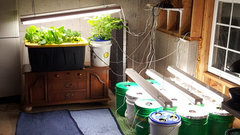
    This is my current setup. The basement is unfinished and open, so I can go as big or small as I want...but bigger means more maintenance so I want to be realistic.

    Ceiling is 9'.

    I can't imagine I need more than 8'x8.

    Does that sound reasonable?

  • 10 years ago

    As with any project, it will grow to fill the space available.

    (:

  • 10 years ago

    I know....ha!

    But for this setup, if I were to hang reflective material to create an 8'x8' room, can I get away with one light?

    By the way, my entire basement has ONE electrical outlet. Lol.

  • 10 years ago

    Yep, sounds reasonable. When I had an indoor grow room, I had 2 spaces. One was for seed starting, cuttings and seedling growth. It was lit using florescents. The other was the main grow room. Florescents are inefficient for a main grow, but extremely efficient for early stage growth. If you have space near your main grow, you can use that for early growth (piggy-backing on the electric already being used,) but if you want to maximize your HID's for crops, a small space with one or 2 florescent fixtures works well.


    I'm sure there are many resources on the web, but if I remember correctly (it's been 20 years) a 1000W HID will cover up to 100 sq. ft. A 400W was like 5' x 5'. Also, depending on the shape of your room, a lot of people preferred to use 2 400W's rather than a single 1000W fixture.You need to move around in the room, and 2 fixtures made it easier to allow for 'aisles'. But really, it's completely up to you.


    I recommend sitting near the space, and using your imagination to come up with idea for what seems like it will work. You'll change as you learn, but I think it's the best way to start.

  • 10 years ago

    One electrical outlet? That will be pushing it. Do the math, and put in another breaker. BTW... always use surge protectors.

  • 10 years ago

    I've got quotes from electricians to upgrade the electrical, and I plan to insulate in the fall. I'm not even close to pushing the 15 amp breaker.

    But this: https://4hydroponics.com/site/calculate-watts

    Gulp! 3200 watts. No can do. Do you guys agree with 50 watts per square ft?

    I guess I could do a 4'x4' for the fruiting plants, and continue with cheap fluoros for greens and herbs.

  • 10 years ago
    last modified: 10 years ago

    I disagree with the link you provided. Here's one with a chart that jives with what I've experienced... http://www.planetnatural.com/growing-indoors/

    There are also mechanical tracks, rails, and 'swings' that can extend the coverage area. I remember one swing that moved the lights in a circle above the room. It had 2 light connections so you could attach 1 MH, and 1 HPS if you wanted.Using that swing, you could take 2 400's and cover the same area as 1 1000W, while simultaneously balancing the spectrum and saving on electricty usage.

    Keep in mind while doing your research that the greatest demand for grow room supplies is for cannabis. It has slightly different needs than many vegetables (cannabis is photo-period sensitive for flowering for example.) So, when choosing lights, you need the proper spectrum for the plants you choose to grow. Some people are switching to LED's. Those on the cutting edge are building their own, and mixing emitters to provide that balance.

    One more word. Growing veggies indoors, while super convenient and fun, is not an inexpensive undertaking. It doesn't have to be outrageous, but unless you have zero yard space, want fresh veggies in the middle of winter, or just want a hobby and cost isn't an important factor, indoor vegetable gardening is still tough to be considered cost-effective. You could start looking into LED's, but even there, while a LOT more efficient, do require a level of knowledge and commitment. However, you seem to have the desire and drive to make something work for you.

  • 10 years ago

    Thanks...I actually meant to ask about cannabis requirements, since that's where so much info comes from these days.

    With our current home, we have no outdoor options. Not even gonna go into it. Nazi HOA. Nightmare.

    We had a large garden at our last home. Huge output, but deer, rabbits, bugs of every kind, snails, slugs, weeds. Yeah...I have the drive. :) And it is a hobby and my wife loves that I'm into it. But it's not a spare-no-expense hobby.

  • 10 years ago

    Wow, thanks for the link rgreen. The fact that I have a window right there helps me. According to that, 600w is more than enough for me.

    This?

    http://www.amazon.com/dp/B00CQ8ROYO/ref=twister_B010F914KA?_encoding=UTF8&psc=1

    Onward!

  • 10 years ago
    last modified: 10 years ago

    Hopefully someone who has kept more up-to-date with the technology can help you better than I. I was there before there was there, and I've been out of it a LONG time lol. There were no 600's way back when...


    I'm not sure what having 2 bulbs without 2 fixtures will help with veggies. It's good for plants like cannabis which have a defined vegetative and blooming phases, but I imagine that different types of veggies would be harvested and replaced all year round. Were it me, I would want to keep a balanced spectrum so that the leafy veggies would get the blues they need, and the fruiting veggies get the reds.


    Even a pepper for instance, needs blues while young, and some reds while blooming. The spectrum needs aren't set in stone, but it's helpful. Maybe start out with something like that and keep on the lookout for upgrading later.

    Keep reading up on it, and call a few suppliers to get their opinions, but I think you are gaining a good understanding. Good luck.

  • 10 years ago

    But you think if I switch lighting mid grow I'll have problems?

  • 10 years ago

    Mid-grow for which plants? If you are doing a monocrop, like just tomatoes, then nope, no problem. If though, you have greens like spinach, and peppers, and carrots... etc, what is midgrow? They all have different 'days to maturity' and spectrum preferences.


    That said, spectrum is not as important as intensity, and you'll have that pretty much covered with the HID's, so it won't matter too much ether way. In fact, at this point I might be confusing you with too many details lol. Sometimes the best thing to do is get in there and do it... if something needs adjusting, there is only so much you can learn from others... experience for what works in your conditions cannot be beat!

  • 10 years ago

    Good advice!

    The hanging fluoros are hard to manage. My bean plant is growing into the lights, but other plants still need them close.

  • 10 years ago
    last modified: 10 years ago

    Honestly, flat white paint on a solid surface works best. I'm not sure about the poly, it might be fine, I just don't know. For curtains, or flexible reflectors, anything white should be okay though. Glossy is not always better. Mylar is good but flimsy (you can get that as wrapping paper - it's not as good as the industrial stuff, but much cheaper.) Tinfoil is good, but it crinkles and tears. I always thought that if I wanted a 'curtain', then maybe those 'old-style', white, roll up blinds might work well and be fairly cheap. But, if you try the poly, then if you change later, it shouldn't be a waste, you can always find a use for it around the house. If nothing else, it would make for a good layer on the floor, or protect surfaces from water (I use an old plastic shower curtain for example, to protect my table for my seed starting station.)

  • 10 years ago

    I found some of the black/white sheeting at a decent price:

    http://www.amazon.com/dp/B018VI71GS/ref=wl_it_dp_o_pC_S_ttl?_encoding=UTF8&colid=1FNMOBSED35KD&coliid=I14YI1PROCO4H8&psc=1

    That one roll will take care of me. Like you said, can always repurpose it if I want to go another route.

    I watched a ton of videos on the subject...people are gaga over the Orca material right now. Too rich for my blood. I did see one video that used the gift wrap. That was my idea weeks ago. :)

  • 10 years ago

    Forgot to ask...when do you switch from 24 hours light to 16/8?

    Received my light kit today. Wow...it's bright. :)

  • 10 years ago

    24 hours? No no no. Plants need a rest. They need a darkness period.

    You may be thinking of when weed growers switch from 16/8 to 12/12 to trigger flowering. You don't have to do that with the plants your growing.

  • 10 years ago

    16/8 should be good for all veggies, all the time. You could start seeds under 24/0, but since running that HID costs, run it 16/8 from the beginning. Oh, and have you looked into how each of the fruiting plants pollinate?


    Lol... yeah, don't stare into the sun. And, I'm sure there was a warning, but don't touch the bulb with your hands at any time. You can leave oils which cause uneven heating and the bulb can break. Now though, you know that there has to be space between the light and the top of the plants. They get super hot!

  • 10 years ago

    Since I have a window right there, should I time my lights so the plants have true darkness...off from say 10pm to 6am?

  • 10 years ago

    Sure, just set them on the schedule that works best for you. Years ago, when I did it, my hours were lights on during the night, and off during the day. It worked best for my schedule at that time, and it was easier to handle the heat issues. However, you have a huge open space there, so give those hours a try and see how it goes. You can always make adjustments.

  • 10 years ago

    "Oh, and have you looked into how each of the fruiting plants pollinate?"

    rgreen, I've read some. I know how to identify male/female cuke flowers and how to hand pollinate, and I know that tomato flowers contain both sexes, so they need to be "vibrated". Not sure about peppers or beans.

    I've yet to see anything flower. My beefsteak tomato seed packet says 80 days to harvest. It's over 90 days old and no buds.

  • 10 years ago

    I'm pretty sure you can treat the peppers much like the tomatoes. You'll have to look yours up or ask in the vegetable forum, but some varieties of beans self-pollinate before the flower even opens.


    That's odd about the tomato, but I did read something (and I have no idea of the veracity... another question for the veggie forum) about tomatoes needing a certain temperature range before they will flower and pollinate. But like you said, they should be vibrated.

Sponsored