Software
Houzz Logo Print
hzdeleted_4355155

Tips for pre staining floor B4 Oil/Varnish Blend topcoat?

10 years ago

We have hardwood floors installed and I've been researching different finishes beyond plain old poly.

I read thru some discussions/articles online on Sam Maloof style finishes via the wood whisperer. And was intrigued. (No we are not going with Waterlox, Bona etc.) However I am in bind with respect to the type of stain to go underneath. I had found a blend of two General Finishes Dyes that gives fantastic color and depth, but worry about how color safe it will be. I debated topping with a subtle Minwax stain just to give it some oomph but worry about the compatibility between this stain and my chosen oil/varnish topcoat.

Any words of wisdom, advice or other would be appreciated here! It's Ash flooring and we are going with a deep cherry/chestnut color.

http://www.thewoodwhisperer.com/articles/make-your-own-oil-varnish-blend/

Comments (15)

  • 10 years ago

    Those finishes are not durable enough for floors. The article starts out referring to cabinet makers, not flooring professionals.

    There is a reason floor finishes are labeled as such. The research and testing have been done to assure the most protection and longest lasting finishes.


    As for stains, the UV rays from the sun will fade any stain or yellow any clear finish. You should be worry free using a stain(combination) with the same base as the top coat---water/water or oil/oil.

    User thanked User
  • 10 years ago

    My browser had trouble opeing the link Rusty but if I follow what you have in mind,Watco Danish oil work's well for me with oil and poly topcoats on furniture. The finish is unique and can't be duplicated with stain and clear,has proven to be durable enough for table tops but I've never tried it on floors. The only problem I've incountered was after Watco formula changed following big lawsuit, about 3 times longer dry time must be alowed before topcoating.

    User thanked klem1
  • 10 years ago
    last modified: 10 years ago

    Thanks for all the replies so far. I'm still leaning towards a "Sam Malooff" style triple blend as the link details. The formula is 1/3 (pure) Tung Oil, 1/3 solvent (I'm using citrus solvent), and 1/3 varnish. The varnish part is where it can make or break the finish from what I've researched. A hi-end finish comprised of phenolic resins with UV inhibitors can be found in Epiphanes Varnish, which is considered a marine quality finish. Essentially this is what Waterlox is, and it's used for gymnasium floors. It's supposed to be built up in layers and yes it has a long curing time. But repairs are dead simple; you just spot sand it back a bit and reapply. It's not meant to sit on top of the wood coating it like poly. This blend is soaked into the wood fibers.

    I haven't tried the alcohol based dyes yet as I was worried about keeping a wet edge on a large project, but the no grain raising part sounds fantastic. You just can't duplicate the color depth in conventional stains from what I see. Klem, I will give Watco a try as I've heard their stains are better than most. I'll have to experiment with it over the dye base perhaps first or test out on a vintage rocking chair i'm working on down the road.

  • 10 years ago

    Words of wisdom: Try out your color and top coat of choice on scrap before starting out on your floor. See if you like it first. Do some stress tests on the cured finish. Not to be insulting, but you'd be a fool to just jump in. I agree that an oil - varnish blend is not the thing you want on a floor. Limited abrasion resistance and water resistance.

    User thanked bobismyuncle
  • 10 years ago

    In response to that, what about Waterlox Marine? It's made for boat decks exposed to extremes in moisture and UV. If my last coat (or 2) uses this why would there be an issue? I'm curious. Thanks Bob. (PS: Epifanes is much the same product)

  • 10 years ago

    I realize it's romantic to drop famous artisans' names while talking about our remodel projects but that doesn't alter the facts. It is undisputable Sam Maloof desighned and built some of the finest furniture on earth and pioneered finishing techniques. His furniture desighns will remain examliary into eternity but his finishes were only great improvment over what was available at the time. His and other pioneers' formulas have been improved on to the point little similarity remains and I doupt they would use the origional finishes themselves today. I confess to trying some old techniques just for the experience but always on small or inconsequential projects. Floors are one of if not the single most difficult finishing project a homeowner will ever undertake, it call's for the very best finish available. I believe we diyers are clinging to oil based material as it slowly become's obsolete. EPA voc regulations have hamstringed all but water based material so that's where chemical companies' research have centered for the last 3 decades or more. I inquired about finish on wood gym floors at the few schools around here that havn't gone to other surfaces. All but one use two part waterborne and report far better durability over oil based polyurathane. I occasionally use Watco along with polyurathane for a piticular look I want but never for optimum durability. I do not believe it possible for one to compound a finish in their garage that come's close to what's available at the local paint store.

  • 10 years ago
    last modified: 10 years ago

    Trust me when I say I'm neither romantic nor a name dropper, but you clearly spent a long time typing a witty reply so.. Thanks? I have respect for the wood whisperers blog, traditional formulas utilizing high quality ingredients, as well as my own (occasionally flawed) judgement with respect to my floor. The finishes you refer to sit on top of the surface and require considerably more investment in refinishing as opposed to a Hardwax finish, or Waterlox et al that offer easy touch up/repairs. And there is no way the (local paint store) Minwax Poly is going on my floor.

    Another article on DIY oil blends is attached. The only negative statement against its use on floors is the time consuming aspect with the need to build up the finish, but it is "so worth it".

    http://thecraftsmanblog.com/how-to-make-your-own-wood-finish/

    Back to the original question: input/advice on the question of stains is appreciated.

    And PS: I answered my own question regarding the use of Minwax stain. They contain an ingredient that will likely inhibit the absorption of the oil blend. But dyes will not be a problem.

  • 10 years ago

    Rusty, I'm positive the DIY oil/varnish blend you wish to use for the floor will look very nice, when new, but it will not offer any longevity. The stresses on a piece of furniture are vastly less than a wood floor.

    For your original question, how does the Ash flooring look with just a natural finish on it?

    User thanked sambah006
  • 10 years ago
    last modified: 10 years ago

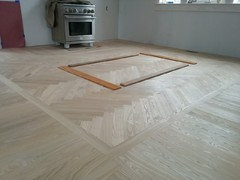
    The ash looks awesome natural... but we have a gorgeous Mahogany staircase (milled from old pews from the building) next to the ash that I would like to complement by using a similar toned dye finish (I finally found a blend of 2 different general finishes that look pretty awesome if I do say so). The other dilemma is the great walloping gaps on the main level that occurred when we were advised the floor was ready to install. Turns out that was a critical error and we have a LOT of gaps everywhere (that's when I became my new installer :-[~ ) so now there are swaths of areas needing wood flour (another issue as I need some serious camouflage here, and no we will not re-do but just consider it part of the floors "charm").

    I don't mind doing the last 2 coats in Waterlox (phenolic resin content) because that IS an oil blend finish also. And with Tung oil just as the home brew has. Samba: what do you think of Waterlox Marine, or Epifanes?

    PS the boards laying there just show island placement. That was my first floor install ever. Not perfect but I'm happy overall.

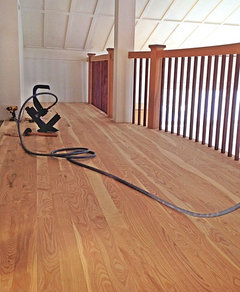
    and up in the loft

  • 10 years ago
    last modified: 10 years ago

    I've only used Waterlox once, and it was on a fir interior door. And it was before I had really honed in my varnishing skills. From what I understand, phenolic resin is very durable. Personally, I prefer the look of alkyd varnishes. And on doors, trim, and such, the extra durability of a phenolic resin compared to alkyd wasn't a concern to me. So I can't really comment on how well waterlox applies since I've focused on mastering a different medium.

    I can tell you this though. The fumes from it are poisonous to rocks. Wear a respirator with fresh cartridges!

    And just say no to marine finishes indoors. Too soft.

    Does the mahogany have a stain on it? Generally, natural finished woods of various species look pretty well together. But I understand wanting them to "harmonize".

    And is waterlox really an oil blend finish? My understanding is that in the process a making waterlox, phenolic resin is added to a big pot of tung oil, some solvents are added and its all cooked up in the absence of oxygen. In the process, the tung oil turns into resin. So essentially, what was once tung oil in a can of waterlox is no longer oil, but a resin. If that makes sense.. Similar to making bread. Yes, it starts out as wheat but in the process of making bread, it has zero of the same attributes of wheat when it came out of the field.

    User thanked sambah006
  • 10 years ago
    last modified: 10 years ago

    I really appreciate the input. So what is your alkyd varnish of choice samba? I live out in the boonies (Canadian Prairie) so it has to be readily available online. PS:I correct myself with respect to Waterlox - it IS a blend of my chosen key ingredients of pure Tung oil, phenolic resin and solvents - but as to wether it is a "wheat" or a "bread"... It's def. bread. I was referencing it as being (likely) more compatible/comparable to the blend as a final top coat for the sake of adding more resilience.

  • 10 years ago

    Well, if you DO decide to go with waterlox, I would do it 100% all coats. Not just the top two.

    You want the resin to soak into the wood fibers. If you put regular tung oil on the wood, the fibers will fill up with the oil, and not the resin.

    Alkyd varnish? Le Tonkinois parquet varnish. I hesitate to recommend it though. It took A LOT of trial and error to make it look good, and even now it's still pretty finicky regarding how much thinner to add, how warm I need to heat it up to flow right. And I'm stuck using it because I want everything to be somewhat consistent.

    Have you considered hiring out the floor finishing to a pro?

    User thanked sambah006
  • 10 years ago

    Here is a useful article and cuts through some of the BS on the label. http://www.popularwoodworking.com/techniques/finishing/oil-finishes-their-history-and-use  

    I have not looked in a while, but last I did, Watco Danish Oil was about 6/9 mineral spirits, 2/9 boiled linseed oil, and 1/9 varnish. So it's a thin oil-varnish blend. In another writing, Flexner pooh-poohs Watco's claim that it "hardens
    from within" -- first, it does not soak in all that much and second,
    BLO is a soft finish when cured. Many people roll their own oil-varnish blend with equal parts thinner, oil, and varnish as the above article suggests. A very common practice. If you want difference, alter the proportions up or down.

    But you should not try to build much film with an oil-varnish blend as the oil will keep the film soft. They're designed to be wipe on-wipe off. If you put a puddle of an oil-varnish blend on a piece of glass and let it cure, you'll see wrinkling around the edges(oil effect) and smoother in the center (varnish effect) The higher proportion of oil, the more wrinkling.

    As far as how varnishes are made, you add a resin (phenolic in the case of Waterlox, alkyd and/or urethane in other cases) and an oil (tung oil in Waterlox, linseed or soy oil in others) It's heated and becomes a varnish. It's not oil and resin any more, just as when you bake bread it's not flour, water and yeast anymore. You can't separate out the components, but you can determine the attributes based on ingredients, just like you can tell white, rye and whole grain breads apart.

    Waterlox is a varnish, plain and simple. In the dozens of pages at waterlox.com where they talk about "tung oil finish" (playing on the tung oil mystique), there is one line that says, "We view our Waterlox
    Original Tung oil finishes as varnishes, and while many make untrue
    product claims, Waterlox has never made any claims that we manufacture
    anything but a varnish." https://waterlox.com/Support/Guide?id=55d7f899-9e95-430b-9788-6ee59ed27e30&q=

    User thanked bobismyuncle
  • 10 years ago
    last modified: 10 years ago

    I had to chuckle at the now twice referred to Bob Flexner article (yes I had already bookmarked that) and his "bread VS wheat" analogy. We have an echo here. Yes, each oil/varnish blend coat is wiped off after a certain period, and with long curing times required. And I vetoed BLO ingredients early on as it is inferior to Tung oil - but cheaper - so it tends get used in a lot of blends. I think a wiping varnish could be a good option to test over top of a cured oil/varnish blend to add greater protection.