Software
Houzz Logo Print
don_elbourne

Raised Bed Garden Plan

10 years ago
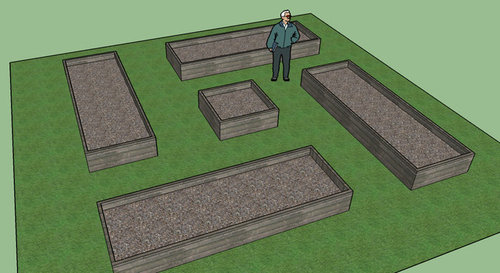
This is my plan for raised beds this year. I already have the wood, so my only cost will be the soil and seeds. Four 4'X12' beds, 16" tall, arranged with one 4'X4' bed in the center will give about 208 sq. ft of growing space. Four foot walk ways between beds will allow for easy access. If I fill them about 1' deep, that would be about 7.7 yards of soil. I think a small dump truck is 9 yards, so I might as well do that. I have no clue how much soil costs. I still need to call around. Too bad I did not do my idea I had last year of posting on Facebook, in our small town, that everyone could drop off their yard waste at my house and do a massive compost bin.

Comments (9)

  • 10 years ago

    One way to think about it is to add, say, four or six inches of composted OM, mix it in a bit, and grow with that for the first season. Your soil will be literally miles deep but you'd only work the top foot.

    After the season, add more OM (and dirt if you want) so that in a few years you'll have a full bed, adding annually only to make up for volume-busting decomposition.

    As for composting the neighborhood yard waste, start NOW! Gardening is long term; gardening is local.

  • 10 years ago

    You should be looking for a soil that approximates loam, soil that is about 45 percent sand, 25 percent clay, 25 percent silt and 5 percent organic matter. In this area of the world soil costs about $22.00 per cubic yard with a delivery charge that varies depending on your distance from the landscapers yard. Do not simply call around to find the least expensive soil, go and look at what is being offered. Do not rely on the sellers description of the product, look at it before you purchase any and again before the truck dumps it at your house to be sure what is being delivered is what you bought. There have been many instances posted here from people who did not do that with very disappointing results.

    Do not let someone tell you that "topsoil" is the same thing as loam either. In the linked description of loam Purdue uses the terms "Organic Matter" and Organic Material" interchangeably and many do. However, Organic Material is the raw material, the compost, shredded leaves and other vegetative waste you add to soil while "Organic Matter" is the residual organic material, what is left in the soil after the Soil Food Web has digested it.

    https://hort.purdue.edu/ext/loam.html

    kimmq is kimmsr

  • 10 years ago

    You can layer your new soil with compostables too, in a lasagna bed arrangement, if you don't have as much compost as you'd like. All depends on the soil you get. If it's super duper stuff with plenty of organic matter, you won't have to worry about it. I bought some 'garden soil blend' a couple years ago (just a yard for a project) and although I could see they had mixed in some compost, it was pretty minimal, so I've been amending it.

    16" deep is a lot. If you're doing it to reduce bending and stooping, more power to you, but most garden plants don't need that kind of depth (on top of already existing native soil).

  • 10 years ago
    last modified: 10 years ago

    4 feet in between might be too much, but at the same time, if you have the space and want 4 feet, why not? Some people use around 18-24" between raised beds, just enough to walk around in. Some others go a little wider so they can use a cart or wheelbarrow around the raised beds.

    You can also consider the plants you will be planting. For example, maybe some of them don't need 1-foot of growing space for the roots. Others might grow tall and block out sun from the nearby beds, if you have planted in such a way that crops affect each other like that.

    And you won't want just soil, but maybe your term soil means that already. Basically, just get a mixture of things into your beds, not just what one place might deliver and call soil.

  • 10 years ago

    Looks like a well thought out plan Don, with plenty of space to maneuver. Are you going to till up and amend the native soil underneath the beds? Probably not required with that deep of beds but you might want to put down a layer of cardboard first before filling with soil. You also might consider filling them to the top of the bed frames as they will settle a few inches the first year.

    I have 6 new 4'x8' foot raised beds completed and put in their places. A local landscape supplier is going to deliver 6 yards of their garden mix this afternoon. $30/yard + $50 delivery charge for the 40 mile round trip. This is good mix with 50 top soil, 25% compost and 25% composted manure. I have gotten it a couple other times already and was very pleased with the product and results. After it settles the first year I add an inch or 2 of compost in the fall to bring the level back up.

  • 10 years ago

    I'm all for the wider spaces between beds if you have the area! Think AHEAD!!!! Several of my beds when I started had only 2' between the beds!. It has been a pain to get a wheelbarrow around the garden! Nancy

  • 10 years ago

    I am with the others saying 4ft wide - that is the preferred minimum width for my walkways. I wouldn't bother tilling unless you have lots of roots from weeds or other plants. Let the worms work the soil.

    Tho I would follow a quasi lasagna style - meaning to lay down cardboard or newspapers first to suppress any weed growth. Cover with your compost.

    Spray the newspapers (cardboard) with water to keep them from blowing around until you can cover them. Tilling just brings up more weed seeds which can lay dormant for like 40yrs.

    I do like the layout Don. I would also plan to use the cardboard/newspaper covered with mulch (wood chips or compost even) in the walkways to keep the weeds down.

    Keep in mind your plants roots will grow out into the walkways where they will feed on nutrients and water.

    Good Luck

  • 10 years ago

    Don, forgot to ask which way is north in the diagram?

  • 10 years ago

    Also forgot to mention to make a 4ft wide perimeter around all of the beds (in case you are not) with no weeds or grass to steal moisture and nutrients from your plants - wider IF you can.

    Use a mulch of your choice - I always prefer something that will decompose and feed the soil like mulch hay, wood chips, etc. to suppress the weeds.