Software
Houzz Logo Print
yukoyd

Red Twig Dogwoods

10 years ago

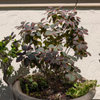
After neglecting it for 10+ years, I noticed that our Red Twig Dogwood bush looked rather sickly. The stems went from red to dullish brown and the leaves were infested with some illness and were turning silver and shriveling up.

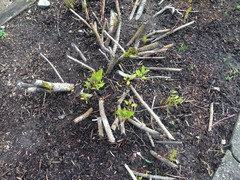
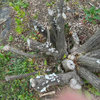
This winter, I hacked it down to the ground after watching a youtube video. Now I'm wondering if that was a bad idea. Buds are forming on my pear trees and spring is definitely in the air, but I don't really see much emerging around the 1 inch stumps...

Will it come back and if so when can I expect it to show new growth?

Comments (22)

  • 10 years ago

    Okay. I'll remember that for future reference, in case it survives my harsh handling. Thank you for responding :-)

  • 10 years ago

    most things SET buds the fall before ....


    it is those types of buds you are seeing starting to break ...


    your little stumps.. need to develop the buds ... so it will take a few weeks or months.. for them to get their act together ... and get moving ...


    there is no way you killed this thing simply thru the pruning.. radical as it was ... i call them RUN THEM OVER WITH YOUR TRUCK plants... lol .. many shrubs are the same ...


    but who knows what problems it was having last season ... they are deciduous in my MI ... so it isnt surprising.. the leaves fell off ... unless we arent sure on the ID ....


    ken

    Mystery Parrot thanked ken_adrian Adrian MI cold Z5
  • 10 years ago
    last modified: 10 years ago

    Most likely will be fine. This treatment-coppicing-is really one of the main ways to handle this plant. I'd be very surprised if it didn't come roaring back. BTW , there's really no reason to leave 1-inch stubs or whatever. Just cut as low to the ground as possible.

    Mystery Parrot thanked wisconsitom
  • 10 years ago
    last modified: 10 years ago

    How fine it will be depends on what was hurting it before and how that left it. And yes, the lack of sprouting is due to all the buds having been cut off - and the fact that it is still early in the season.

    Mystery Parrot thanked Embothrium
  • 10 years ago

    True enough^. But from the description provided, this is classic for red twig dogwood in serious need of renewal pruning. Not as if this is some rare happening here. Extremely commonplace, in every detail. Most likely, nothing "was hurting it before" except simple growth. Little stem cankers and whatnot are the norm on this plant once its seen a dry summer or two.

    OP just watch it coming back-how nice and red the new stems are, how lacking in all the little blemishes the old growth featured. This is exactly why we treat these shrubs as we do-to get new growth, new stems. Very, very unlikely to be anything but this situation.

    Mystery Parrot thanked wisconsitom
  • 10 years ago

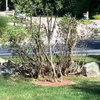
    You were right! It came back!! Here's a photo of it as of today.

    Thank you very much for all the input!

    Can't wait for it to grow!!


  • 10 years ago

    It'll look "brand new"! About the only limiting factor across most of the US for this plant would be dry soil. Pretty hard to kill red twig dogwood, for which I am greatful. Wonderful shrub, even if common as can be.

    Mystery Parrot thanked wisconsitom
  • 10 years ago

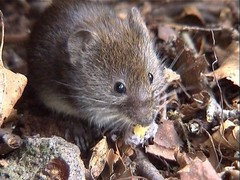
    "Pretty hard to kill red twig dogwood" Unfortunately voles seem particularly fond of dogwood roots . . . they have so far killed at least one red-twigged dogwood and at least 3 C. alternifolia in my yard (among other plants), so they aren't immune to quite everything.

  • 10 years ago

    I don't doubt you NH, but have never seen such occur. I do think however that I happen to live in Cornus sericea (or stolonifera, or alba, lol) central here in east-central Wisconsin. I know of areas-now houses and streets-that used to be shrub carres completely dominated by this plant. I hear calls for diversity all the time, but seeing these vast areas of bright red all through the winter, I wondered if perhaps that (diversity) wasn't a bit overrated!

    Seem to like "sweet" to circum-neutral soil better than acid stuff too, which matches what we've got in this part of WI. I could be wrong on this, but I picture New Hampshire being almost completely acidic soil. Not sure how or why that (acidic soils) would up the appeal of the plant for voles though.

  • 10 years ago

    I think the vole problem is as much a soil texture issue as anything else. Voles weren't rampant when I lived in OH and aren't at my sister's in WI, both of which have a high clay component to the soil. Here I'm in lake sediments, fine sandy loam that's easy digging, and since my gardens are surrounded by rough field, and both our cat and our neighborhood foxes have died, we are inundated with voles.

    We have large areas of native Cornus sericea here also, mostly along the edges of wetland areas, so I don't think it could be too fussy about pH since we do indeed have very acid soil . . . blueberries, cranberries, and rhodora are among the native acid lovers here.

    My deceased Cornus all lifted out of the ground without any effort due to complete lack of roots . . . I now plant certain types of plants in large wire mesh rings and regularly stomp all over my beds to collapse vole tunnels.

  • 10 years ago

    Interesting-the bit about the wild C. sericeas. In my state, there is a rather noticeable cutoff of this species as you leave the more clay-base, neutral to limey areas and get into the sandy acid stuff. Still around mind you, just not nearly as common nor are individual plants as luxuriant. I'm again not doubting your words. Not at all sure why you or anyone else would misinform about a plant, lol....but they are known to be calciphiles. Maybe along the creek, it's easy access to whatever nutrients may be needed, not sure. As for voles, they are certainly a part of the Wisconsin fauna. Not always obvious why they gang up in one area and not another. And the voles? They aren't talking about it.

  • 10 years ago

    Perhaps regional variation explains different pH preferences or tolerances. It's pretty common in northern New England (though not as common as in WI) where almost everywhere has acid soil.

  • 10 years ago

    I would not consider them to be calciphiles necessarily - just not very picky about soil pH. If you check the authorities, preferred pH for these plants is listed from 6.1 (moderately acidic) to 8.5 (moderately alkaline). A pretty wide range of preferences!! Just to echo Babs' sentiments, redtwig dogwoods are fully native to my area as well, which is generally considered to have slightly to moderately acidic soils and is home to various Ericaceous native species as well.

  • 10 years ago

    True-very wide native distribution, but pH 6.1 to 8.5 is way out of the range of what is normally considered an acidophile. That is to say, 6.1 is. Most true acid-lovers like it down in the 5's and even lower for a few. Just saying......my initial observation about the relative abundance of this plant in my own state backs up very well what I said up yonder. Your reportage simply backs it up. Where things do turn decidedly more acidic, the willows and dogwoods give way to tag alder. It's as uniform a transition as exists in nature.

  • 10 years ago

    I did not mean to imply that they were acid lovers - only that they are not fussy about soil pH and will grow in both acidic, neutral and slightly alkaline situations. btw, most acid lovers are not all that fussy about the degree of acidity either, as long as the soil is at least moderately acidic. This is readily demonstrated in the PNW where soils are indeed acidic but not overly so - typically in the 5.5 to 6.5 range and native ericaceous plants abound - rhododendrons, vacciniums, arbutus, arctostaphylos, salal and mahonia. And a wide range of non-natives Ericaceaes/recognized acid lovers as well - blueberries, camellias, pieris, heaths and heathers, eucryphia, leucothoe, fothergilla, hydrangeas, Japanese maples......the list is nearly endless :-) Few folks here ever bother to acidify their garden conditions - what we have naturally tends to be more than adequate (with some minor exceptions).

    FWIW, the vast majority of plants are adapted to a relatively wide range of soil pH (considering it is a logarithmic scale and each point is a ten-fold increase or decrease) and most would prefer to grow in slightly to moderately acidic soils as that tends to offer the greatest nutrient availability.

  • 10 years ago

    In the main, we are in complete agreement. I usually urge folks to not get hung up on soil pH, since, as you correctly point out, most species do not exist on some knife's edge of requirements, but are instead adapted to a range. Thus the world did turn green.

    But within just the broadest of soil pH and plant interrelationships, what I report in at least my home state is true-Cornus sericea both "does better" and is more numerous in the "sweeter soil" areas. Then continues with less abundance and even apparent vigor on into the very sandy, gravelly areas of this, a state with a very confused soil distribution.

  • 10 years ago
    Voles!!
  • 10 years ago

    Looks like there might be some dogwood debris on the ground there too!

    Mostly kidding................;^)

  • 10 years ago
    last modified: 10 years ago

    I always thought c.alba, sanguinea, stolonifera, sericea etal were unfussed about ph and would happily grow in what I would consider acidic soils as well as my own highly alkaline soil (8ish)...unlike cornus floridus, nutallii, mas, and even the creeping canadensis...which simply refused to grow in anything over 7.5 (Oh yes, I have tried...and failed). Regarding ph, I find it easier to move up the scale but have heartsink at the rhodie and camellia demanders (in chalky Cambridge) especially if they refuse to consider giant pots. I hate that hopeful sequestrene dance and generally refuse to play even though I would prance nakedly through briar roses to have enkianthus.

  • 10 years ago

    Don't feel bad, I've lost several Canandesis myself. Maybe they got lost in the shuffle, but I haven't seen any in my garden in several years. I know I had some at one time.

    Somebody mention Enkianthus?! Here's one of mine.

    http://i75.photobucket.com/albums/i283/Botann/IMG_0592.jpg

    Mike


  • 10 years ago

    Yes Camp, but that simply supports what I've been saying. pH 7.5 is not acidic. And while I wouldn't call it strongly alkaline, it is at least on that side of things. So success in growing a plant-any plant-at that pH simply does not indicate what it would do at say, pH 4.5