Software
Houzz Logo Print
mrclint_so_cal

Pomegranates: 2016

10 years ago
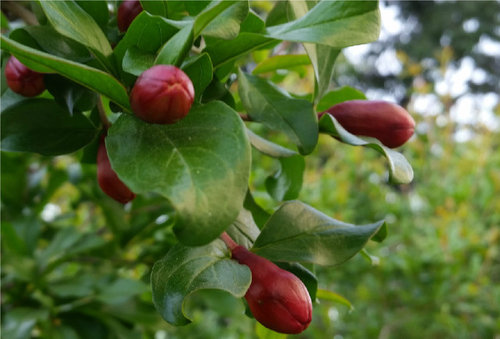
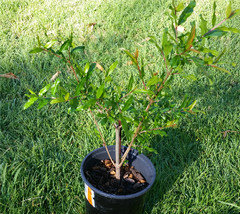
'Angel Red' all leafed out and ready to bloom:

Comments (28)

  • 10 years ago
    last modified: 10 years ago

    I have an Angel Red too, and the young plant does appear to grow more vigorously and blossom earlier than my other pomegranates.

    Which is interesting because it's also supposed to grow 2 feet shorter than other varieties. Angel Red is sort of like a semi-dwarf pomegranate variety. And "angelic" really is a fitting name for how this variety tastes (noticably softer seeds, sweet, not too tart, kind of mild).

    Angel Red is an early bearing variety (fruit ready to be picked in late August to September, a month before most other pomegranate varieties), so consider getting it to extend the pomegranate season if you have more than 1 tree.

  • 10 years ago
    last modified: 10 years ago

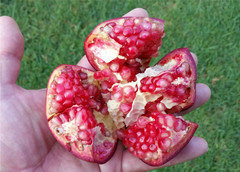
    I hope you all know how to eat a pomegranate without making a mess. First take a knife and cut along the outer edge, diving the fruit into 4 or 5 segments, but do not slice deep into the fruit! Just a half inch into the surface. Then cut a circle into the top and bottom areas at an angle so you can pull them out. Now the segments are ready to be pried apart. Do this over a big bowl to catch any arils or juice that falls out. If you are lucky, it should come apart very nicely without any arils breaking open. Fill the bowl with water and separate out the arils from the rind by hand, submerged under the water. This should not be too difficult. Be gentle but firm. Once you get a little practice this should all be an easy process that will just take 2 or 3 minutes.

    Many people do not like pomegranate because they think it's too much work or messy. But actually it's not if you utilize the proper technique.

    Now for the seeds inside the arils, spit them out or swallow them? I usually just swallow most of them (they are good for you) but if you get a big mouthful of seeds (the mash has accumulated in the sides of your mouth) and they are gritty you can spit it out. The softer the seeds are of the pomegranate variety, the less you will be spitting out. Some varieties have seeds that are so soft you really don't feel like you need to spit anything out at all, but I still do just a little bit.

    Pomegranate makes great fresh squeezed juice. The best way to do it is to separate the arils from the pulp rind and then press the arils for their juice. You do not want to squeeze the arils with the pulp rind because it will impart a bitter flavor, and you do not want to pulverize the arils in a blender because then the seed mash will be mixed with the juice and it will not be clear, or as tasty. Fresh squeezed pomegranate juice tastes much much better than the pomegranate juice sold at the supermarket. This is really one type of juice that you are better off making yourself (despite all the work).

  • 10 years ago

    Looking good! Leafed out up here in the last couple weeks, no flowers yet but will be plenty as they are going on 4th year I think.

  • 10 years ago

    Pom cutting from last year, leafing out and ready for a bigger pot:

    They grow fast!

  • 10 years ago

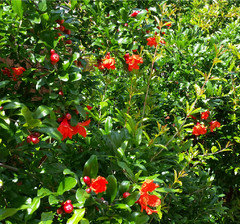
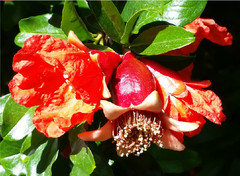
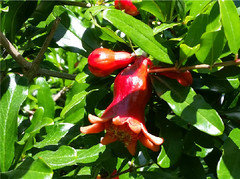
    'Angel Red' in heavy bloom:

  • 10 years ago

    Very nice! I was eyeing a small 'Wonderful' plant at a local nursery yesterday but was told its an average variety, and not sure if the ones they're selling are fruiting age yet.

  • 10 years ago

    Ah...

    Currently living outside US, and looking for some 'best varieties' pomegranate cuttings. I've been looking for it on ebay, but most of them do not provide any cuttings (just seeds).

    Anyone could recommend me how to to get the pomegranate cuttings? Especially like angel red, parfianka, eversweet, ambrosia, granada, etc?

    So curious about them.


  • 10 years ago

    There really isn't any money to be made on 'Wonderful' poms any more. They have zero sex-appeal --are dirt cheap and readily available. They have been here since the 1800's and have already launched the Pom Wonderful franchise, What's more "average" than that?

    It's no surprise that someone would guide you toward a pomegranate from somewhere-else-istan that costs a-lot-more-istan. :)

  • 10 years ago

    Hi mrClint..

    Well, I new in growing pom. I just wanna looking for some best variety. I don't really care about it's origin, or how beautiful it looks. As far as it have a 'great' taste, hardy, a good size of fruit, really soft/edible seeds. For me, the looks is just a bonus.

    So, you mean that angle red fits with my criteria?

  • 10 years ago

    I'm so full of zone envy right now, and very jealous of those nice-looking pomegranate plants. I also liked your flowering olive pics in the other post.

    This spring here in NM we've been teased by way-too-early warmth, and now it is colder than it was back in February! So of course it will be yet another year without much hope for fruit (except the late bloomers like mulberry, grape, other berries, etc.).

    But the closest in-ground pomegranate plants to me are in Albuquerque, about 60 miles away and 2000 feet lower in elevation, where the leaves are just barely starting to come out. They may well be killed back before all danger of frost is past in another month or so.

  • 10 years ago

    No Mr Clint that was the only variety at the nursery, when I say I was told it was average I mean through my own online research lol. It's the only one commercially available here.

  • 10 years ago

    I'm not sure that 'Wonderful' (or any other pom) is going to be all things to all people. It's an excellent and reliable piece of fruit here. 'Angel Red' is earlier, smaller and with softer seeds. Both taste great. Between the two trees I harvest poms for fresh eating from September to December.

  • 10 years ago

    I may still get one then, grower experience trumps hearsay articles for me.

  • 10 years ago

    Chances are that the fresh pomegranates and juice that you purchase from a market are going to be from the 'Wonderful' variety.

  • 10 years ago
    last modified: 10 years ago

    Maybe, but freshness of the juice really makes a difference also. I just think the juice loses something when it has been flash pasteurized and sitting around for two months in refrigeration. And when the juice is from concentrate, that really seems to take away the flavor. A good way to store fresh pomegranate juice is to freeze it, although this can be a little inconvenient for immediately using because the freezing tends to separate the liquid out into ice and darker more concentrated juice, so you want to let all the ice first melt before you use it.

  • 10 years ago

    'Angel Red' starting to set fruit:

  • 10 years ago

    Looking good so far, the blooms look almost like the double flowers of the ornamental varieties. Do you have to water these at all, or just mulch heavy/rely on rainfall?

  • 10 years ago

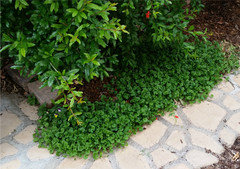
    Our rainy season is done for the year. Poms need irrigation water through the hot dry Summer here. I use redwood bark mulch around the planter and living mulch in some areas. Here's dichondra (to choke out weeds) with a few violas under 'Angel Red' :

  • 10 years ago

    In Southern California fruit trees like pear or cherry seem to prefer some partial shade, but pomegranates bloom and fruit more with more sun.

  • 10 years ago

    I'm so jealous, pomegranates are one of my favorite fruits but I'll never be able to grow them here. Yours look great!

  • 10 years ago
    last modified: 10 years ago

    No reason to feel bad, there are tradeoffs. Pomegranates are one of the few fruits that really grow well here. The lack of winter chill in zone 10 creates its own set of problems, and many traditional fruits like pear and cherry can be challenging to grow (even planting low-chill varieties). The foliage can get scorched in the hot dry summers. It is extremely difficult to grow raspberries here (though I keep hearing people say they grow like weeds in other parts of the country). On the other hand, it is possible to grow many tropical fruits, albeit they do not grow the best and have to be continually watered during the dry half of the year.

    You start going North, things become different. California has many climate zones. Go inland and they get some winter chill but it can also be like a baking hot desert and the air is desiccatingly dry, even if you grew the fruit trees hydroponically the leaves would STILL get a little dried out and wilty in the open sun.

  • 10 years ago

    Here's 'Wonderful' setting some fruit:

  • 10 years ago

    'Angel Red' coming in nicely:

  • 10 years ago

    How's it taste? It looks great. I'm excited for pomegranate season.

  • 10 years ago

    AR tastes excellent this year as always. Sweet-tangy balanced juice with soft seeds.

  • 10 years ago

    Glad most of you had a good season. My tree was full of blooms last April but 2 late freezes took care of that. Also lost all other fruit tree harvests except for the persimmons which are now starting to blush a little orange.

  • 9 years ago
    last modified: 9 years ago

    People in other states may be able to find pomegranates, but they very likely will not be very fresh. Despite the thick outer rind, pomegranates don't really have that long of a shelf life. The pomegranates you may find in a supermarket very often have a few arils inside near the edges that have turned a brownish shade and gone bad (or at least developed an off flavor). Unfortunately there may be many people who have never tasted a truly fresh pomegranate. And by "fresh", I'm not just talking about raw fruit. People are so used to packaged convenience food nowadays that they automatically assume something is "fresh" just because it is uncooked in its raw state and has not gone bad yet. I am thinking this may be one of the reasons pomegranates fell out of favor. The fruits look like they're still good but they're not, so people taste one and it doesn't taste all that good, then they think they don't like pomegranates. But they've never picked a fresh one from the tree. If you live in Southern California you can find some very fresh pomegranates in the farmer's markets (during the right season).