Software
Houzz Logo Print
garethrussell

Tackling overgrown vegetable garden in winter

10 years ago
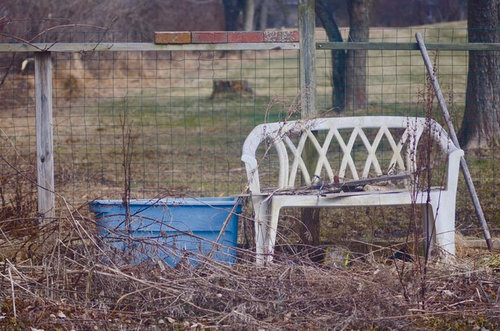
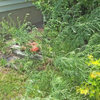
Late last summer we bought a house in NJ with a nice fenced vegetable garden. But, for obvious reasons, the previous owners did not work the garden that year, so by the time we moved in it was waist-high in weeds (thistles, etc.) that had already seeded. Now, of course, it's died back to a ground mat. My question is: after we clear the ground, is there anything we can/should do *now* in preparation that will help retard what is sure to be an explosion of weeds in and around any vegetables we plant? Herbicide? Black plastic? The picture shows what it is like now. What would savvy Houzz gardeners do?

Comments (8)

  • 10 years ago

    Weed thoroughly, plant and mulch well. And keep on top of any weeds that pop up during the course of the growing season, as they will regardless of the current state of the garden!

  • 10 years ago

    We were in a similar situation in our previous home. We cleared out as much of the brush as we could early in the year (i.e. now) & then we spread black plastic to "kill" the weed seeds until just before planting time. When we removed the black plastic we spread newspaper & mulch over the whole garden. We watered that so the newspaper could break down & then planted. We repeated this process every year & it was pretty successful.

  • 10 years ago

    p.s. to the previous post - we did not rototill the garden at all. We researched no till gardening and used that method.

  • 10 years ago

    Thanks for the replies! As a Brit who was brought up on double-depth spade digging, no-till seems like blasphemy. I'll have to get into the research myself to see if I will feel comfortable...

  • 10 years ago

    That makes me smile, Gareth. I was just thinking 'Why doesn't he just dig it over?' ;-) I can't see how big it is but I'm sure it wouldn't take long - with a proper Brit fork, of course. (Obviously not a shovel ...) Seriously though, whatever you decide to do, get the hoe going the minute any seedling weeds appear. You know the saying, 'One year's seeding, seven year's weeding.'

  • 10 years ago

    Spraying any "weed" killer now will do little since they all need to be applied to growing plants.

    What to do depends on the condition of the soil. If by "clear the ground" you mean removing the now dead top growth you can then determine if the soil is compacted enough to need tilling, but these simple soil tests may be of some help in determining what needs to be done next.

    1) Soil test for organic
    material. From that soil sample put enough of the rest to make a 4 inch level in
    a clear 1 quart jar, with a tight fitting lid. Fill that jar with water and
    replace the lid, tightly. Shake the jar vigorously and then let it stand for 24
    hours. Your soil will settle out according to soil particle size and weight.
    For example, a good loam will have about 1-3/4 inch (about 45%) of sand on the
    bottom. about 1 inch (about 25%) of silt next, about 1 inch (25%) of clay above
    that, and about 1/4 inch (about 5%) of organic matter on the top.

    2) Drainage. Dig a hole
    1 foot square and 1 foot deep and fill that with water. After that water drains
    away refill the hole with more water and time how long it takes that to drain
    away. Anything less than 2 hours and your soil drains’ too quickly and needs
    more organic matter to slow that drainage down. Anything over 6 hours and the
    soil drains too slowly and needs lots of organic matter to speed it up.

    3) Tilth. Take a handful
    of your slightly damp soil and squeeze it tightly. When the pressure is
    released the soil should hold together in that clump, but when poked with a
    finger that clump should fall apart.

    4) Smell. What does your
    soil smell like? A pleasant, rich earthy odor? Putrid, offensive, repugnant
    odor? The more organic matter in your soil the more active the soil bacteria
    will be and the nicer your soil will smell, to a point. Too much organic matter
    can be bad as well.

    5) Life. How many
    earthworms per shovel full were there? 5 or more indicates a pretty healthy soil. Fewer than 5,
    according to the Natural Resources Conservation Service, indicates a soil that
    is not healthy.

    Once you have looked closely at the soil you can start to work on the soil as needed.

    kimmq is kimmsr

  • 10 years ago

    Great advice on soil testing. The base soil is this: https://soilseries.sc.egov.usda.gov/OSD_Docs/C/CHALFONT.html and it's pretty wet and sticky in winter. What I don't know yet is how much the previous owners amended the soil in the vegetable patch.

    If it looks terrible I might go for raised beds and get in some better-quality topsoil.

  • 10 years ago

    Keep in mind that there is no real definition of "topsoil" and it can be anything the seller wants it to be, so when looking for soil take a good look at what you are buying. Let the buyer beware applies here. This may be of interest.

    http://msue.anr.msu.edu/news/the_shocking_truth_about_topsoil

    Look for a soil closer to loam, 45 percent sand, 25 percent silt, 25 percent clay, and 5 percent organic matter.

    kimmq is kimmsr