Software
Houzz Logo Print
hareball17

Question about feeding roses

10 years ago

I have a seaweed/molasses mix that I bought from a organic nursery in town. It says to use as a foliar spray. I was wondering if this could also be used as food? The nursery says to spray it on plants to help build up beneficial stuff and even help plants to protect itself. (don't remember word for word lol) I also have a liquid fertilizer that you mix with water (Hasta Gro). I didn't know if these two things are ok or if there is something roses like to eat more :) And how often do you all feed your roses? Thanks! :)

Comments (12)

  • 10 years ago
    last modified: 10 years ago

    The thing about roses is the black spot on the leaves. The Idea is to make the plant healthy to fight off any fungal infection.

    Those two fertilizers are great. Sounds good. The seaweed/molasses is to feed the good microbes.

    The most important thing is to have 2" of good compost every spring. I make Alfalfa tea. Works good. Feed the soil. Soil feeds plants.

    The book by Field Roebuck from Texas is great. Complete roses

    Hareball thanked User
  • 10 years ago

    Straw: A very important point made regarding the smell of seaweed and molasses attracting pests. Thanks.

    BTW, I found tobacco water quit effective against leaf mold and powdery mildew.

    Hareball thanked Khalid Waleed (zone 9b Isb)
  • 10 years ago

    Thank you so much. I really appreciate all the info. The website had this info about the seaweed/molasses mix:

    Use this product as a foliar spray to increase the health and vigor of all plants. Molasses supports beneficial microbes on foliage and makes plants more resistant to diseases. Seaweed thickens leaf tissue reducing insect problems.

    Would the info you provided apply to most plants or just roses in regards to the fertilizer? I'm trying to grow vegetables also.

  • 10 years ago

    Hareball: I agree with Straw that use of molasses and seasweed might attract more pests towards the plants. Curing reasons that cause fungal and other diseases might be a better idea than the foliar sprays and for that, improving the soil texture ensuring right proportion of required minerals might work better.

    You may find this link helpful http://forums.gardenweb.com/discussions/3528532/npk-and-ph-of-organic-matters?n=105

    best regards

    Hareball thanked Khalid Waleed (zone 9b Isb)
  • 10 years ago

    Hi Hareball: The info. I provided apply to roses and tomato .. both attract greenish slugs/worms. I see the logic for spraying leaves seaweed (has salt, which suppress fungus), but zero logic for spraying leaves with molasses.

    The dose of 1 teaspoon of NPK 6-6-6 per gallon, 3 times a week apply to tiny marigolds grown in green-house. Roses are much bigger, same with tomato, so one can do the same dilution, except 3-gallons of water per rose, once a week. It's best to water ONCE a week for roses and tomato to encourage DEEP ROOT. I hope that helps.

    Hareball thanked strawchicago z5
  • 10 years ago
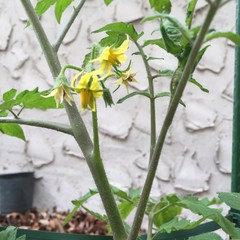
    I just came home and two of my tomato blossoms look like they are drying out. I want to have a thriving garden so bad but there's always so much conflicting information. Everyone says something different :( I'm just having trouble processing what you are saying. I hear people say use this kind of NPK then others saying the numbers don't matter it's the bioavailability of the minerals. Then I worry about overwatering even though I live in an area that gets pretty warm most of the year. I'm so afraid of over or under doing something (feeding, watering) I'm just confused :( I'm sorry I just needed to vent a little. On a good note my roses look ok today lol
  • 10 years ago
    Hmmm... Maybe the dry flowers have been pollinated? That would be awesome. Still confused lol :)
  • 10 years ago
    last modified: 10 years ago

    People are right about the bio-availability of minerals, PLUS NPK does matter. When we get rain water at pH 5.6, that's acidic and break the bonds in the minerals in the soil, so it can release nutrients to plants. But when you water it with tap-water .. the tap-water is treated with calcium-hydroxide, which raise the tap-water pH to WAY ABOVE NEUTRAL, or very alkaline ... which TIE-UP the nutrients in the minerals, so they won't be available.

    The year which I get bumper-crop of tomato & or at least 40 blooms per rose-bush is when I get rain ONCE a week. But when you water it frequently with alkaline tap-water, that LOCKS-UP the nutrients in soil. Or last year when we got tons of heavy & all day long rain, which leached out nitrogen and potassium (for blooming) .. then my roses were wimpy & stingy, and my tomatoes didn't give much fruits.

    The NPK does matter, because you want to add decent nitrogen and potassium esp. when you get heavy rain that leaches nutrients out. Phosphorus mobility is a 1, it hardy get leached out, so the high number of 12 won't be utilized, it crystallizes with soil, making soil compacted, plus kill mycorrhyzal fungi that help plants to utilize phosphorus. You want decent number of nitrogen and potassium, at least a 6 for heavy rain ... roses and tomato are heavy-feeder, they need nitrogen for growth, and potassium for blooms.

    Your tomato's flowers look GREAT. I don't like to use seaweed (high in salt) in warm weather, since the salt really scorch & dry out plants, esp. when it's above 80. Seaweed is best used in spring, when there's tons of rain.

  • 10 years ago
    Can you recommend an organic fertilizer with the information you gave me? Or should I just use what I have but diluted to the amounts you mentioned? And give a deep watering once a week with the fertilizer in the water. If no rain separate the feeding through the week right? We've been getting rain about once a week but that won't last long.
  • 10 years ago
    last modified: 10 years ago

    Hareball: You said it well .. yes to all. You have the best SOLUBLE fertilizer ever, so keep on using it. Most soluble-fertilizer like fish-emulsion has acid added, to control the stinky microbes, plus the acid neutralizes alkaline-tap-water.

    When there's no rain, and you use tap water only .. the addition of that SOLUBLE fertilizer, will give instant-nutrients to plants.

    Soluble-fertilizer is like ready-made-food for plants ... roots of plants don't have to secret acid to break-down hard-minerals in soil. That's the logic for VERY DILUTED dose more than once a week if it's hot & dry (no acidic rain to break down nutrients). Clay soil retains water well, and can handle once a week watering in hot & dry ... but NOT so with loamy or sandy soil.

    Hareball thanked strawchicago z5
  • 10 years ago

    Thank you so much. I really appreciate it. Sorry for all the questions! :) So much good information. :D