Software
Houzz Logo Print
ponyboat

Need help planning small flower bed!

10 years ago
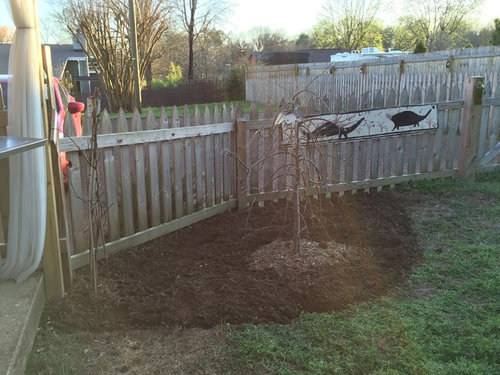
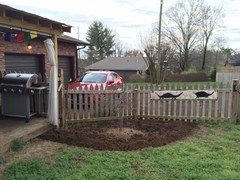
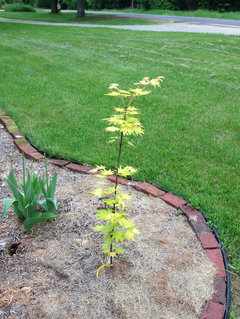
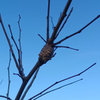
Hello, I just dug up a bed and planted a weeping pussy willow in the middle of it. There is an american wisteria on the left hand side of it that I hope to train up that post. I don't know what else to put in the bed and would love some input! I have posted a photo below. It is about 15 feet from end to end including the curve. On the left is my covered patio, and the bed opens out into a wide expanse of grass in my backyard. I am zone 7, the spot is full sun, I know I can't get too tall except maybe up against the fence, but I don't want all low and boring either. Some things I like: spikey flowers like delphinium and lobelia, flowering grasses (not liriope, more like feather grass or pink pampas-is there a dwarf variety?), poppies and lilies or iris (which i would have to plant bulbs). I like a mix of grasses and flowers. The pussy willow won't get any bigger because of the weeping shape. Any suggestions greatly appreciated!

Comments (24)

  • 10 years ago

    its a rather small spot.. for the number of plants you want ... lol .. isnt it always ...


    i would plant one of each on your list .... and see how it all works out ... i would not be stopped by over analyzing a plan ...


    and when you swamp out the small space ... you can move some of them out.. to the next new bud you make ...


    think of it as a nursery bed.. for growing out future plants.. and think how much you will learn.. about a myriad of plants.. in the mean time ...


    it would help to know where you are ...


    the comment that the PW will not get larger made me chuckle ...


    delphs are extremely short lived.. except for the very hardcore D peeps.. most of us have given up on them .. as they become rather expensive annuals ...


    if it were me.. i would go to a high end nursery ... and buy the lot .. and experiment ... high end.. for a larger selection ... rather than the common lot at bigboxstore ...


    iris are not bulbs ... they are rhizomes i think.. im still in winter mode ... lol ... they are not planted in fall .. like most bulbs... being the point ...of my collection ... i got half of them.. by knocking on a door .. and asking for a piece ...


    which also makes me think ... if you can.. join a local garden club.. two upsides to that.. visiting local clubs ... finding local friends.. and third??? ... finding peeps who share plants.. especially with newbs.. regardless that you might not have anything to share back ....


    just have fun .. and dont go all retentive on a plan ...


    ken


    ps: never grew a wisteria ... others can comment on your post idea .. i am thinking .. in 20 years it might collapse the post.. and the fence.. etc ... but i could be real wrong on that ... anyone???


  • 10 years ago
    last modified: 10 years ago

    Great advice from Ken.

    Re the first point: most herbaceous perennials only bloom for 2 or three weeks, at least here; hence the bias to larger perennial beds.

    For continuous flower colour, a mixing of perennials and annuals helps with a small bed.

  • 10 years ago

    Re the wisteria... I have both a Chinese and a Japanese one, both grown as 'trees'. I haven't tried an American one but I doubt that the support one would require is anything less than that needed for its Asian relatives - which is to say that the post is VERY inadequate! If you keep the growth well pruned to control size, it gets quite dense - which gives the wind something to push against! Both my 'trees' blew over on windy days, breaking their (very inadequate!) supports. They both now have angle-iron supports. Even as the trunk gets larger, it remains quite flexible due to the spiralling nature of the growth, so getting blown over didn't break or damage the tree - it only damaged the support!

  • 10 years ago

    Some day lilies along the edge would be pretty--pick several varieties to give you blooms for a longer time. And put some iris in with them. There are many different grasses--some are small enough to put in the front. Muhly grass is a lovely native with pink tints, also look at Switchgrass (Panicum vergatum). For spiky blooms, try some of the perennial salvias although they can get pretty big. I'm thinking you could easily fill your bed with grasses and big clumping salvias or agastache. Veronicas are another spiky perennial. But you would eventually need to move the pussy willow! Ken's idea is good, too. There are so many choices you'll have to experiment. Perhaps you should pick a "theme" such as butterflies or hummingbirds, or scents?

    I've had an American wisteria for over 8 years growing on a round 6' trellis. I would say it is not nearly as vigorous as the chinese ones. Since it blooms on new wood you can prune it as much as you want to. It would look pretty running along the top of your fence.

  • 10 years ago
    Thanks! Re the wisteria you can't see from the photo but the post I am training it up is on the covered porch, a solid 4x4, then attached to the horizontal beam which is 2 2x4s bolted together. Pretty sure it will hold anything! But my research has indicated the American variety is much less aggressive. Yes the plot is small and I will expand, but a small number of plants sounds right. Just don't know which ones! For example the grasses. Regular pinky pampas is too high. Do I do spikes against the fence? Or in a clump?
  • 10 years ago

    I used to own a house with a wisteria. I definitely had the aggressive kind - whichever one that is. That thing was vicious. My house was natural limestone and the wisteria loved it, attaching its spiny little claws to the rocks on its way up to the top of my chimney. Tendrils tried to enter around the windows, and when I looked out I could see them looking in, watching and waiting for me to accidentally leave a window open all night so they could come inside. The vines grew in tangled masses larger than my thigh and we had to have a chain saw to cut them down. Several times. Even after it ALL was removed, every year new vines popped out of the ground, sometimes as much as 10 feet away from its original spot. That thing was scary. And on top of that, the d@mn thing rarely bloomed! It just grew vines. Lots and lots of vines. I thought it was going to eat my house.

    Never, never would I plant a wisteria.


  • 10 years ago

    Forgot to add - at the Missouri State Fairgrounds, at the Highway Patrol Gardens, there is a wisteria planted on supports so that it creates a green tunnel through which to walk. The tunnel is probably 14 or 16 feet long. The wisteria covers the sides and top completely. The side supports are regular size utility poles (sunk into the ground who knows how deep). I'm not sure of the diameter of a utility pole - 12 inches? And then the top of the tunnel consists of steel hog panels welded to an iron framework which joins the utility poles together. Just looking at the setup, I'd say it easily would support the weight of 5 or 6 grown men if they wished to sit on top. Heavy, heavy duty.


  • 10 years ago

    Sorry, why did the pussy willow comment make you chuckle? Does it grow faster than I am expecting it to? I was told once they make them weep in that shape they stay the same size as long as you clip the new growth of the top? No? :o

  • 10 years ago

    I took your comments to heart and made the bed about a foot wider today. Not sure if you can tell from the photo. Also you can see the porch meant to support the wisteria!

  • 10 years ago

    Excuse the grass in the photo. It's still pretty weedy waiting on the bermuda to green up, and the first mow of the season is due!

  • 10 years ago

    It would not be a good idea to let the wisteria twine around the porch support. The stems quickly become woody and thick. If you ever want to remove the vine, I doubt that you could unwind it from the support post. So it would be better to keep the vine support post separate from the building structure unless you are rigorously careful to keep the vines from twining around the porch support.

  • 10 years ago

    I like juncos' idea of Panicum virgatum, my fave is 'Shenandoah' or you could use Schizachyrium scoparium - Little Bluestem.

    Miscanthus would give winter interest. There are shorter ones like 'Huron Sunrise' or 'Kleine Fontaine'. I just put in Miscanthus 'Super Stripe' and have been quite impressed with it. They are invasive in some areas so check first. I have heard people complain about Nassella (feather grass) being very invasive.

    I would put any of these on the right hand corner.

    Sporobolus heterolepis - Prairie Dropseed is well behaved and one of the short grasses. It takes on beautiful fall color.

    Salvia 'Caradonna' is wonderfully compact and spiky. I like all the Salvia nemerosa such as 'Schneehugel' and 'East Friesland' etc. You can grow a much wider range of Salvia in your zone. Coreopsis verticillata is a great companion to them.

    Nepeta has a very long flower period also and there are many named varieties and sizes available.

    I grow and enjoy Delphinium but they require staking, despite growing the Magic Fountain series which are approx. 4'. I adore Delphinium grandiflorum but they are short lived. I gather the seed and scatter it every couple of years.

    These are just a few of many that you might consider.

  • 10 years ago
    last modified: 10 years ago

    Wow. Second time is a charm. My computer deleted my first reply for unknown reasons.

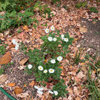
    Ok. You mentioned lilies. I am going to assume you meant traditional lilies rather than daylilies. I am in the same zone as you. I have had good luck with orientals, asiatics, and and orienpets (oriental/trumpet hybrids), but not with traditional trumpet lilies. I will try them again eventually but I recommend the orienpets for the back-middle as your focal point. Probably like four of them. They are really showy.

    Next to them in the back but on the outside edge delphinium or larkspur or something else tall and spikey like liatris.

    Put your grasses on the outside corners like sentinels of the overall garden. Pampas grass is WAY too big for your spot. On the other hand, diamond grass is similar, comes in white/pink and only grows 3-4ft. It is perennial and a little dab will do you. I recommend just getting two.

    Absolutlely do poppies but start them right away because they like to get started in cool weather when grown from seed. Just sprinkle the seeds on the surface of the dirt because they need light to germinate and detest being transplanted. Get them started right now too. We are running out of time.

    Finally, put things like Nemophila/Penny Blacks or Bellis perennis - the red pompon variety is amazing (aka English daisy) in front. Short things should go in front. If you do all this, your garden should look to have three neat layers and will have a cohesiveness that is admired. Symmetry is also your friend in a small space like this where it is already very symmetrical. I would only break the symmetry by sort of mixing up the short plants in front a little bit so it still has a natural feel to it.

    Maybe get some of those decorative garden bricks to put on the edge and make it all look polished.

    Remember to weed and fertilize. Be ruthless with tearing out any seedlings the grasses may toss your way (whether give-away or garbage).

    And Happy Gardening ~ I hope you have fun.

    I love your dinosaur art by the way.

  • 10 years ago

    This is a rough sketch of what I was suggesting. Also, that is Montego Bay orienpet lily in the picture in my previous post. Orienpets come in many different color varieties.


  • 10 years ago

    Have you considered making a large flower bed somewhere more in the center of your lawn? Go big and spread out! My friend has 2 weeping pussy willows...they're 7 feet tall and at least 5 feet wide...just a thought.

  • 10 years ago
    Yes this is just phase one. Yikes about the pussy willow! If it gets that big I'm just looking at ground cover in that bed lol
  • 10 years ago

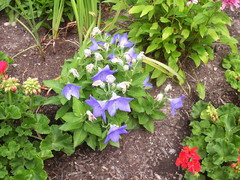
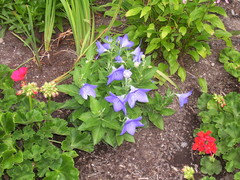
    Re dwarf balloon flowers: True, dwarf balloon flowers, like those of the Sentimental series, don't require staking.

    On the other hand, the spent blooms may look even less attractive (concentrated) on dwarf forms than they do on the taller varieties.

    Personally, I deadhead all balloon flowers in the interests of appearance/

    neatness.

    Below (July 25, 2012).

  • 10 years ago

    Have you considered Clematis instead of the wisteria. I have group 3 clematis growing up the side of my house. No problems with it at all. Just cut it down in the early spring. They are loaded with blooms every year.

    I also have Wisteria Blue Moon but even tho it is not suppose to be invasive I have it planted back further in my yard. I have had it three years and it hasn't bloomed yet, maybe this will be the year.

  • 10 years ago
    last modified: 10 years ago

    I am actually going to contradict a bit what some others have said. I think you should only do this bed this year. Move on to making other beds in following years. It is important to enjoy your flowers too and that you not spend all your time digging, weeding, fertilizing, and watering. It is also better to grow a few things well than a lot of things badly.

    Just my opinion I guess.

    (If you find yourself with a well manicured bed though and jonesing for more garden projects, don't let me stop you. My advice is just coming from someone who has bitten off more than he can chew before. It is good to complete one project utterly before opening a new can of worms.)

    And your pussy willow isn't going to immediately become a large tree. You have a few years to plant whatever around it. Stay true to your original vision.

  • 10 years ago
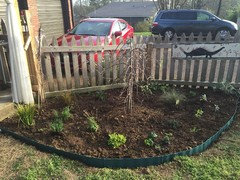
    Well here is what I ended up with!
  • 10 years ago
    Some hollyhocks and foxglove in the back, a few random flowers and grasses to see what they do - yarrow, bellflower, iris, lithofora, armeria, and even some sage and lavender!
  • 10 years ago

    Cool. I'm sure it will be wonderful. Looks like you got your spacing right. Well done. :)

  • 10 years ago

    It looks like this will fill in nicely, and provide you a nice start. Watch out though, it's addictive! ;>)

    One suggestion: I would get a straight-bladed spade and sink the edging lower so that there's only at most about 1/2" above ground level on the lawn side. That will help keep grass roots from growing under it and also make it almost invisible once the grass grows. I also usually line the inner edge with brick, and the lower edging allows the lawn mower wheels to run on the brick so you don't have to weed whack the edge. It will make for much easier maintenance.