

Oklahoma raised beds
Hi everyone,
I recently made a raised bed that in intend to used as a vegetable garden. I am looking into filling it but am not to sure as to what to fill it with. I am just south of norman so I was thinking about heading to there composting facility to fill my truck with compost. Would that be sufficient or should I be adding other stuff like peat moss, topsoil , cow manure, or vermiculite?
Also I what are some varieties of tomatoes, cucumbers, zucchinis, and melons that you have had luck with growing in the Oklahoma heat?
Thank you
Matt
Comments (51)
 10 years ago
Hi Matt, When I fill raised beds, I mix compost with native soil. My native soil is red clay and is very rich in minerals, hence it is rich in nutrients. Once you add compost to red clay, you have a great gardening medium. Some people buy a compost/soil blend from a bulk seller. We did that for my brother who had rocky, caliche' clay soil down near Granbury, TX. I removed as much of the rock as I could from grade level soil down to a depth of about six inches and then built raised beds 6" above grade level. We bought a dumptruck load of a compost/topsoil blend and filled in the beds, so he had great soil down to a depth of 6" below grade and 6" above grade. Everything grew like crazy in that. However, had he not had all those rocks, I just would have added compost to the native soil.
What you choose to add is up to you. There's plenty of ways to do it, and there is not a one-size-fits-all solution since all of us start out with different kinds of soil. Do you know what sort of native soil you have?
It is important, if you have sandy soil or sandy loam, that you not make your raised beds too well-draining as sandy soil and sandy loam already drain really well as it is. You don't fill raised beds purely with compost because it dries out too much in the summer heat and doesn't hold moisture well. If you have clay, it is important to add a lot of organic matter to improve how it drains. Much depends on how heavy your clay is. Around our house, we have dense, red clay that you could use to make flower pots. In our front garden, we ranged from a narrow band of sandy soil at the west end to a fairly dense red clay in most of the garden (but not as dense as the clay around the house) to a clay/sand blend at the extreme northeast corner. I amended each area individually according to its needs, and also according to what I intended to grow there that first couple of years. You don't have to have a really high amount of compost or humus in your soil---just 3 to 5% is plenty. I like well-amended clay because it both drains well and holds moisture well, while my well-amended sandy/silty soil tends to drain too fast even after all the amending. That mean I have to irrigate that part more often
If you aren't sure which kind of soil you're starting with, I suggest you do the soil jar test as described in the linked article. That will show you what you're starting out with.
To tailor your initial soil improvement, ask yourself what you are going to grow in the area you're working on.
In our early years here, I added lots of peat moss to the area where I wanted to grow Irish potatoes because our soil was highly alkaline and the peat moss helped bring down the alkalinity a bit (as did the use of sulfur) to a pH range that was preferred by potatoes.
In the area where I was going to grow okra and purple hull pinkeye peas, I didn't do much amending because they tolerate mediocre soil. I also didn't amend the green bean area much that first year because green beans can tolerate poor soil, though they produce better in somewhat better soil.
I saved most of my amending for areas where I was growing highly valued food that we love like tomatoes and peppers.
Having both sandy-silty soil to start out with and heavy dense clay, I reserved the sandy silty soil for carrots, sweet potatoes and melons because they thrive in loose sand. (I did add some compost and cow manure the first year to the sandy soil, and used cover crops and compost crops to enrich it more and more over time.) Clay gets a bad rap. As long as you are starting out with red or black clay, once it is amended, almost anything will grow well in it. If you are starting out with gray or yellow clay, I don't know if it is possible to make that stuff garden-worthy.
Remember, you don't have to do all your amending in one year. I started out with awful red clay in 1999, and amended each and every year since then. We got decent crops even in the early years, but every year, as the soil gets better and better, so does the crop yield.
As for varieties that grow well in Oklahoma, here's the OSU list of recommended varieties:Recommended Vegetable Varieties for Home Gardens
Here's some of my favorites:
Tomatoes: I could go on forever but will try to keep this brief. If you want to grow hybrids, you can't go wrong with Carmello, Better Boy, Early Girl, Big Beef, Better Bush, Beefmaster, Brandy Boy, SunGold (cherry), Marion and Rutgers. (I could list 100 more, but all these are great for new gardeners.)
If you want to grow heirlooms or modern-day open-pollinated types, here's a few long-time favorites: Cherokee Purple, Black Krim, Marianna's Peace, Bradley, Arkansas Traveler/Traveler 76, Speckled Roman (a paste tomato), German Queen, Woodle Orange, Dr. Wyche's Yellow (an Oklahoma heirloom), Heidi (a paste type), Black Cherry, Ildi (a yellow grape type), Carbon, Mystery Black, Nerbraska Wedding and Matt's Wild Cherry.
Cucumbers: For fresh eating, Sweet Success, Lemon Cucumber, Sweet Slice, Sweeter Yet, and Poona Kheera.
For pickling: County Fair (best disease tolerance), H-19 Littleleaf, Carolina, Sumter and Calypso.
Zucchini: almost any variety you plant will do well here until the squash vine borers find it. We like a couple of old heirlooms called Costata Romanesco and Cocozelle di Napoli. Caserta is a more modern Cocozelle type. Other great ones are Golden Zucchini, Magda and Black Beauty.
For resistance to the squash vine borers, you can grow a Korean summer squash called Meot Jaeng I Ae. Seeds of it is available online from Kitazawa Seeds.
Melons: You didn' specify which kind of melon, so here's some of our family's faves:Muskmelons (in the USA these are called cantaloupes, though they are not actually true cantaloupes): Hale's Best Jumbo, Carole, Ambrosia, Israel/Israeli/Original Israeli, and Ha'Ogen/Ogen.
Cantaloupes: Collective Farm Woman, Canoe Creek Colossal.
Charentais is a superb, traditional French melon.
Watermelons come in many different sizes. The large melons like Black Diamond take up tons of space, so nowadays in the interest of getting as many watermelons from the available space, I mostly grow the icebox melons, which are small-fruited varieties that produce melons that easily fit into your fridge without you having to take everything else out. Our favorite icebox melons include: Blacktail Mountain, Sugar Baby, Bush Sugar Baby, Yellow Doll, New Orchid, Yellow Baby, and Tiger Baby.
Varieties we like that produce larger watermelons include Black Diamond, Yellow Belly Black Diamond, Moon and Stars, Stone Mountain, Crimson Sweet and Raspa.
If you want names of some of the more obscure types of melons like casaba, crenshaw, crane or winter melons, let us know and I'll list some.
Dawn
 10 years ago
Hey Matt. I'm on the other side of Norman. Norman address/Moore schools.
We got a truckload of compost from Norman in the fall. It was still steaming when we picked it up. It's a little chunky still---like it needs to break down a bit more, but I used it in my new raised beds. I also purchased a couple of truckloads of garden ready soil from Minicks to mix with it. I used more soil and less compost.
I love the soil in my old raised beds (They were made last year). I used Minicks and K&Ks garden ready soil and mixed it up with some of my own home-made compost. As I was cleaning the beds out last week, I noticed how wonderful the soil is there now. It was full of earthworms and the weeds came out easily. I'm hoping the new raised beds are as wonderful in a year! Oh, and I also lined the beds with cardboard. It's nearly composted now, which is good and bad. The worms probably enjoyed it, but now I've noticed the bermuda grass is trying to creep in under the edges of the beds.
Do you know when the next compost release date is? I've checked the City of Norman website and the spring release date isn't up yet.
Related Professionals
Cambridge Landscape Architects & Landscape Designers · Jacksonville Landscape Architects & Landscape Designers · Rockford Landscape Architects & Landscape Designers · Lewiston Landscape Architects & Landscape Designers · Vineland Landscape Contractors · Sugar Land Landscape Contractors · Bloomington Landscape Contractors · Muncie Landscape Contractors · Los Angeles Landscape Contractors · Pocatello Landscape Contractors · Seattle Landscape Contractors · Hot Springs Accessory Dwelling Units · Jacksonville Accessory Dwelling Units · Santa Rosa Accessory Dwelling Units · Honolulu Accessory Dwelling UnitsMatt Lyons
Original Author10 years agoThank you guys for taking the time to answer with such details!
I am not sure when the spring release date is but I'll be calling them soon and will let you know if I figure it out.
After doing some work on my garden boxes today I am pretty sure my area is mostly sandy, I'll have to add in lots of organic matter to help make my soul better.Dawn thank an you for all the varieties or plants that do well here, I just moved to Oklahoma so it's nice to get an idea of what grows best here. However I left out one plant, peppers. Do you have any advice on some sweet peppers that do well here and have relatively high yields? I am sure most do pretty well as they love the heat.
Does anyone have any advice on best places to purchase organic/non GMO seeds or starter plants? I'd like to grow mostly organic plants. I am located just south of Norman, I hear they have farmers markets up that way so that might be a good place for me to start.
Thanks againMatt
- 10 years agolast modified: 10 years ago
Hazel, in the past the norman farmer's market has had a great variety of plants from a variety of vendors. I've bought from sunrise acres also, but it is quite a trek to their farm from my place in NE Cleveland county.
Matt Lyons thanked wulfletons - 10 years agolast modified: 10 years ago
Hi Matt. Are you in Goldsby? If so I live south of Washington, not far away. Because of me being near Washington, I always think of Goldsby as South of Norman and Noble never crosses my mind. But I guess you could be near Noble to.
Anyway I have built some beds for other people and in the raised wood beds I line them with weed fabric so the soil will not spill through the sides. Then I mix gardenready mix from minick with a little extra compost from Norman and fill the beds nearly full. They will settle over time. Then since Norman compost is so black and pretty, I usually will put a 2-3 inch layer on top of the soil mixture. The nutrients will leach further down into the mix, and every time the gardener plants, weeds, and tends the garden, the top layer gets mixed in just a little. It seems to grow things nicely. Of course you need to add a little compost every year to replace lost nutrients.
And as a side thought, I do not know how big your beds are or what pickup you have, but soil can get real heavy real fast. An 8x3x2 foot tall bed is 48 cubic feet, or 1.7 yards, or at least 2 tons depending on the mix ratio. The compost is quite a bit lighter, and the topsoil in the soil mix will be quite a bit heavier. The tons/yard will just depend on the mix ratio, but it all is heavier than people think. When you order at minick, if you do, take your measurements and they can convert it to tons. That is how they sell it, by the ton. They can deliver for a fee, or someone you might know can go get it.
Matt Lyons thanked scottcalv  10 years ago
I dig a new raised bed almost every year - I'm a frugal (cheap!) gardener when I can be so some years the bed gets a bunch of added dirt/compost and sometimes it doesn't. Like Dawn said, you don't have to amend it all at once. I'm playing a long game in the garden - I try to add good dirt/compost/vermiculite/whatever bit by bit each year to at least one bed. One bed is really just a frame over my freshly dug former lawn. I have to be vigilant with weeding at first, but I mostly have pretty clean beds.
Echoing Dawn about heat - one of the things to be aware of as a new-to-Oklahoma-gardener is that our "full sun" in the high heat of summer is way, way too much for some plants. I sometimes rig up sheets (a battle with the wind!) or other shade providing things to give some more delicate plants (and my tomatoes, honestly) a break in the hot, hot, hot times. People talk about taking a break from gardening in the winter but honestly, I take a break (minus some watering) in August - things just cook! I am able to garden in the winter some using a row cover on one of my beds, but in August? Forget it! Maybe if I grew okra! :) Good luck!Matt Lyons thanked Kate OK USA (7b)- 10 years ago
I grow a lot of "full sun" plants in morning sun until about 1 pm and then in dappled shade for the rest of the day and they produce like crazy. In our hot summers, full sun can be brutal in the hotter years. (Not that we have a lot of cooler summers, but some are cooler than others.) I also grow some "part shade" plants in almost full shade. It keeps them happy and producing longer, and I sometimes put up 50% shade cloth over tomato and pepper plants in July and August to help them deal with the heat. I have had good luck growing lettuce in containers so that I can move the containers into the shade as we get hotter and hotter. If I keep the containers well watered, the shaded lettuce can hang on surprisingly deep into summer, long after in-ground plants have given up and bolted. August is simply brutal and if we are in drought, July isn't a picnic either. I coast a lot in July and August, mostly just watering and harvesting and letting everything else slide until the weather cools down again.
Matt, Another thing.....I don't know where you gardened before, but will warn you that when variety descriptions say a given plant is "heat-tolerant", that normally is referring to the sort of heat most of the USA has, and should not be interpreted to mean that the same variety is heat-tolerant to Oklahoma heat. Our summers are just as brutal as the summers much further south....like in coastal portions of Texas and Florida, but without the cooling breezes off the ocean, and some years just as bad as the summers in Arizona. Last summer was fairly mild, so I expect this one will not be mild as we rarely get two good summers in a row, weather-wise.
We moved here from Texas in 1999, moving approximately 80 miles further north. I knew what heat was and, yet, when the daytime high hit 111 our first August here, I was wondering what we'd gotten ourselves into. It turned out (I am sad to say) that here in southern OK we are hotter in summer than we were in north-central Texas and colder in winter, prompting one of my friends to remark that we lost all the way around weatherwise when we moved here. It would have been so much nicer if we'd learned it was cooler here in summer and warmer in winter, but that's not how things turned out.
Dawn
Matt Lyons thanked Okiedawn OK Zone 7 Matt Lyons
Original Author10 years agoThanks again everyone for all the great info! I have my beds set about 2-3 feet from the house. So that I can lean some trellises up against the house to grow cucumbers and melons on. It is in full sun till about 2/3 pm. At first I was a little nurvous that I wouldn't get enough sun for my plants. Being from New York full sun means full sun or your yields will suffer. However after reading all your responses I am quite happy I decided to do this.
Again in thanks for all the helpMatt Lyons
Original Author10 years agoFor anyone interested Norman is now releasing compost. I filled up my truck yesterday.
- 10 years ago
Hey Matt. What's the texture of the compost? Is it pretty chunky still? And thanks for letting us know.
Matt Lyons
Original Author10 years agolast modified: 10 years agoYeah it is still pretty chunky, I needed some soil so I had to take what I could get, in a few months it will break down and continue releasing nutrients!
I ended up mixing in some of the sandy soil, for aeration and drainage. I also added a bagof peat moss to try and retain some of the moisture in the soil.
We we will see how that works out for me.
Matt Lyons
Original Author10 years agoSo I am off today and am getting anxious, was thinking about heading to sunrise acres farms to grab some tomato or pepper plants for the garden. If I do am I making a mistake as it's still a little to early or do you think I should be alright?
Thanksmatt
- 10 years ago
If you're in central OK, you're probably okay, but always keep an eye on the weather and be prepared to cover up the plants (a bedsheet or sheer curtain would work this late in the season) if a late frost or freeze threatens. Our temperatures can bounce around alarmingly at this time of the year....from the 20s or 30s to the 80s or 90s.
Matt Lyons
Original Author10 years agoThank you dawn. I am just south of Norman so I think I should be alright
- 10 years ago
Speaking of peppers...is it too late to start some as seed. Starting peppers from seed is new to me this year. I have bell peppers and cayenne peppers about ready to go outside. But...I want jalapeno and banana peppers too. I bought some seed tonight and wonder if I can start them now.
Matt, I've never been to Sunrise Acres. What did you think about it? What type of peppers and tomatoes did you get?
I"m going to plant some tomatoes (Early Girl) tomorrow afternoon and hope for the best. I've tried to harden them off and they've been through it. I may put some large food containers around them to help protect them from the wind. That's been the biggest thing at my house--the wind. It's brutal and damaging.
- 10 years ago
You can start them from seed now because the pepper-growing season runs from now through the first freeze, but you shold know they are fairly slow to germinate and to grow compared to tomato plants. So, just don't be overly concerned at how slow they are. I often use their slowness to my advantage, letting them grow on slowly in their little containers until I've harvested onions or some other cool-season crop, and then using the peppers as a succession plant that follows the cool-season crops.
I've had four Mucho Nacho jalapeno pepper plants in the garden for about 3 or 4 weeks now for early peppers, but my main pepper crop (which will be several dozen plants) won't go into the ground until sometime in May and some might not go into the ground until June. It just depends on when space opens up for them in my always overcrowded garden. That's fine with me because they'll produce most of their crop after the main tomato crop, so I am not having to do too much canning at once. Sometimes it is an issue when the jalapenos and tomatoes are ready for salsa making and the bell peppers are lagging a little behind, but other years the bell peppers catch up and are ready at the same time even when planted later.
Pepper plants are more sensitive to cool soils and cool air temperatures than tomato plants are, so I generally plant them quite a bit later than tomato plants and still get a great harvest, and a surprisingly early one even from late plantings. The 4 really early pepper plants that I have had in the ground were planted with the early tomato plants, so they have been covered up on cool nights and are doing fine but haven't made tons of growth yet either whereas the early tomato plants are towering over the peppers, having made plenty of early growth. However, the young pepper plants starting to bloom anyway even though they are still small.
I usually tuck pepper plants into the onion bed as onions are harvested, so that by the time all the onions are harvested, the bed has miraculously transformed over time into a pepper bed. It happens gradually over a couple of months so that at first you have mostly onions with a random pepper plant here and there, and then gradually there's more and more peppers and fewer onions. Since both like nitrogen-rich soil, the onions are perfectly happy to follow the peppers. In order to make the spacing work out right, I strategically harvest onions for home cooking before they are fully mature, plopping a pepper plant into each space where I've pulled out a couple of onions for cooking. That's how I cram pepper plants into a garden that doesn't have much open space left for them. I always carefully plant my onions in order, with short day types in one section, intermediate day times in another and long-day types in a third. That helps me with the onion bed to pepper bed transition too because I know to start putting peppers into the short day area first. My short day onions begin to bulb up by early May most years and are harvested in mid- to late-May just when the pepper plants are starting to whine and complain because they aren't in the ground yet. Somehow, every year, it all works out and the peppers end up growing happily, mostly following the onions. I do tuck peppers into the ground here and there wherever I have space, but mostly they go into the onion bed or sometimes the bed where the brassicas grew. My broccoli is heading up big time and likely I will begin harvesting it next week or the week after that, so that also will open up some space for my still smallish pepper plants.
Sometimes the summer heat will cause blossom drop on sweet peppers just like it does with tomatoes, but sometimes it doesn't, especially if your peppers have shade during the worst part of the hot summer days. Hot peppers are less sensitive to heat.
Matt Lyons
Original Author10 years agoI ended up I ended up not making it all the way to sunrise acres, It's about 1 hour from me. I ended up stopping at a garden center in Norman. I planted some sweat cherry peppers(never tried them), some red and green bell peppers, a jalapeño plant, and some sweat banana peppers. As far as tomatoes I for a sweat 100 cherry tomato plant, an Arkansas traveler, a big beef, and I can't think of the other type!
Hopefully they all do well. Dawn didn't mention sweat 100 so I am hoping they do well in the Oklahoma heat!We will see!
- 10 years ago
My two cents worth. If I had an area with a lot of sand, I'd work in some dry clay. My favorite soil includes clay, sand and composted manure.
Johnny
 10 years ago
Sweet 100 was the first thing I ever grew, from a pack attatched to a magazine. They were soooo good that year that the next year we tilled up the back yard (yeah, we tilled bermuda), put down black plastic (something I read about) and hay on top (pretty sure it was hay not straw) and tried to grow EVERYTHING. It was one of those unbarebly hot summers and I was out there trying to poke SVBs or slit the stems to dig them out. Not much grew, except for tomatoes and the very best melon we ever had. After #2 son was born, the garden went back to bermuda. I'm sorry, that unleashed a flood of memories!
- 10 years ago
Sweet 100 is a great tomato that I once grew regularly. It probably was the first cherry tomato I ever grew in my own garden, which was long, long ago. My dad grew Sweet 100 and Large Red Cherry forever and forever. Then, I moved on to the improved Supersweet 100 and, after that, to Sweet Million. All 3 of them are great tomatoes. Supersweet 100 is less prone to cracking than Sweet 100, and Sweet Million produces significantly larger tomatoes and produces more heavily. You can't go wrong with any of them. They're all good.
I don't remember what cherry tomato varieties I had on my 2016 Grow List, but I know what ones I had in my hand when it was time to sow seeds: Black Cherry, SunGold, Ildi, Mexico Midget and Apricot Dreams. Oh, and Balconi Yellow for a large container where it will be planted with several other veggies. If push came to shove and I ran out of room in the garden, we could survive on just SunGold and Black Cherry but, luckily, that hasn't happened yet.
- 10 years ago
So I planted a few Early Girls yesterday. I get home after dark on Wednesdays, so I took a flashlight out to the garden (after shutting the chicken door) to check on them. One of the tomato plants was almost gone! I caught a caterpillar red handed just munching away.
- 10 years ago
I have had some luck with Bt Kurstaki.
http://www.planetnatural.com/product/monterey-bt-kurstaki-bt-k/
- 10 years ago
I think I have 14 tomato plants in the ground so far and hope to finish before the rain starts, which for us is Sunday night. I am growing fewer varieties than normal. I didn't exactly plan it that way, but my plant starting space was not available this year since I had more family members here. I also planted more hybrid plants than I normally do, but I need to make a lot of salsa this year.
I will have plenty of Sungold, 1 Yellow Jelly Bean, and as many Tess's Land Race as I can pick. LOL Dawn, I planted 5 Tess seeds and got 5 plants. With the number of seeds you sent to me, I can plant for 5 or 6 years. I planted them later than the other seeds so they are still small, but I am unlikely to put 5 in the garden. I could probably build a fort with 5 Tess plants. My other cherry type is Tumbling Tom.
I have Mortgage Lifter, Black Krim, Lemon Oxheart, San Marzano, and Better Boy which will be caged. Then I have Early Doll and Rutgers (both determinate) which I plan to plant along my back fence and to the west of the new asparagus bed.
I probably had a choice of a hundred or so, but I am only growing 12 types and I usually have a lot more. When I was planting, I was thinking I would plant more, but it just never happened, and I still ended up with more plants than I have room for. Even with only twelve, I have cherries in gold, yellow and red, and other tomatoes, in black, pink, yellow, and red, so it turned out OK.
I hope that Lemon Oxheart does well and that we like it since it is new to my garden this year. I have read that it may not be a true oxheart, and behaves more like a beefsteak. We shall see. So far everything is looking nice and if I can get more planting done before the week of rain arrives, it should make a big difference. Of course, I am so far north that most of you are way ahead of me. Yesterday we took the grandkids on a little road trip to visit the Quapaw Tribal Museum then to run some errands and eat lunch in Joplin. We were only gone a few hours but had been in Oklahoma, Kansas, and Missouri before we came home.
- 10 years ago
I guess I shouldn't have said that Rutgers is a determinate, because it depends on which company you are reading from, since I find it listed both ways. At any rate, it has never gotten very tall for me in the past.
Matt Lyons
Original Author10 years agoWhat's everyone's opinions on pruning your tomatoes? I have them in cages so I am trying to decide if I should prune or just let them go crazy.
Let et me know, thanks as always.-Matt
- 10 years ago
I have been gardening since I was a child (I'm in my late 50s now) and we always have grown tomatoes in the same way---inside sturdy, well-staked cages, and with no pruning other than removing diseased or broken limbs. Then, at a certain point in the season, I sometimes remove the lowest limbs for better air flow and as a disease prevention method. I grow from 100 to 600 tomato plants per year, though it has been almost a decade since I've had the 600 (I think that was in 2006).
In our climate, the summer heat and intense sunlight are brutal and sunscalded fruit is a huge issue. For that reason, I abhor pruning. Every time you remove a leaf or limb, you are removing potential protection that would have shaded fruit and helped prevent sunscald. Sometimes you'll get sunscalded fruit anyway, simply because a fruit is located in a place where the limbs don't shade it, but you'll get a lot more sunscalded fruit if your plants are in a full sun location and you prune away the foliage.
Look at it this way---the leaves of the plant are the factory wherein photosynthesis occurs, and photosynthesis is essential for plant growth and performance. So, every time you prune, you are reducing the size of your plant factory.
The best way I know to illustrate how this can be damaging is to describe a neighbor we had in Texas in the 1980s, who carried "pruning" too far. She was a very difficult woman, not a pleasant person at all, and rarely spoke to us or responded to a wave. (So, even though she lived next door, we clearly were not friends, but that was her choice, not ours.) She planted tomato plants in dappled shade one summer, perhaps inspired by her three nearest neighbors, all of whom had lovely, productive gardens in sunnier parts of their yards. She put an 8' wooden stake in the ground by each plant. Then, she must have read a book written for someone in some other climate, so she pruned off EVERY single limb that formed. She pinched off all the blooms. What she had by July or August was a tall, palm tree looking thing 7 or 8' tall with only a couple of leaves at the top and no fruit whatsoever. Eventually her husband asked me what they were doing wrong and I told him, as kindly as possible that you can't get fruit when you prune off 99.9% of the leaves and all the blossoms which would give you fruit. That is an extreme example of pruning carried too far!
Now, I'll add this. Lower leaves are vulnerable to soil splash which can carry diseases up onto the leaves, so as the season goes on and the plants enlarge, I often remove the lower limbs for better air circulation. That helps reduce disease. Keeping the area beneath plants muched also helps with that issue. Many foliar diseases are also airborne though, so keeping the lower limbs pruned off will not guarantee your plants will remain disease-free, but it can help.
If you want a lot of fruit, prune off as little foliage as possible. If you are wanting to grow fewer, but larger, fruit, prune off some of the fruit and a little of the foliage, but never enough of the foliage to leave your fruit exposed to direct sun.
Sunlight and heat can be such an issue here in the hot, often dry months of July and August (especially in a drought year) that I have shade cloth I put over the tops of my tomato plants and pepper plants some years to keep the plants cooler (and more productive) and to prevent the fruit from sunscalding.
My nice, neat rows of caged tomatoes in April turn into a huge, crazy tomato jungle by late May or early June and I harvest enough tomatoes to can hundreds of jars of tomato products, dehydrate a lot for use as sun-dried tomatoes, freeze some, and give away fresh tomatoes to our friends and extended family. I wouldn't have it any other way and pruning away foliage likely would make my jungle look a little tidier, but it also would probably give me some sunscalded fruit and likely less fruit. My goal every year? To have so many tomatoes that I get sick of harvesting them, eating them, preserving them, etc. Once I hit the "sick of tomatoes" stage, I know my entire gardening year has been a huge success no matter what is going on in the rest of the garden.
- 10 years ago
Holy cow! I have never heard of Sunrise Acres and they are only 4 miles south of me!?!? Their address is Blanchard, but that's basically Newcastle. wow! I have complained for years about a major lack of greenhouses/nurseries in my area. I usually have to drive over to K&K on the northeast side of Norman.
I will definitely be checking them out!
- 10 years ago
dulahey, let us know what you think of Sunrise Acres. I've never been there. I'm just around the corner from K & K. haha.
- 10 years ago
Kim, It is such a sad story. Anyone who's ever had a neighbor who is difficult to deal with will understand why I bit my tongue and kept my mouth shut as she grew those palm tree-like tomato plants in her back yard that summer. I was dying to ask her what in the world was she doing and why, but I didn't because even had I phrased it in the nicest way possible, I knew what sort of icy response I'd get. The odd thing is that we all had chain link fences in that neighborhood (though, eventually a couple of years later, we did put up a wood privacy fence after we added a swimming pool to our backyard), so she could see how her three nearest neighbors grew tomatoes---in cages, unpruned, and with huge yields. If she wanted to grow tomatoes, why didn't she just do it in the manner she observed was working for the rest of us? I was young back then and didn't feel experienced enough in gardening on my own away from my dad yet to say "hey, you're doing this all wrong" but I really wanted to tell her that.
I should add that after I spoke with her husband, he decided it would be best for him and his marriage if we just pretended we never had that conversation. He knew he'd be in trouble for coming over and asking me the questions and he didn't even want to relay to her that she'd created her own problem and prevented them from getting any harvest. I felt sorry for him and promised him I'd keep my mouth shut.
Her efforts are a perfect example of taking a method that might work somewhere, in someone else's climate, and using it in your own. I have seen strongly-pruned tomato plants with huge fruit lying along stems with very little or at least relatively little foliage. That might work in a milder climate and I know it can work in professional growers' intensively managed greenhouses, but you know what our intense sunlight would do to tomatoes exposed to that much sun.....and it wouldn't be pretty and the fruit wouldn't be edible.
There's no one best way to grow tomatoes here in this country, or even in this region or state. Different people use different methods. You have to do what works for you. However, I've been around people growing tomatoes since the 1960s in both Texas and Oklahoma, and every highly successful tomato gardener I've ever known did as little pruning as possible and raised their plants inside cages. A plant staked and pruned strongly just doesn't stand a chance in our summers. Stand outside in your garden in full sun on a day that the high temperature is 95 or 105 or, God forbid, 110-115 degrees, and no one has to explain why those plants need all that foliage to shelter their fruit. On a day like that, I wish I had foliage shading me wherever I go in the garden to work.
Dawn
- 10 years ago
Hazel, In bad caterpillar years, I use a worm killer that contains Bt 'kurstaki'. It works great, but isn't long-lasting on the plants, so repeat applications may be needed. I just buy it at the local stores---they have worm killer products in every store around me right now.....whether it is Wal-Mart or Lowe's or Tractor Supply or Atwood's. There are many such products available, both name-brand from major garden pesticide companies and store-brand at some of the farm stores. I only have to order it online when there is a huge caterpillar outbreak and the local stores sell out. Just be careful where you spray products containing Bt 'kurstaki'. It is a bacteria that will kill all butterflies and moths that inject it, so I don't spray it on any ornamental flowering plants and I don't spray it on the herbs (fennel, dill, parsley, for example) that I grow specifically for the tiger swallowtail larvae to eat.
Usually, bad caterpillar outbreaks are fairly limited here, particularly if you nip them in the bud as soon as you discover them. I think I've only had to spray my entire garden with a product containing Bt 'kurstaki' one year, and I sprayed it 2 or 3 times that spring because cutworms and army worms were cutting down plants right and left and/or stripping plants down to bare, naked stems. I think that was in 2010. My preferred method is to wear disposable nitrile gloves to hand-pick the damaging caterpillars off the tomato (and other) plants, and then I feed the caterpillars to the chickens. If a particular type of caterpillar is not being eaten by the chickens, I drown those caterpillars by dropping them into a bowl of soapy water.
Because I like having a garden full of butterflies and moths, I usually don't spray anything and only hand-pick the caterpillars that actually are doing damage. However, if they are doing a lot of damage to tomato plants, I do spray those plants. I try to prevent caterpillar issues by using Slug-Go Plus in the garden, sprinkling it on the ground monthly. It not only takes care of snails, slugs, pill bugs and sow bugs, but most cutworms too. It doesn't help with any caterpillars that do not spend a portion of their life cycle in the ground. My worst caterpillar springs do seem to follow a previously wet year, so I am expecting caterpillar issues this spring. So far, though, I've mostly only been finding and destroying cut worms but that might be because it is still so early yet.
I have seen tent caterpillars appearing in fruit trees for the last week. I do spray their web when I see one. They are a lot easier to spray and kill while they are still inside their webby nest.
Dawn
Matt Lyons
Original Author10 years agoHi everyone, hope your gardens are growing well.
All my seeds have sprouted and are doing pretty well. I bought a few tomatoe and pepper plants a few weeks back.
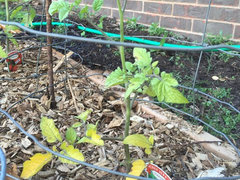
The peppers are doing alright, have lost some of the lower leaves. However most of my tomatoe plants have a lot of yellowing on the bottom leaves and have grown only so slightly. Is it possible that there has been to much water? I haven't watered since I planted but I have been getting pretty steady rains. anyone else have any idea what could be going on?
thanksMatt Lyons
Original Author10 years agoI
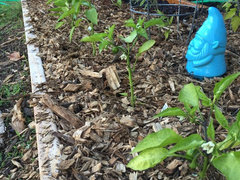
heres a photo of one of my sweet 100 plants. I have been pinching back most yellowing leaves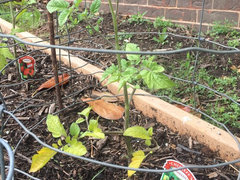
- 10 years ago
Yellow leaves this early in the year usually are a sign of some sort of stress, and it could be any stress. Based on how much rain has fallen recently, my best guess is that your soil is too wet. The stress leading to the yellow leaves even could be from before you purchased the plants. I'd keep a close eye on the plants and watch to make sure no leaf spotting begins occurring.
Keep in mind that when we are excessively wet, the plant roots can become clogged with water, which then interferes in the ability of the plant to take up nutrients from the soil. That could be what is happening with your plants, or it could be that the weather where you are is still a bit cool which is making the nitrogen in the ground not very well available yet. I don't worry too much about yellow leaves early in May when plants have been in the ground for a relatively short while. Now, if the leaves still are yellowing from the bottom up a few weeks from now, that would be more worrisome.
Matt Lyons
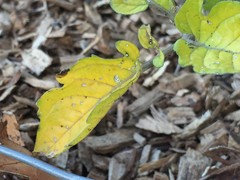
Original Author10 years agoThanks for your response as always dawn. I'll keep everything you have said in mind. I decided to head outside today and try to take some better pictures to see if that might help you help me figure out what's going on.
- 10 years ago
To me, those yellow leaves look like they are starving and need to be fed, but it may not be a deficiency of anything in the soil---it may just be the excess moisture.
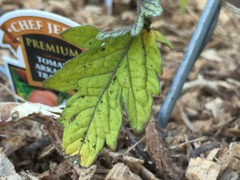
Older leaves often turn yellow and start to look like crap during rainy weather. I tend to pick them off and throw them away. If more leaves immediately begin to yellow with the yellowing moving from the lower leaves upward, then that's more likely a disease like Early Blight in its earliest stages, but you won't know for sure until you start seeing concentric dark circles on the yellow leaves. There's so many reasons that leaves go yellow that often it is hard to pinpoint it, especially with purchased plants as you have no idea how they've been treated before you buy them.
I looked carefully at my tomato plants today to see if I could find similar yellowing leaves on any plants in the ground but I couldn't. However, some of my oldest plants that have been in the ground the longest (since early to mid-March) and which have been subjected to a lot of rain do have some yellowing on the lowest leaves---not quite as yellow as yours---accompanied by bacterial speck. It isn't on any of the upper leaves, so I just picked off the sick leaves and trashed them. If it had been moving up the plant, I would have sprayed them with a product labeled for bacterial speck.
Based on your latest photos, I'd suggest you look at this link and see if you see anything that makes a light bulb go off in your mind. Consider both bacterial speck and bacterial spot as possibilities. If that dark spot on one leaf has concentric circles, it may be Early Blight. The problem with trying to ID from a photo is that the photo only captures one moment in time, whereas disease develops and progresses over a period of time, and a photo just doesn't show us that progression.
I just don't get too excited over anything that shows up on foliage in April and the first half of May because the rain causes lots of issues that go away when the moisture drops off in June. Or, if June stays rainy and hot, then here come all the fungal diseases.......but let's wait until June and see if it happens.
If you feel like you're starting to obsess over the leaves, might I suggest that you spray preventively with a fungicide or two, alternating from one to the other each time you spray so any diseases present don't develop a tolerance of one fungicide. Follow label directions. I expect most of them will say to spray once every 7 -10 days. Chlorothalonil (sold in many products, and a common one is Daconil or Ortho Disease Control) is a popular one, for example. Serenade is an organic choice. So is neem.
I don't know what your level of experience with plant disease was in your previous garden, but here in OK with our hot, humid and often rainy late springs and summers, Early Blight is common. Since you're from New York, you might be relieved to know that Late Blight, on the other hand, is very rare here. I've been here since 1999 and never seen a single case of late blight on tomatoes here. So, at least there's that.
Your peppers do look great. I have found peppers are not as finicky about moisture as tomatoes and often maintain better color.
Dawn
- 10 years ago
Matt, some of my plants are looking yellow too. It's been really wet and muddy. Did you get a lot of rain too? You're in south Norman, right? I'm glad we're supposed to be dry for awhile. My tomatoes look okay so far. It's the beans and ground level potatoes that are having some yellowing of leaves. And some torn places and brown spots. I'm guessing those are hail dings. The tomatoes were covered. I'm just going to leave them alone and see what happens. If you search something like "tomato plants too wet yellow leaves", you can probably find some pictures of too wet tomatoes that look just like yours.
- 10 years ago
I wonder if he would be better off building raised rows or mounds to plant in. That allows water to drain away from some of the roots.
Works for us.
Johnny
Matt Lyons
Original Author10 years agoThanks everyone for the responses. I'll take a look at that website dawn and see how things progress. I do like the idea of the organic fungicide.
Hazel we did get a good deal of rain here. I don't really keep track of every storm for the year but I do check the rain gage after every storm. I got 5" in a 4 day span about a week ago so everything is pretty wet. I am hoping everything drys out pretty good.
On on a side note I am hoping I have enough nutrients in my soil. I used about 60% compost from Norman, 20% peat moss and 20% existing soil which is very sandy. I am unsure if the compost from Norman will be enough to give my plants a jumpstart. I may have to look into more nutrients.- 10 years ago
Matt, I imagine the plants will be fine when all is said and done. Rainfall of 5" in a 4-day time span would tend to clog the roots with water, limiting nutrient uptake, and could cause a yellowing of the leaves.
Also, keep in mind that lower leaves often yellow as a natural part of the aging process anyway, so you may be seeing yellow leaves developing as part of that natural process but aggravated by all the rain.
However, that much rain also could lead to bacterial speck, bacterial spot, early blight, and other foliar diseases, all of which are very common here in spring and early summer. Mulching is very important to reduce soil splash that carries diseases from the soil up onto the plant foliage, but I wouldn't add any more mulch now until the soil has dried out some since mulching helps keep the soil from drying out.
Remember too that a significant portion of your raised bed is compost and peat moss, both of which tend to hold tons of water when wet. That will be great in summer when the weather tends to be a lot drier and rain often comes infrequently, but it may be a little bit harder on the plants in April and May when rainfall often comes in huge amounts.
For what it is worth, tomato plants in raised beds generally can tolerate a lot of moisture for a prolonged period of time. Last year, in record rainfall that I hope never will be repeated, my garden got 12" of rainfall in one day in May and 24" total in the month of May, followed by another foot of rain in June. That was roughly the equivalent of our entire annual rainfall in two months. My tomato plants looked pretty bad at times, but in the end, they came through it just fine and we harvested tons of tomatoes. Had I not had raised beds that drain well, though, I expect every plant would have died, and I base that on the experience of folks in my specific neighborhood who did not have raised beds. Often, raised beds here make the difference between success or failure since our rainfall often comes in torrential downpours.....or not at all.
Hazel, I would expect the yellowing after all the rainfall.
I picked about a half-gallon of bush beans yesterday, and as I did so I simultaneously weeded the bean bed and also picked off any yellow leaves that were on the plants. On my plants, it tended to be the oldest two leaves on the plant that were yellowing and since I plant my beans densely, they are yellowing partly because of the rainfall and partly because they are not getting good light now that the plants have filled in and the dense planting means lower leaves are shaded.
I also saw just a hint of bean rust on a couple of older leaves. I picked those leaves off as well. Hopefully there won't be more rust developing. I rarely have rust because our normal weather tends to be hot and dry and we spend more time in drought than out of it, but we had lots of bean rust in last year's persistently wet weather.
We have been very wet for most of April, and then had light rain last evening that was the last thing we needed but at least it was very light....although that means the bean leaves had moisture on them all night long. The bush beans have been in the ground since pretty early in March, so I would expect yellowing of some of the lower leaves by now. That's fairly typical. The pole lima beans, pole snap beans and southern peas that have been in the ground for only a couple of weeks now and which are just developing their first true leaves show no yellowing, so the moisture doesn't seem to be affecting them as much as it is affecting older plants.
Nothing else in the garden seems negatively affected, so far, by the heavy April rainfall, which totaled about 7.5" but we also had a lot of rain in March, so it remains very wet and the lower part of the garden where there are no raised beds isn't even planted yet. At this rate, I may never get that area planted.
My potatoes do not have many yellowing leaves yet, but (because of the voles that eat every potato you grow) their beds are raised very high since they have to do all their growing above the hardware cloth that lines the bottom of the beds. Those beds are about 20" high above grade level. I expect they will develop yellowing leaves in May, simply because they always do. Potatoes are related to tomatoes and develop similar foliar diseases in wet weather.
Dawn
- 10 years ago
That's funny, stockergal. I almost said something about the little blue gnome. I have the same one...and a green and pink one too!









Okiedawn OK Zone 7